
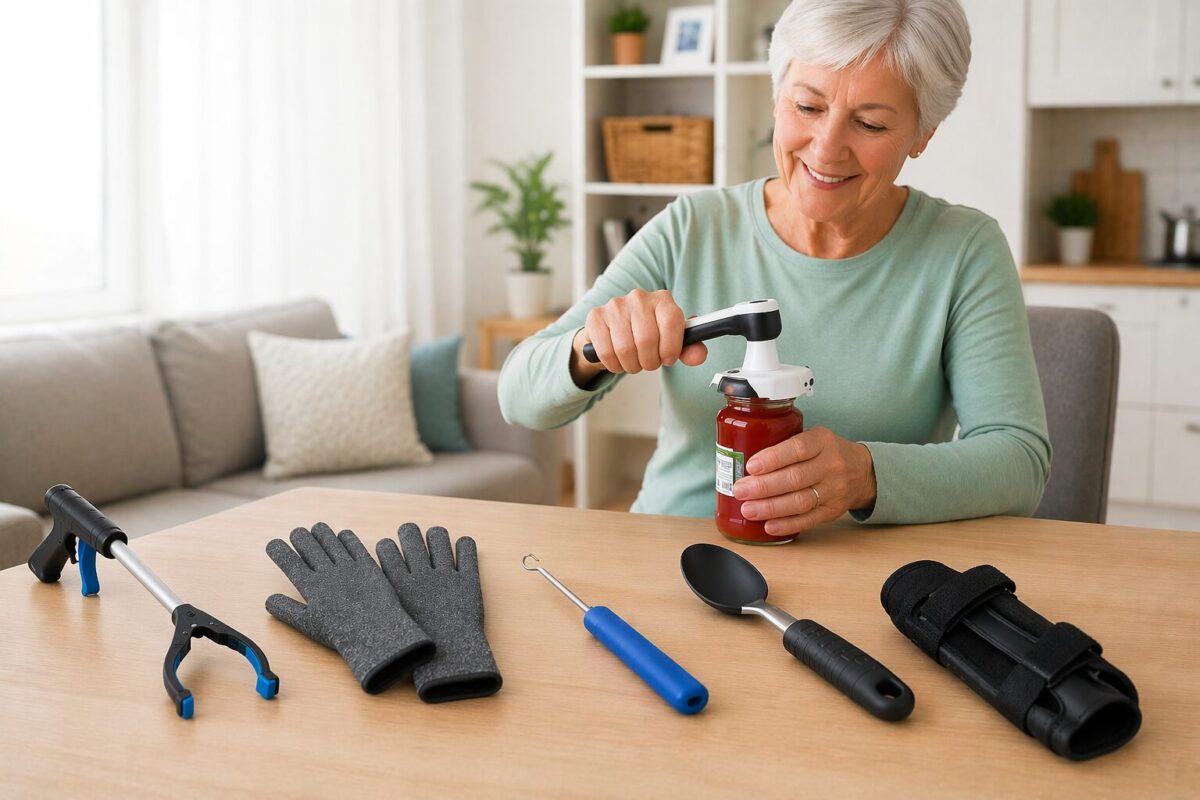
Opening a jar. Buttoning a shirt. Picking something up off the floor. Getting in and out of the shower. These everyday tasks can become surprisingly difficult when arthritis causes pain, stiffness, weakness, or reduced range of motion.
The right tool doesn’t eliminate arthritis, but it can change how you approach a task — so your joints aren’t the ones doing all the work. This guide walks through practical arthritis tools for daily living, organized by the challenge they solve: the kitchen, the bathroom, dressing, and the small transitions in between.
You don’t need to buy everything at once. Start with the one or two tasks causing you the most frustration, and build from there.
Quick Answer: The most useful arthritis tools for daily living include easy-grip jar and can openers, ergonomic kitchen utensils, reacher grabbers, dressing aids, shower chairs, grab bars, compression gloves, and other tools that reduce the need for painful gripping, twisting, bending, or fine finger movements.
If you want help deciding which type of assistive device is right for you, see our How to Choose Arthritis Assistive Devices: Buyer’s Guide.
For a broader overview of arthritis supplies and daily living aids, visit our Arthritis Supplies & Tools: Complete Guide to Daily Living Aids.
How We Chose These Products
Our editorial team evaluates arthritis products based on the specific joint movements they reduce or eliminate — gripping, twisting, pinching, bending, and reaching — rather than marketing claims alone. Where relevant, we note when a product may still require more hand strength or dexterity than expected, since “arthritis-friendly” labeling doesn’t always match real-world ease of use. We update this guide as products change and as reader feedback comes in.
Best Arthritis Tools by Daily Challenge
| If you struggle with… | Tools to consider | How they help |
|---|---|---|
| Opening jars and bottles | Under-cabinet jar openers, electric jar openers, rubber grip pads | Reduce twisting and the amount of grip strength required |
| Opening cans | Electric can openers | Eliminate most manual turning and sustained hand pressure |
| Cooking and food preparation | Easy-grip utensils, adaptive knives, lightweight cookware, food choppers | Make gripping, cutting, stirring, and lifting easier |
| Weak grip or painful hands | Ergonomic handles, built-up grips, compression gloves | Reduce hand effort and make objects easier to hold |
| Getting dressed | Button hooks, zipper pulls, sock aids, long-handled shoe horns | Reduce pinching, bending, and fine finger movements |
| Picking things up | Reacher grabbers | Reduce bending, stretching, and overreaching |
| Bathing safely | Shower chairs, grab bars, non-slip mats, handheld showerheads | Improve stability and reduce standing and reaching demands |
| Personal care | Long-handled sponges, easy-grip grooming tools, electric toothbrushes | Make grooming tasks easier when hand strength or reach is limited |
| Getting in and out of bed | Bed assist rails and transfer aids | Provide a stable handhold when changing position |
| Getting in and out of a car | Car assist handles | Provide an additional handhold for entering and exiting |
| Writing and working | Large-grip pens, ergonomic mice, trackballs, keyboard supports | Reduce sustained gripping and repetitive hand movements |
| Household chores | Lightweight cleaning tools, rolling carts, ergonomic handles | Reduce lifting, carrying, and repetitive strain |
Quick tip: Don’t try to solve every problem at once. Pick the task that causes the most pain or frustration and find a tool specifically designed to make that task easier.
How Arthritis Tools Make Daily Tasks Easier
Arthritis tools work in different ways. The best ones don’t eliminate pain entirely, but they can reduce the physical demands placed on your joints by helping you:
- Use less gripping force
- Avoid painful twisting or pinching
- Reduce repetitive hand movements
- Reach objects without bending or overextending
- Sit instead of standing for tiring tasks
- Improve stability and safety
- Rely on larger muscle groups instead of small finger joints
- Complete tasks more independently
A useful way to think about it: if a task hurts because of how you have to perform it, look for a tool that changes the movement — not one that asks you to push through with a stronger grip.
For example, if twisting a jar lid hurts your hands, the answer isn’t a stronger grip. It’s a tool, like an under-cabinet jar opener, that changes the task so your hand doesn’t have to supply the force in the first place.
Tools for Weak Hands and Poor Grip Strength
Weak grip strength can turn simple household tasks into daily frustrations. Opening containers, turning keys, holding utensils, and carrying objects can all become harder when your fingers, thumbs, or wrists are painful or stiff. The best tools for weak hands generally have large handles, non-slip surfaces, built-in leverage, or automatic operation.
Under-Cabinet Jar Openers
An under-cabinet jar opener mounts beneath a kitchen cabinet. You position the jar lid in the gripping mechanism and use the tool’s leverage to loosen it — without needing to grip the lid tightly while twisting.
This can help with thumb arthritis, painful finger joints, wrist pain, and general difficulty twisting lids.
Best for: People who regularly struggle with jars and want a permanent kitchen solution.

Electric Jar Openers
If even a mounted opener requires too much effort, an electric jar opener automates most of the process. This is worth considering for significant hand weakness or severe arthritis symptoms.
Best for: Minimizing manual gripping and twisting as much as possible.
Rubber Grip Pads
Sometimes the simplest solution is enough. Rubber grip pads improve traction between your hand and a lid, making bottles and jars easier to open. They’re inexpensive, compact, and a reasonable first step for mild grip difficulties.
Best for: Mild grip difficulties and an affordable starting point.
Related reading: Best Hand Relief Tools for Arthritis
Kitchen Tools That Make Cooking Easier
Cooking involves a surprising amount of gripping, pinching, twisting, chopping, stirring, and lifting. If your hands hurt while preparing meals, look for tools that reduce the force required.
Electric Can Openers
An electric can opener removes one of the most frustrating kitchen tasks for hand arthritis. Instead of gripping and turning a manual opener, you position the can and let the motor do the work.
Best for: Moderate to severe hand arthritis, or anyone who finds manual openers difficult.

Easy-Grip Kitchen Utensils
Adaptive utensils typically feature wider, softer, or ergonomically shaped handles. Look for large-diameter handles, non-slip materials, lightweight construction, and designs that don’t require a tight pinch grip.
Lightweight Cookware
Heavy pots and pans can be difficult when arthritis affects your hands, wrists, shoulders, or elbows. Consider lighter cookware, two-handled pots, silicone cookware grips, and rolling kitchen carts — and keep frequently used items within easy reach. The goal isn’t finding a stronger way to lift something; it’s reducing how often you need to lift it at all.
Push-Down Food Choppers
Manual chopping requires repetitive wrist and hand movement. A push-down food chopper can help if knife work is difficult — just choose a model that doesn’t demand excessive downward force to operate.
Related reading: Kitchen Tools for Arthritis
Dressing Aids for Stiff or Painful Hands
Getting dressed can be frustrating when arthritis affects your fingers, thumbs, shoulders, or back. Buttons, zippers, socks, and shoes each require different fine motor control — and dressing aids work by swapping difficult pinching and bending movements for simpler ones.
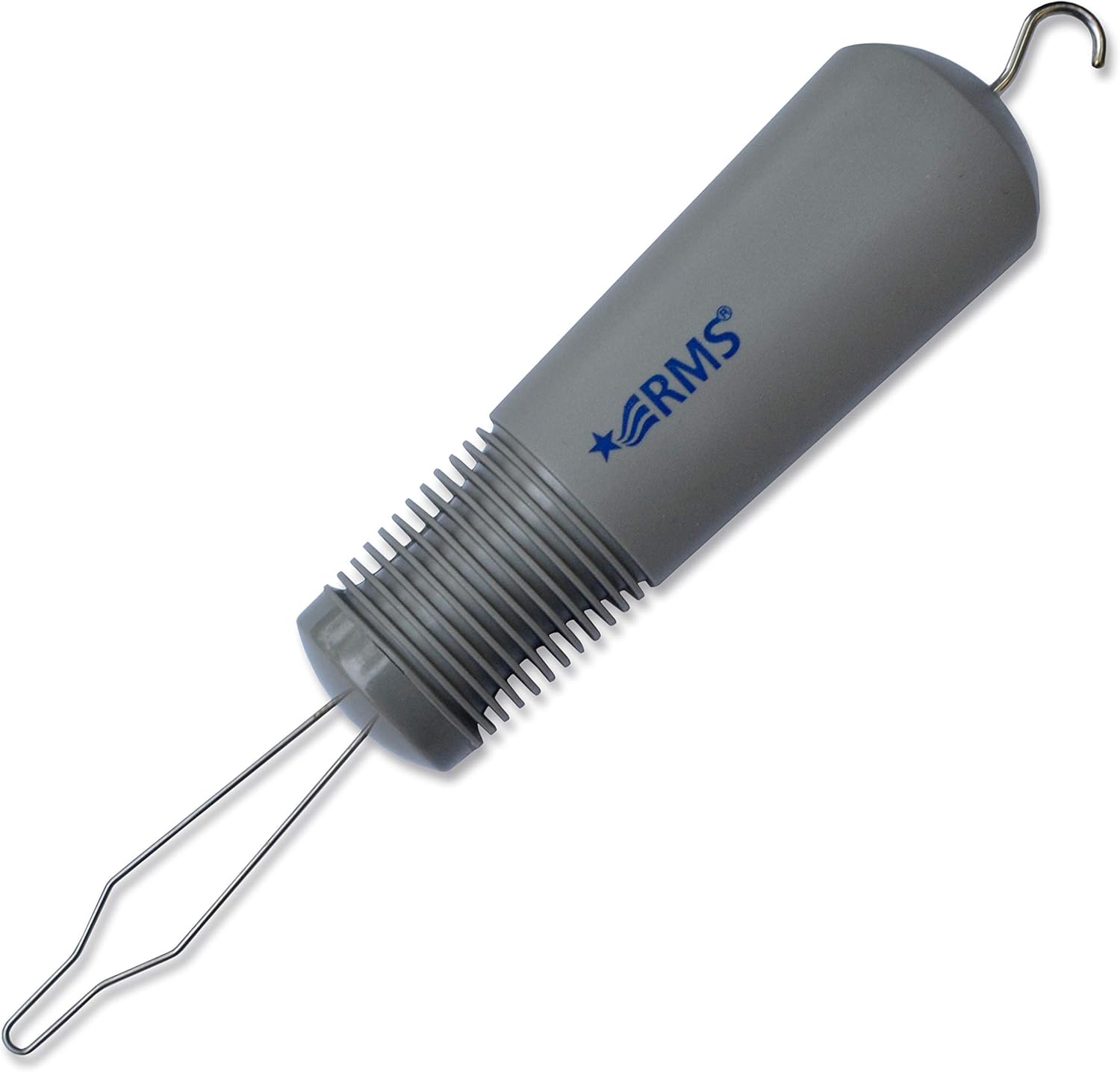
Button Hooks and Zipper Pulls
A button hook lets you fasten buttons with a hooking motion instead of pinching a small button between your fingers. A zipper pull extends the zipper tab into something larger to grasp. Together, they can make a noticeable difference in a morning dressing routine.
Best for: Finger stiffness, painful thumbs, and reduced dexterity.
Sock Aids
A sock aid holds the sock open so you can slide your foot in and pull it up using long handles or straps — without bending forward or reaching toward your feet.
Best for: Difficulty bending, reaching, or pulling.
Long-Handled Shoe Horns
A long-handled shoe horn helps you put on shoes without bending deeply or reaching toward your feet. Look for a sturdy design with a comfortable handle sized for your height.
Best for: Back, hip, or knee stiffness, and anyone who struggles to bend down.
Adaptive Clothing
Sometimes the best solution isn’t a tool at all. Clothing with elastic waistbands, magnetic closures, Velcro fasteners, larger zipper pulls, or a looser fit can be easier to manage than traditional buttons and small fasteners.
Related reading: Adaptive Clothing and Dressing Aids for Arthritis
Reacher Grabber Tools for Bending and Reaching
A reacher grabber is one of the most versatile daily living tools available. It can help you pick up dropped objects, reach high shelves, retrieve items from the floor, and avoid unnecessary bending or overreaching. For arthritis in the back, hips, or knees, avoiding repeated bending can make everyday life considerably easier.
What to Look For in a Reacher
- A lightweight design
- An easy-to-squeeze trigger
- A rotating head
- Non-slip gripping jaws
- A magnetic tip for small metal objects
- A length appropriate for your needs
A longer reacher isn’t automatically better — an excessively long tool can be harder to control. Choose a length that gives you useful reach without becoming awkward to operate.
Best for: Limited mobility, painful bending, or difficulty reaching objects.

Bathroom and Bathing Tools for Arthritis
The bathroom can be one of the most challenging areas of the home when arthritis affects balance, strength, or mobility. Wet surfaces add safety concerns, and getting into and out of the shower or tub can require significant bending and weight shifting.
Shower Chairs
A shower chair lets you sit while bathing instead of standing for the entire shower — helpful for knee or hip arthritis, balance concerns, fatigue, or pain when standing on hard surfaces. Look for adjustable legs, a suitable weight capacity, and stable non-slip feet.
Important: A shower chair isn’t a substitute for a professional assessment if you have significant balance problems. If you’re unsure whether your bathroom setup is safe, an occupational therapist can advise.

Grab Bars
Properly installed grab bars provide additional support when entering or exiting a shower or tub and when standing near the toilet. They should be secured into appropriate structural support rather than relying on suction alone.
Best for: Anyone who needs additional stability during transfers and bathroom movement.
Non-Slip Bath Mats
A non-slip mat can reduce slipping on wet bathroom surfaces. Choose one designed specifically for bathroom use with a secure grip, and check that it doesn’t curl at the edges — a curling mat can become its own tripping hazard.
Long-Handled Bath Sponges
A long-handled sponge or brush makes it easier to wash hard-to-reach areas, particularly if arthritis affects your shoulders, back, hips, or hands.
Related reading: Best Bathroom Safety Aids for Arthritis
Tools for Personal Care and Grooming
Personal care tasks often involve small, repetitive hand movements that can be difficult with finger or thumb arthritis. Look for larger handles, non-slip surfaces, easy-to-operate buttons, and — where useful — powered operation, such as electric toothbrushes, easy-grip hairbrushes, long-handled grooming tools, and easy-grip nail clippers.
The right choice depends on which movement causes difficulty. If squeezing a traditional toothbrush is painful, a larger handle may help. If repetitive brushing causes shoulder pain, a lighter or longer-handled brush may work better.
Related reading: Personal Care Tools for Arthritis: When You Can’t Grip or Reach
Everyday Tools for Getting In and Out of Bed and Cars
Arthritis can make transitions — standing up, sitting down, getting into a vehicle — more difficult than the activity itself.
Bed Assist Rails
A bed assist rail provides a stable handhold when getting into or out of bed, useful if changing position or standing from a lying position is difficult. Before buying, check that the product fits your bed and mattress setup, and follow the manufacturer’s installation instructions.

Car Assist Handles
A car assist handle fits into the vehicle’s door latch mechanism and provides a temporary handhold when entering or exiting — useful if getting out of a low car is difficult due to knee or hip stiffness.
Safety note: Follow the manufacturer’s instructions and confirm the device is compatible with your vehicle. It should be used as intended and shouldn’t replace a properly installed vehicle support system where one is needed.
Ergonomic Tools for Work and Hobbies
Arthritis doesn’t stop at the desk or the craft table. Repeated hand movements during typing, writing, crafting, sewing, gardening, or painting can all cause discomfort. Large-grip pens, ergonomic keyboards, trackball mice, cushioned wrist supports, easy-grip scissors, and adaptive craft or gardening tools can each reduce repetitive strain.
Look at the specific movement causing discomfort: if gripping a pen hurts, try a larger barrel. If moving a traditional mouse aggravates your wrist, a trackball may reduce the movement required.
Related reading: Best Craft Tools for Arthritis | Ergonomic Gardening Tools for Arthritis
How to Choose the Right Arthritis Tool
The best arthritis tool isn’t necessarily the most expensive or the one with the most features — it’s the one that solves your specific problem with the least effort. Before buying, ask yourself:
What specific task is difficult?
Be specific. Instead of “I need something for my hands,” try “opening jars hurts my thumb.” That points you directly to a jar opener rather than a generic hand-support product.
Which joint or movement is the problem?
Is it gripping, pinching, twisting, bending, reaching, standing, walking, or fine finger movements? The right tool should address the specific movement causing trouble.
How often will you use it?
A tool you’ll use several times a day deserves more attention than something you’ll use once a month. For frequently used tools, prioritize comfort, durability, ease of cleaning, ease of operation, and appropriate size and weight.
Does it actually reduce strain?
A tool that technically lets you complete a task isn’t a good solution if it still causes pain. Ask yourself whether it makes the task easier on your joints — that matters more than the number of features it offers.
Can you operate it comfortably?
This is an easy mistake to make: a product marketed for arthritis can still require considerable hand strength to operate. Before buying, check how much pressure it requires, whether it needs a pinch grip, whether the handle is large enough, how heavy it is, and whether you can operate it with one hand.
Build Your Own Arthritis Toolkit Gradually
You don’t need to turn your home into a collection of adaptive equipment overnight. Start with the two or three daily tasks causing the most frustration.
Best Arthritis Tools by Specific Need
| Your biggest challenge | Start with |
|---|---|
| Weak grip | Jar opener or easy-grip tools |
| Painful twisting | Electric opener or mounted jar opener |
| Difficulty bending | Reacher grabber or long-handled tools |
| Fine motor difficulties | Button hook and zipper pull |
| Trouble putting on socks | Sock aid |
| Difficulty standing in the shower | Shower chair |
| Bathroom balance concerns | Properly installed grab bars |
| Hand stiffness | Ergonomic tools and, when appropriate, compression gloves |
| Difficulty getting out of bed | Bed assist rail or transfer aid |
| Difficulty getting into a car | Car assist handle |
| Cooking-related hand pain | Adaptive kitchen tools |
| Repetitive computer work | Ergonomic mouse or trackball |
Remember: This is a starting point, not a prescription. The best tool depends on your specific arthritis symptoms, strength, mobility, and environment.
When to Ask a Professional for Help
Most simple daily living tools are straightforward to use, but some situations call for professional guidance. Consider talking with an occupational therapist or physical therapist if:
- You aren’t sure which assistive device is appropriate
- You have significant mobility or balance problems
- You’re considering a cane, walker, or rollator
- You have difficulty transferring in or out of bed or a chair
- A tool continues to cause pain
- You’re unsure how to safely use a mobility or bathroom aid
A professional can assess how you move and recommend equipment suited to your individual needs and environment.
Frequently Asked Questions
What Are the Best Tools for Arthritis in the Hands?
Jar openers, electric can openers, easy-grip kitchen utensils, large-grip pens, and button hooks are among the most useful — the best choice depends on the specific task that causes you the most difficulty.
What Kitchen Tools Help the Most With Arthritis?
Electric can openers, jar openers, easy-grip utensils, lightweight cookware, and food choppers can all reduce the gripping, twisting, and repetitive hand movement required during meal prep.
Are Compression Gloves Helpful for Arthritis?
Some people find compression gloves helpful for hand stiffness, swelling, or discomfort during daily activities. They’re best viewed as one possible comfort tool rather than a treatment for arthritis itself. Choose a comfortable fit and discontinue use if they cause increased pain, numbness, or other concerning symptoms.
What Tools Help People With Arthritis Stay Independent at Home?
Reacher grabbers, dressing aids, jar openers, adaptive kitchen tools, shower chairs, grab bars, and bed assist rails can all help with different daily tasks. Start with the tools that address your biggest limitations.
How Do I Know Which Arthritis Tools Are Right for Me?
Start by identifying the tasks causing the most pain or frustration, then look for a tool that reduces the specific movement involved — gripping, twisting, bending, or reaching. For significant mobility or safety concerns, an occupational or physical therapist can help identify appropriate equipment.
Are Expensive Arthritis Tools Better?
Not necessarily. A simple, inexpensive product that solves your specific problem can be more useful than an expensive device with features you don’t need.
Should I Buy Arthritis Tools for Every Room?
Not necessarily. Start with the areas where you experience the greatest difficulty, then consider duplicates in frequently used rooms once you know which tools genuinely help.
Start With the Task That Bothers You Most
You don’t need to redesign your entire home or buy a collection of specialized equipment.
Start with one frustrating task.
If opening jars is difficult, try an opener. If bending down is painful, consider a reacher. If getting dressed is frustrating, try a button hook or sock aid. If standing in the shower is difficult, look at a shower chair or appropriate bathroom support.
The best arthritis tool is the one that makes your difficult task easier.
Once you find something that works, you can gradually adapt other areas of your routine using the same principle: reduce gripping, twisting, bending, reaching, or repetitive movement whenever possible.
For help choosing the right type of device before shopping, see our How to Choose Arthritis Assistive Devices: Buyer’s Guide.
For a broader collection of arthritis aids and products, visit Arthritis Supplies & Tools: Complete Guide to Daily Living Aids.