
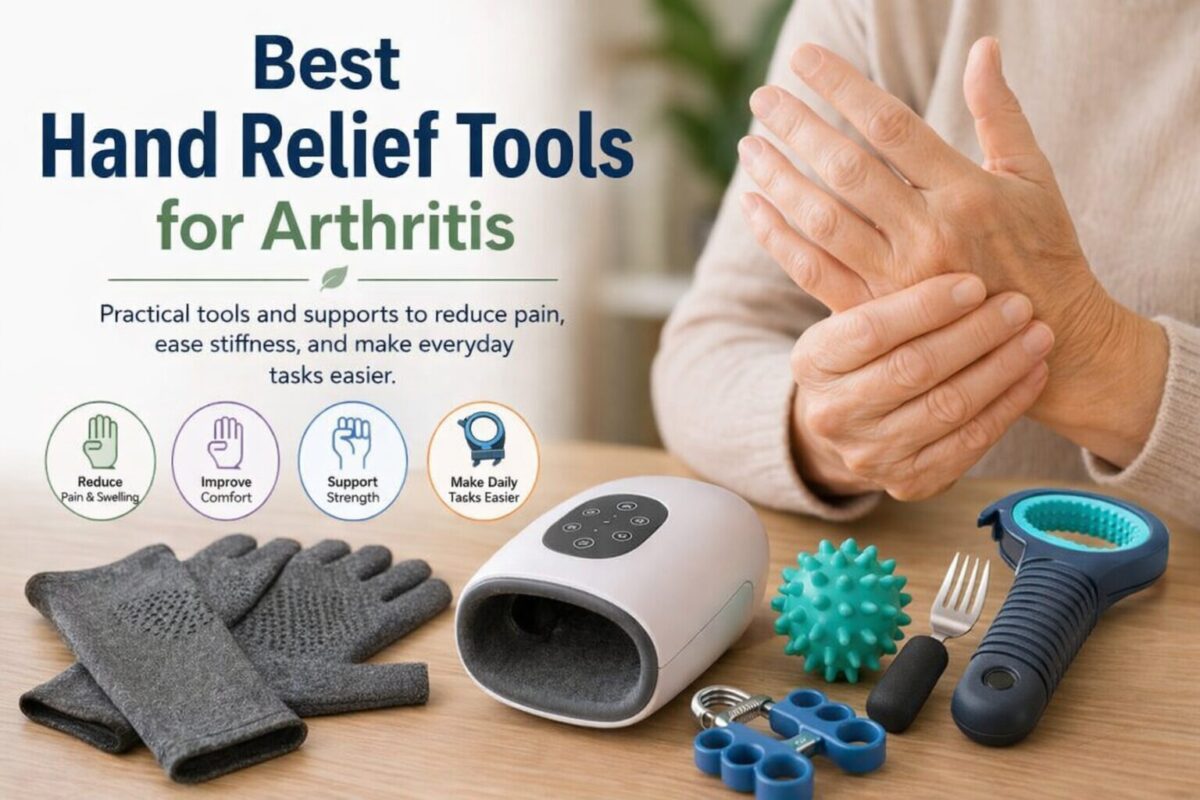
Buttoning a shirt, opening a jar, turning a key, or gripping a cooking utensil can become surprisingly difficult when arthritis affects your hands.
The right tool won’t cure arthritis, but it can make some everyday tasks easier, provide temporary comfort, or reduce the amount of force your hands need to use.
This guide covers the main types of hand relief tools for arthritis, including compression gloves, hand massagers, easy-grip tools, heat products, and hand therapy tools. The goal is not to find one product that does everything. It’s to match the tool to the problem you’re actually trying to solve.
Quick Answer: Which Hand Relief Tool Is Best?
The best starting point depends on what is bothering your hands most.
| If your main problem is… | Consider starting with… | Why |
|---|---|---|
| Morning stiffness | Compression gloves or gentle warmth | Can provide warmth and comfort while your hands loosen up |
| Aching or tired hands | Hand massager | Provides a short, targeted comfort session |
| Difficulty opening jars or gripping objects | Easy-grip and adaptive tools | Reduces the force or twisting your fingers need to provide |
| Cold, stiff hands | Heated gloves, warm mitts, or another gentle heat option | Keeps the hands warm and may make movement more comfortable |
| Weak grip | Hand therapy or exercise tools | Can be used for gradual strengthening when appropriate |
| Pain around a particular joint | A splint or support, when appropriate | May reduce stress on a painful joint during certain activities |
| Several of these problems | A small combination of tools | Different tools serve different purposes |
The important distinction: some tools are primarily for comfort, while others change how you perform a task or provide exercise. Don’t assume that a product designed for one purpose will solve another problem.
What Can Hand Relief Tools Actually Do?
Hand arthritis can cause pain, stiffness, swelling, weakness, reduced range of motion, or difficulty with everyday tasks.
Different tools address different parts of that problem.
Tools that make tasks easier
Adaptive and easy-grip tools can reduce the amount of force or awkward gripping required for everyday activities.
Examples include:
- Jar and bottle openers
- Easy-grip utensils
- Large-handle pens
- Key turners
- Button hooks
- Easy-grip scissors
- Electric can openers
- Reachers and other aids
These products don’t treat the underlying arthritis. Instead, they change the task so your hands don’t have to work as hard.
Tools that provide warmth or comfort
Warmth can be useful when hands feel stiff and uncomfortable, particularly before activity. Options include:
- Heating pads
- Warm compresses
- Heated gloves or mitts
- Warm-water soaks
- Paraffin products designed for hands
Heat isn’t appropriate for every situation. If a joint is suddenly swollen, red, or acutely inflamed, cold may be more appropriate than heat.
Tools that provide compression or support
Compression gloves and certain wrist or hand supports can provide warmth, light compression, or support.
The fit matters. A product that feels uncomfortably tight, causes numbness, tingling, or changes in skin color is not something you should simply continue wearing.
Tools used for exercise
Therapy putty, squeeze balls, finger exercisers, and resistance devices are intended for movement or strengthening rather than immediate comfort.
These tools deserve their own buying guide because the appropriate resistance and exercises can vary considerably from person to person.
1. Compression Gloves

Compression gloves are a popular option for people who want warmth, light compression, and coverage for the hands without using an electronic device.
Some designs leave the fingertips open, allowing you to type, use a phone, or handle small objects while wearing them.
Best for:
- Hands that feel stiff or achy
- People who prefer a wearable option
- Cold hands that feel more comfortable when kept warm
- Light support during everyday activities
- People who want something that can be used while doing other tasks
What to look for:
- A comfortable fit without excessive pressure
- Breathable fabric
- Open fingertips if you need to handle small objects
- Easy-to-use construction
- Machine-washable material when possible
Compression gloves aren’t the right choice for everyone. If you have significant swelling, circulation problems, numbness, or another condition affecting your hands, ask a healthcare professional whether compression is appropriate.
See our full guide: Best Compression Gloves for Arthritis
2. Hand Massagers

Hand massagers are designed for short periods of use rather than all-day wear.
Depending on the model, they may use heat, air compression, vibration, kneading, or a combination of features.
They’re particularly appealing if you want a dedicated period of relaxation after using your hands throughout the day.
Best for:
- Tired or aching hands
- End-of-day comfort
- People who enjoy heat or massage
- Short relaxation sessions
- People who prefer an active comfort tool rather than a wearable product
What to look for:
- Adjustable pressure
- Adjustable heat, if included
- Controls that are easy to operate
- A comfortable fit for your hand size
- A session length that doesn’t require you to hold complicated controls
A hand massager should feel comfortable, not painful. More pressure or more heat isn’t necessarily better.
See our full guide: Best Hand Massagers for Arthritis
3. Easy-Grip and Adaptive Tools

For many people with hand arthritis, the most useful tool isn’t something designed to massage or warm the joints. It’s something that makes a difficult task easier.
Adaptive tools can help with activities such as:
- Opening jars
- Turning keys
- Opening bottles
- Using kitchen utensils
- Writing
- Cutting with scissors
- Buttoning clothing
- Turning knobs and handles
The basic idea is simple: change the task instead of forcing your hands to work harder.
For example, a jar opener can provide leverage so you don’t have to generate as much twisting force with your fingers.
Best for:
- Weak grip
- Thumb or finger pain during daily tasks
- Difficulty opening containers
- Cooking and kitchen activities
- Dressing and personal-care tasks
- Anyone trying to maintain independence with everyday activities
What to look for:
- Wide, comfortable handles
- Non-slip surfaces
- Lightweight construction
- Simple operation
- Minimal twisting or squeezing
- Designs that let you use larger joints and muscles when possible
The Arthritis Foundation recommends looking for products with good grip, lightweight construction, simple controls, and designs that avoid difficult twisting or grasping.
See our full guide: Best Kitchen Tools for Arthritis
4. Heat and Warming Products

Heat can be useful when your hands feel stiff, particularly before movement or activity.
Options include:
- Heating pads
- Warm compresses
- Heated gloves
- Heated mitts
- Warm-water soaks
- Paraffin baths designed for hand use
The American College of Rheumatology/Arthritis Foundation guideline conditionally recommends locally applied heat or cold for hand osteoarthritis, and specifically conditionally recommends paraffin for hand OA.
Best for:
- Cold, stiff hands
- Morning stiffness
- Warming the hands before activity
- People who find warmth soothing
What to look for:
- Adjustable temperature
- Automatic shutoff
- A comfortable fit
- Easy controls
- A design that doesn’t require constant gripping or repositioning
Avoid excessive heat and protect your skin. If your hands are acutely swollen, red, or inflamed, heat may not be the best choice.
5. Hand Therapy and Exercise Tools

Hand therapy tools include products such as:
- Therapy putty
- Soft squeeze balls
- Finger exercisers
- Resistance bands
- Finger extension devices
- Wrist and forearm exercise tools
These are different from massage or comfort products. Their purpose is to support exercises that work on strength, movement, or coordination.
Best for:
- People working on grip strength
- Maintaining hand movement
- Finger and hand exercises
- People following an exercise program recommended by a therapist
What to look for:
- Low resistance options
- Multiple resistance levels
- Comfortable materials
- A design that matches the exercise you need
- Clear instructions
Start with an appropriate level of resistance rather than choosing the strongest tool. Exercise should not cause sharp or worsening joint pain.
See our full guide: Best Hand Therapy Tools for Arthritis
6. Splints, Braces, and Wrist Supports

Some people need more than a comfort product or adaptive tool. A splint or support may be useful when a particular joint needs additional support during certain activities.
These products vary considerably. Some support the thumb, some the wrist, and others are designed for individual finger joints.
For hand osteoarthritis, the American College of Rheumatology/Arthritis Foundation guideline strongly recommends hand orthoses for first carpometacarpal (thumb-base) OA and conditionally recommends them for OA affecting other hand joints. The guideline also notes that there isn’t enough evidence to say that one type of hand orthosis is best for everyone.
Best for:
- A specific painful joint
- Thumb-base discomfort
- Activities that repeatedly stress a particular joint
- People who have been advised to use a support by a healthcare professional
What to look for:
- The correct size
- A comfortable fit
- Support appropriate for the joint involved
- Materials that don’t irritate your skin
- A design that still allows necessary movement
If you’re unsure what type of support you need, an occupational therapist or hand therapist can be particularly helpful with fitting and choosing an appropriate device.
Which Tool Should You Choose?
Instead of asking, “What’s the best arthritis hand tool?” start with the specific problem you’re trying to solve.
| Your main problem | Good starting point | What to consider |
|---|---|---|
| Morning stiffness | Warmth or compression gloves | Try gentle warmth or a comfortable wearable option |
| Cold, uncomfortable hands | Heated gloves, warm mitts, or warm water | Choose a product with manageable temperature |
| End-of-day aching | Hand massager or warmth | Look for adjustable settings |
| Difficulty opening jars | Jar opener | Look for leverage and a non-slip grip |
| Trouble holding utensils | Easy-grip utensils | Choose larger, comfortable handles |
| Difficulty turning keys | Key turner | Look for a large handle that provides leverage |
| Weak grip | Appropriate hand exercise tool | Start with low resistance |
| Thumb-base pain | Appropriate support or orthosis | Consider professional guidance on fit |
| Stiffness plus difficulty with daily tasks | Combination of comfort and adaptive tools | Solve each problem separately rather than buying one product that claims to do everything |
Do You Need More Than One Hand Relief Tool?
Not necessarily.
It’s easy to see a long list of arthritis products and conclude that you need several of them. You don’t.
A better approach is to identify the one or two situations that cause you the most trouble.
For example:
If mornings are your hardest time:
A warming product or comfortable compression glove may be more useful than an exercise gadget that you don’t want to use first thing in the morning.
If opening containers is the main problem:
An adaptive jar opener may provide more practical benefit than a hand massager.
If your hands are tired after a long day:
A short session with a comfortable hand massager or another warming product may be worth considering.
If weakness is the main issue:
An appropriately selected exercise tool may make more sense than another comfort product.
This approach also helps prevent spending money on products that solve a problem you don’t actually have.
What to Look for in an Arthritis-Friendly Hand Tool
A product doesn’t need to be marketed specifically for arthritis to be useful.
When comparing products, look for features that make them easier to hold, operate, or adjust.
1. Comfortable grips
Large, cushioned, or textured handles can be easier to hold than thin, slippery handles.
2. Less twisting
Products that require repeated twisting with the fingers can be frustrating for people with hand arthritis. When possible, look for lever, push-button, or other easier-opening designs.
3. Lightweight construction
A heavy tool adds work to an already difficult task.
4. Simple controls
Small buttons, complicated settings, and difficult-to-open battery compartments can turn an otherwise useful product into a frustrating one.
5. Adjustable settings
For products involving heat, pressure, vibration, or resistance, adjustable settings let you find a level that feels comfortable.
6. Easy maintenance
If a product is difficult to clean, charge, assemble, or store, you’re less likely to use it consistently.
7. The right size
A product that is too large or too small can be difficult to operate. Hand size matters, particularly with gloves, massagers, grips, and exercise tools.
Heat or Cold for Hand Arthritis?
This is one of the most common questions when choosing a hand-relief product.
Heat is generally more useful for stiffness and warming the hands. A warm shower, heating pad, warm compress, or paraffin treatment may make stiff hands more comfortable before activity.
Cold can be useful for acute pain and swelling. If a joint becomes suddenly swollen or inflamed, cold may be preferable to heat.
Neither approach is right for every person or every situation. If you are uncertain whether heat or cold is appropriate for your symptoms, ask a healthcare professional.
When a Hand Tool May Not Be Enough

Hand tools are useful for managing certain everyday challenges, but they aren’t a substitute for evaluating persistent or worsening symptoms.
Consider speaking with a healthcare professional if you have:
- Increasing hand swelling
- Persistent or worsening pain
- Significant loss of grip strength
- Numbness or tingling
- A joint that becomes increasingly difficult to move
- New or unexplained deformity
- Symptoms that interfere substantially with daily activities
An occupational therapist or hand therapist can also help identify ways to modify tasks, choose adaptive equipment, and develop an exercise program appropriate for your needs.
Frequently Asked Questions
What is the best hand relief tool for arthritis?
There isn’t one best tool for everyone. Compression gloves may suit someone who wants warmth and light compression, while an adaptive jar opener may be much more useful for someone whose main problem is opening containers. A hand massager may appeal to someone looking for a short comfort session, while an exercise tool is designed for a different purpose.
Start with the problem that interferes with your daily life the most.
Do arthritis gloves help with hand stiffness?
Compression gloves provide warmth and light compression, and some people find them comfortable for stiff or aching hands. The fit is important, and they shouldn’t cause numbness, tingling, excessive pressure, or changes in skin color.
Are hand massagers good for arthritis?
Some people find hand massagers useful for temporary comfort, particularly when their hands feel tired or achy. Models vary considerably in how they use heat, vibration, massage, or compression. Choose adjustable settings and stop if the device causes pain or discomfort.
What tools help with weak grip from arthritis?
Easy-grip and adaptive tools can reduce the amount of gripping force required for everyday tasks. For people who are appropriate candidates for strengthening exercises, hand therapy tools may also be useful.
If weakness is significant or getting worse, it’s worth discussing it with a healthcare professional rather than simply buying a stronger exercise device.
What is the best tool for opening jars with arthritis?
A jar opener that provides leverage can reduce the amount of twisting force your fingers need to produce. Look for a design that is easy to grip and doesn’t require you to squeeze a small handle tightly.
Can I use hand therapy tools if my hands hurt?
It depends on why your hands hurt and how severe the symptoms are. Exercise should not be treated as a test of how much pain you can tolerate.
If an exercise causes sharp pain, substantially increases symptoms, or aggravates a swollen joint, stop and reassess the exercise or resistance. If you’re unsure what type of exercise is appropriate, a hand or occupational therapist can help.
Should I wear compression gloves all day?
Not necessarily. Some people like wearing them for extended periods, while others prefer them for particular activities or times of day. Follow the product instructions and make sure the gloves remain comfortable.
Remove them and seek advice if you develop numbness, tingling, unusual swelling, skin discoloration, or other concerning symptoms.
Are expensive arthritis tools better?
Not necessarily.
A simple jar opener that solves your biggest daily problem may be more useful than an expensive electronic device with features you rarely use.
Before buying, ask:
What problem will this product solve, and will I actually use it?
Related Reading
If you’re looking for a specific type of hand tool, these guides go into more detail:
- Best Compression Gloves for Arthritis — Compare compression glove options and features.
- Best Hand Massagers for Arthritis — Explore hand massagers with heat, compression, and other features.
- Best Kitchen Tools for Arthritis — Find adaptive tools for opening jars, cooking, and other kitchen tasks.
- Best Hand Therapy Tools for Arthritis — Compare exercise and therapy tools for grip, finger, wrist, and hand exercises.
- Best Heated Clothing for Arthritis: Vests, Gloves & Socks — Explore heated glove options for people who want warmth as well as hand coverage.
The Bottom Line
The best hand relief tool for arthritis is the one that addresses your particular problem without creating another one.
If stiffness is the issue, warmth or compression may be worth trying. If everyday tasks are difficult, adaptive tools can reduce the amount of force your hands need to use. If you’re working on strength or movement, an appropriately selected therapy tool may be more useful.
You don’t need to buy everything.
Start with the task or symptom that causes you the most trouble, choose one tool designed to address it, and see whether it actually makes your day easier.
Practical tools. No hype.
Medical Disclaimer: This article is for informational purposes only and does not constitute medical advice. Always consult your doctor, rheumatologist, or occupational therapist before making changes to how you manage your arthritis.
