
Disclosure: As an Amazon Associate, Arthritis Wares earns from qualifying purchases at no extra cost to you. We are not paid or sponsored by any manufacturer. Affiliate links help support our work.
If your hands are stiff, swollen, or achy, even simple tasks such as typing, cooking, opening containers, or getting dressed can become more difficult. Compression gloves are designed to provide gentle pressure and warmth while still allowing you to use your hands.
But do compression gloves actually help arthritis?
The answer is more complicated than many product descriptions suggest. Some people find that arthritis gloves make their hands feel more comfortable, less stiff, or less swollen, but clinical research has produced mixed results. Benefits may come from a combination of gentle compression, warmth, support, and the glove simply making the hands feel more comfortable during activity.
That makes fit, comfort, warmth, dexterity, and how you plan to use the gloves more important than marketing claims.
This guide compares five popular compression-glove options and explains what to look for if you have arthritis, hand swelling, morning stiffness, or difficulty using your hands comfortably.
Quick Answer: Are compression gloves worth trying for arthritis?
They can be worth trying if you want a relatively simple, non-drug option that allows you to keep using your hands while wearing them.
However, compression gloves should be viewed as a symptom-management tool, not a treatment for the underlying arthritis.
Research on arthritis gloves is mixed. Some studies have reported improvements in symptoms such as swelling, pain, or stiffness, while other controlled research has found that loose-fitting gloves providing warmth can produce similar results to tighter compression gloves.
If you decide to try them, prioritize:
- A comfortable, snug fit rather than the strongest possible compression
- A size that does not cause numbness, tingling, or finger discoloration
- Open fingertips if you need good dexterity
- Full-finger coverage if warmth is a priority
- Breathable fabric if you plan to wear them for several hours
- Easy washing if you expect to use them frequently
Copper-infused gloves are another option, but there is no good evidence that copper woven into the fabric provides additional arthritis pain relief.
What compression gloves are designed to do
Compression gloves are usually made from stretchy materials such as nylon, spandex, elastane, or similar fabrics.
The fabric applies gentle pressure around the hand and fingers. Depending on the design and fit, this may provide:
- A feeling of support around the small joints of the hand
- Warmth that may make stiff hands feel more comfortable
- Some reduction in the feeling of swelling or puffiness
- Greater awareness of how you are positioning your fingers
- Comfort during everyday activities
The amount of compression varies considerably between products, and manufacturers do not always provide comparable pressure measurements.
That means you should not assume that a glove advertised as “more compression” will necessarily work better for your hands.
Compression is not the same as a brace
A compression glove is flexible. It is intended to let you continue moving your fingers and using your hands.
A brace or splint has a different purpose. It may restrict movement or hold a particular joint in a specific position.
For example:
- Compression gloves: general hand comfort, warmth, stiffness, and swelling
- Thumb brace: support for a painful or unstable thumb joint
- Wrist brace: limits wrist movement when wrist support is needed
- Finger splint: supports a specific finger joint
If one particular joint is unstable or painful with certain movements, a compression glove may not provide enough support.
What does the research say about compression gloves?
This is one area where it is worth looking past product marketing.
A systematic review of studies involving rheumatoid arthritis and hand osteoarthritis found that the evidence for compression gloves was inconclusive. The studies were small, and although some participants experienced reduced finger-joint swelling, results for pain and stiffness were inconsistent. The review also found no clear improvement in grip strength or dexterity.
A later randomized controlled trial involving people with rheumatoid arthritis compared compression arthritis gloves with loose-fitting gloves. After 12 weeks, both groups reported similar improvements in hand pain, stiffness, and function. The researchers concluded that compression itself may not be the only factor responsible for the perceived benefit.
That does not mean compression gloves are useless.
It means the evidence does not support promising that compression alone will reliably relieve arthritis pain for everyone.
Warmth, comfort, gentle support, and individual preference may all play a role.
The American College of Rheumatology and Arthritis Foundation guideline also notes that gloves may provide warmth and compression for the joints of the hand, while emphasizing that there is not enough evidence to recommend one type of hand support over another.
What this means in practical terms
If you put on a comfortable pair of gloves and your hands feel warmer and easier to use, that can be a useful benefit even if the glove is not changing the underlying arthritis.
The goal is not to find the glove with the most impressive marketing claims.
The goal is to find a pair that:
- Fits comfortably
- Does not interfere with hand function
- Provides a level of warmth or compression you like
- Is comfortable enough that you will actually wear it
Who might want to try compression gloves?
Compression gloves may be worth considering if you experience:
- Aching or stiffness in several finger joints
- Mild to moderate hand swelling or puffiness
- Hands that feel particularly stiff in the morning
- Hands that become uncomfortable when they get cold
- Discomfort during activities such as typing, crafting, cooking, or gardening
- A preference for flexible support rather than a rigid brace
They may be particularly appealing if you want something you can wear while continuing to use your hands.
An occupational therapist or hand therapist can also help determine whether a compression glove, splint, brace, or another adaptive tool makes more sense for your particular symptoms.
Compression gloves vs. hand braces
| Feature | Compression gloves | Hand or thumb braces |
|---|---|---|
| Main purpose | General comfort, warmth and gentle support | Support or stabilization of a specific joint |
| Flexibility | High | Varies from flexible to rigid |
| Finger movement | Usually largely unrestricted | May intentionally restrict movement |
| Coverage | Usually several fingers and the hand | Often focused on one joint or area |
| Useful for | Stiffness, swelling, warmth and general hand discomfort | Joint instability or pain with specific movements |
| Dexterity | Usually good, especially with open fingertips | May be reduced depending on design |
| Best for all-day activity | Often suitable if comfortable | Depends on the type and reason for wearing it |
A compression glove is not automatically the better choice for pain and swelling, and a brace is not automatically necessary for more severe arthritis.
The right choice depends on which joints are affected, what movements cause problems, and whether the main issue is comfort, swelling, instability, or loss of function.
For a more targeted support option, see our guide to Thumb & Wrist Braces for Arthritis.
Five Compression Gloves Worth Considering
Rather than ranking these gloves from “best” to “worst,” the options below are organized around different priorities.
Product availability, sizes, materials, and designs can change, so check the current product listing and sizing information before ordering.
Dr. Arthritis Compression Gloves — a versatile everyday option
Dr. Arthritis compression gloves are designed specifically for hand discomfort and use an open-finger design.
The exposed fingertips can be useful if you want to type, use a phone, handle small objects, or perform other tasks that require fingertip sensation.
Good for
- Everyday wear
- Typing and phone use
- People who prefer open fingertips
- Those looking for a general-purpose arthritis glove
Things to consider
- Open fingertips leave part of the fingers uncovered
- Fit is particularly important because an overly tight glove can become uncomfortable
- Check the current sizing chart carefully before ordering

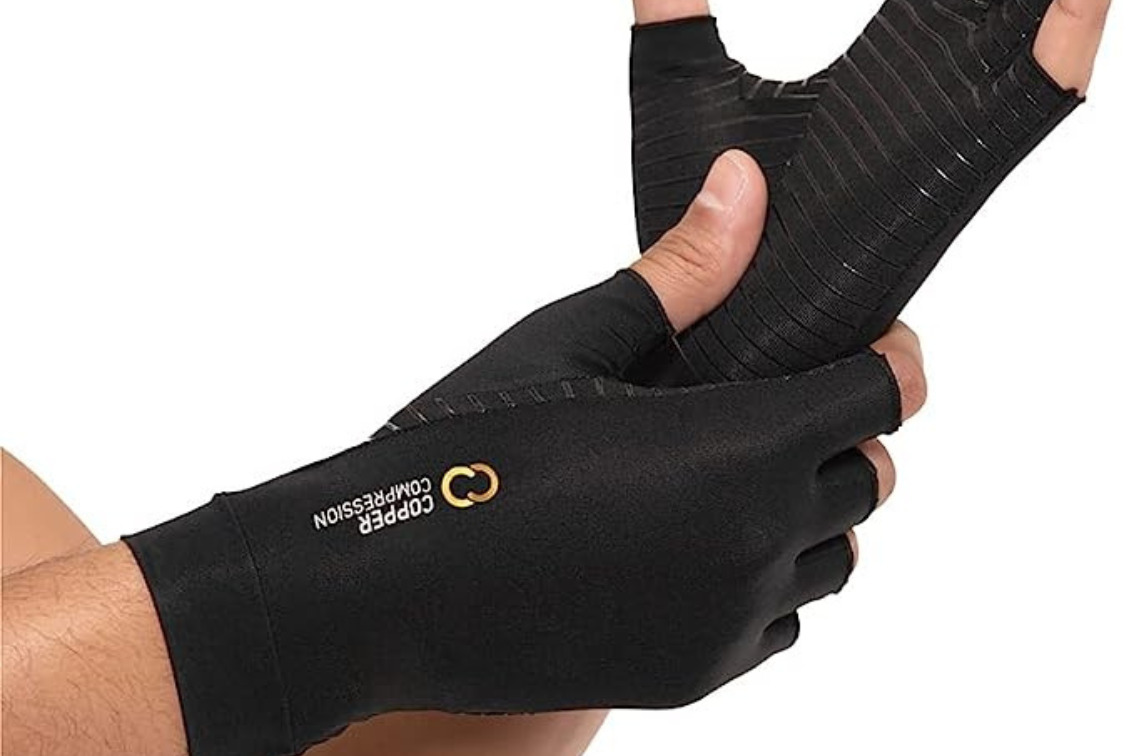
Copper Compression Arthritis Gloves — for people interested in copper-infused fabric
Copper Compression Arthritis Gloves combine a fingerless design with copper-infused fabric.
The open-finger construction preserves much of the dexterity needed for typing, crafting, cooking, and other everyday activities.
The important distinction is that the copper should not be treated as the reason the glove works for arthritis.
There is not good clinical evidence showing that copper-infused fabric provides additional arthritis pain relief compared with a similar non-copper glove.
Good for
- People who specifically want copper-infused fabric
- Fingerless-glove users
- Typing, crafting, and other activities requiring fingertip access
- People who prefer a snug, flexible glove
Things to consider
- Copper does not have a demonstrated arthritis pain-relief advantage over ordinary compression fabric
- The value of the copper feature is therefore largely a matter of personal preference
- Check sizing carefully because compression gloves need to fit evenly

Vive Compression Gloves — a simple option for trying compression
Vive compression gloves are a straightforward option if you want to see whether this type of glove works comfortably for you before spending more on specialized features.
Their open-finger design allows you to continue using your fingertips while wearing the gloves.
Good for
- First-time compression-glove users
- Everyday hand comfort
- People who prefer fingerless gloves
- Those who want a simple design without specialized features
Things to consider
- Individual comfort and compression preferences vary
- A lower-profile glove may not feel supportive enough for everyone
- Compare the current size chart with your hand measurements before ordering

Thermoskin Premium Arthritic Gloves — for people who prioritize warmth
Thermoskin’s arthritic gloves are designed around a combination of warmth and support.
This makes them particularly interesting if cold temperatures make your hands feel uncomfortable or stiff.
Warmth is an important consideration because some people find that keeping their hands warm provides as much practical comfort as compression itself.
Good for
- Cold hands
- Morning stiffness
- Cold-weather use
- People who prefer more warmth than a lightweight compression glove provides
Things to consider
- A warmer glove may feel uncomfortable in hot weather
- The construction is different from a lightweight open-finger compression glove
- Check the current model carefully because Thermoskin offers more than one glove design

IMAK Compression Arthritis Gloves — for a soft, lightweight design
IMAK Compression Arthritis Gloves are made from a soft cotton-based fabric and have open fingertips.
The Arthritis Foundation’s Ease of Use program has recognized IMAK arthritis gloves for their design. That recognition is about ease of use and accessibility; it should not be interpreted as proof that the gloves are clinically superior for relieving arthritis pain.
The open fingertips make them practical for everyday activities where you need to feel and manipulate objects.
Good for
- People who prefer soft fabric
- Everyday use
- Open-finger dexterity
- People who want a lightweight design
Things to consider
- They provide mild rather than rigid support
- They will not stabilize an unstable thumb, finger, or wrist joint
- The main advantage is comfort and usability rather than a specialized medical feature

Compression Gloves Compared
| Glove | Design | Particularly useful if you want | Main consideration |
|---|---|---|---|
| Dr. Arthritis | Open fingertips | Versatile everyday use | Check fit carefully |
| Copper Compression | Fingerless, copper-infused fabric | Copper-infused material and dexterity | Copper has no established arthritis pain advantage |
| Vive | Open fingertips | Simple compression-glove design | Compression preference varies |
| Thermoskin | Warmth-focused design | Warmth plus support | May feel too warm in hot weather |
| IMAK | Open fingertips, cotton-based fabric | Softness and everyday dexterity | Provides gentle rather than rigid support |
Do copper compression gloves work better?
This is one of the most important questions because copper gloves are heavily marketed for arthritis.
The short answer is: there is not good evidence that copper-infused fabric provides additional arthritis pain relief.
Copper is an established antimicrobial material in certain applications, but that does not mean that wearing copper-containing fabric treats arthritis.
There is also no good reason to assume that copper woven into a glove will reduce joint inflammation simply because copper has biological effects elsewhere in the body.
So if you like a copper compression glove, there is nothing wrong with choosing one.
Just make your decision based primarily on:
- Fit
- Comfort
- Fabric
- Warmth
- Dexterity
- Durability
- Price
rather than assuming that more copper means more arthritis relief.
Are compression gloves supposed to feel tight?
No.
A properly fitted compression glove should feel snug and supportive, not painful or restrictive.
The glove should not:
- Cause numbness
- Cause tingling or pins and needles
- Make your fingertips change color
- Cause increasing pain
- Leave painful pressure points
- Restrict normal finger movement
Occupational-therapy guidance specifically advises monitoring for pressure areas, worsening discomfort, numbness, tingling, and fingertip discoloration.
If any of these occur, remove the gloves and reassess the size and fit.
How to choose the right compression gloves
1. Get the size right
Fit is more important than the brand name.
Measure your hand according to the manufacturer’s instructions and compare the measurement with that brand’s sizing chart.
Do not automatically choose a smaller size because you think tighter compression will work better.
A glove that is too tight can cause discomfort and may interfere with circulation or sensation.
2. Decide whether you want open or closed fingertips
Open-finger gloves are usually more convenient for:
- Typing
- Using a smartphone
- Sewing
- Knitting
- Crocheting
- Handling small objects
- Cooking
Full-finger gloves provide more coverage and warmth but may make fine-motor tasks more difficult.
If dexterity is one of your biggest concerns, open fingertips are often the more practical design.
3. Consider warmth
If your hands feel worse when they are cold, warmth may be an important part of the benefit you experience.
A thicker or thermal glove may be preferable in winter, while a lightweight fabric may be more comfortable in warmer weather.
4. Look at the fabric
If you plan to wear the gloves for several hours, fabric comfort matters.
Consider:
- Breathability
- Stretch
- Seams
- Moisture
- Skin sensitivity
- How easy the gloves are to wash
5. Don’t automatically choose maximum compression
There is no established “stronger is better” rule for arthritis gloves.
Research has not established one ideal compression level for everyone, and the amount of pressure depends on the glove material, construction, size, and fit.
Comfortable, consistent pressure is more useful than simply choosing the tightest glove you can tolerate.
How long should you wear compression gloves?
There is no single number of hours that applies to everyone.
Your wearing schedule should depend on the glove, your symptoms, and how your hands respond.
A sensible approach is to:
- Start with a shorter period
- Check how your hands feel while wearing them
- Remove them and inspect your skin
- Gradually increase wear if they remain comfortable
Some people use arthritis gloves during activities, while others prefer them for periods of rest or overnight use. Occupational therapists commonly recommend using them according to individual symptoms rather than treating continuous wear as necessary.
Do not assume that wearing them longer will produce greater benefit.
Can you wear compression gloves at night?
Some arthritis gloves are designed or used for nighttime wear, but you should follow the instructions for the specific product.
Nighttime wear is not automatically better than daytime wear.
If your gloves cause numbness, tingling, discomfort, or finger discoloration during the night, remove them.
If you have significant circulation problems, neuropathy, Raynaud’s disease, severe hand deformity, or another condition that could be affected by compression, discuss glove use with a healthcare professional before using them. These issues were excluded from a clinical feasibility study because compression could potentially aggravate symptoms.
When compression gloves may not be enough
Compression gloves are a relatively general-purpose tool. They may not address the underlying problem if you have:
- Significant thumb pain
- Joint instability
- A finger that repeatedly catches or locks
- Significant wrist pain
- Loss of grip strength
- Severe swelling
- A specific joint that needs stabilization
- Persistent or worsening pain
In these situations, a targeted brace, splint, hand therapy program, or medical assessment may be more appropriate.
For example, the American College of Rheumatology and Arthritis Foundation strongly recommend hand orthoses for first carpometacarpal (thumb-base) osteoarthritis and conditionally recommend them for osteoarthritis affecting other hand joints.
See our guide to Thumb & Wrist Braces for Arthritis if your main problem is concentrated around the thumb or wrist.
Frequently Asked Questions
Do compression gloves really help arthritis?
They can help some people feel more comfortable, but the research is mixed.
Studies have reported improvements in some symptoms, particularly swelling, while other controlled research has found similar improvements with loose-fitting gloves. This suggests that warmth, comfort, and individual response may be important alongside compression.
Compression gloves are therefore best viewed as a symptom-management option rather than a proven treatment that works for everyone.
Are compression gloves good for swollen hands?
They may be helpful for some people with hand swelling. Research has found reductions in finger-joint swelling in some rheumatoid arthritis studies, although overall evidence remains limited and inconsistent.
If swelling is sudden, severe, one-sided, or accompanied by significant pain, redness, or other new symptoms, don’t assume it is simply arthritis.
Do compression gloves improve circulation?
Compression gloves are often marketed as improving circulation, but that phrase can be misleading.
The physiological effects of compression depend on the amount and distribution of pressure, the person’s health, and the fit of the glove. For arthritis, the practical benefit may be warmth and comfort rather than a meaningful improvement in circulation.
If you have a diagnosed circulation disorder, ask your healthcare professional whether compression gloves are appropriate for you.
Do copper compression gloves work better than regular compression gloves?
There is no good evidence that copper-infused fabric provides additional arthritis pain relief.
If you prefer copper gloves because you like the fabric, fit, or design, they can still be a reasonable choice. Just don’t pay extra expecting copper itself to treat arthritis pain or inflammation.
Can I type while wearing compression gloves?
Usually, yes, particularly with open-finger gloves.
Fingerless designs leave your fingertips exposed, making them more practical for keyboards, phones, tablets, and other activities requiring fingertip sensation.
However, any glove that changes your grip or makes your fingers feel restricted may make certain tasks harder.
Can compression gloves help with carpal tunnel syndrome?
They are not a substitute for a wrist splint or treatment specifically directed at carpal tunnel syndrome.
Compression gloves primarily cover the hand and fingers, while carpal tunnel treatment may require controlling wrist position.
If numbness or tingling is a major symptom, especially at night, it is worth determining the cause before choosing an arthritis glove.
How do I know if compression gloves are too tight?
Remove the gloves if you experience:
Numbness
Tingling or pins and needles
Finger discoloration
Increasing pain
Significant pressure or pinching
Skin irritation
A snug fit is expected. Painful or restrictive compression is not.
Can I wear compression gloves while driving?
Check the specific glove and consider whether it affects your ability to grip the steering wheel safely.
Some occupational-therapy guidance warns that certain compression gloves can affect grip, particularly because of their material or surface.
If you cannot confidently maintain control of the steering wheel, don’t wear them while driving.
The Bottom Line
Compression gloves can be a useful addition to an arthritis self-management toolkit, particularly if you like the combination of gentle support, warmth, and unrestricted hand movement.
But the evidence does not justify treating them as a guaranteed pain-relief solution.
The most important things to look for are:
- A comfortable fit
- Appropriate compression
- Good dexterity
- Breathable or warm fabric according to your needs
- Easy care
- A design you will actually wear
If you’re considering copper gloves, remember that the copper is optional; the fit and comfort are what matter most.
And if your symptoms involve one particularly painful or unstable joint, a targeted brace or splint may make more sense than a general compression glove.
Related Reading
- Best Hand Massagers for Arthritis
- Best Hand Therapy Tools for Arthritis
- Best Paraffin Wax Baths for Arthritis
- Best Thumb & Wrist Braces for Arthritis
- Best Topical Pain Relief for Arthritis
Medical Disclaimer: This article is for informational purposes only and does not constitute medical advice. Always consult your doctor, rheumatologist, or occupational therapist before making changes to how you manage your arthritis.
