
Disclosure: As an Amazon Associate, Arthritis Wares earns from qualifying purchases at no extra cost to you. We are not paid or sponsored by any manufacturer. Affiliate links help support our work.
Gardening with arthritis doesn’t have to mean giving up the activities you enjoy. The right tools can make pruning, planting, weeding and moving supplies easier by reducing the amount of gripping, squeezing, bending and lifting required.
This guide compares seven gardening tools for people with arthritis, from manual pruning shears and hand-tool sets to electric pruners, long-handled tools, garden gloves, kneelers and rolling carts. The goal is to help you choose tools that match your needs, budget and gardening style—not simply buy more equipment.
Quick answer: If hand pain or weak grip is your main problem, start by considering easier-to-use pruning shears and comfortable hand tools. If knee or hip stiffness makes bending difficult, look at long-handled tools and a garden kneeler-seat. If carrying soil, pots or equipment is tiring, a rolling garden cart may be more useful than another hand tool.
Quick Comparison: Gardening Tools for Arthritis
| Tool | Best for | Main benefit | What to consider |
|---|---|---|---|
| Ultra Sharp pruning shears | Light pruning and trimming | A dedicated cutting tool for routine garden jobs | Check opening width, spring action and required hand pressure |
| 9-piece gardening tool set | Planting and general hand gardening | Several tools for common garden tasks | A full set may include tools you rarely use |
| Lilyvane 45-inch garden hoe and cultivator | Weeding and cultivating from a standing position | Reduces the need to bend down for some tasks | Long tools can still strain shoulders if heavy or poorly balanced |
| Cordless electric pruning shears | Repetitive pruning | A powered cutting action reduces repeated manual squeezing | Requires careful handling, charging and safe storage |
| Garden kneeler and seat | Low-level planting and weeding | Offers a padded kneeling surface or a seat | Kneeling and standing up may still be difficult for some people |
| Leather gardening gloves | General garden protection | Helps protect hands during routine gardening | Fit and flexibility matter; leather alone does not reduce gripping force |
| Folding utility wagon | Moving tools and lighter supplies | Reduces the need to carry items by hand | Check wheel size, load limits and maneuverability on your paths |
Product features and availability can change, so check the current listing for specifications, included accessories, sizing, weight and return conditions before ordering.
What Makes a Gardening Tool Easier to Use With Arthritis?
A tool marketed as “ergonomic” is not automatically comfortable for every person. The most useful features depend on which joints are affected, the task you want to do and how much strength or movement you have.
Comfortable, easy-to-hold handles
Thin, hard or slippery handles can be uncomfortable when finger joints are tender or grip strength is reduced. Look for handles that fit your hand without requiring you to squeeze tightly.
- Choose a grip that feels secure without stretching your fingers excessively.
- Look for non-slip surfaces and rounded edges that do not press into painful joints.
- Consider whether the handle remains comfortable when you wear gardening gloves.
- If a tool feels too small in your hand, a suitable grip sleeve may help enlarge it, provided it can be fitted securely.
A thick handle is not always better. The ideal size is one you can hold comfortably without forcing your thumb and fingers into a painful position.
Less squeezing and twisting
Pruners, snips and other hand tools can require repeated force. Spring-assisted or lever-assisted mechanisms may make some tasks easier, but the amount of effort varies by design.
For hand arthritis, pay attention to how far the handles must open, how much force is needed to close them and whether you can release them comfortably after each cut.
Appropriate weight and balance
Lightweight tools can reduce fatigue, particularly when used repeatedly. However, balance matters as well. A long tool that feels manageable at first may become tiring when held away from your body.
Whenever possible, test the tool in the position you will actually use it. For online purchases, check the listed weight and look for a return policy that allows you to assess comfort at home.
Longer handles and better reach
Long-handled tools can reduce bending and kneeling, especially when working at ground level. They may be particularly helpful for people with knee, hip or back limitations.
However, extended reach can transfer the workload to your shoulders and arms. Choose a length that lets you work close to your body instead of stretching or reaching overhead.
For more ideas on adapting your garden itself, see Accessible Garden Design for Arthritis.
Best Gardening Tools for Arthritis: Our Picks
These options address different gardening tasks. No single product is right for everyone, and the best choice is often the tool that solves the specific problem stopping you from enjoying your garden.
1. Ultra Sharp Pruning Shears — For Routine Trimming
Best for: Gardeners who need a dedicated hand tool for pruning small stems, trimming plants and routine maintenance.

Hand pruning can be uncomfortable when it requires repeated squeezing with the fingers and thumb. A purpose-built pair of pruning shears can help with everyday trimming, but the design of the handles and cutting mechanism matters more than a promotional claim about cutting effort.
Before buying, check the current listing for the handle design, spring mechanism, blade type, maximum recommended cutting diameter and cleaning instructions.
Potential advantages
- Useful for routine pruning and trimming jobs.
- Keeps a dedicated cutting tool available for garden maintenance.
- May be suitable for people who prefer manual tools over battery-powered equipment.
Limitations
- Manual shears still require grip and cutting force.
- A stiff spring or narrow handle opening may be uncomfortable for some hands.
- Thick, woody stems can require more force than the tool is designed to handle.
Buying tip: If squeezing is painful, look for a tool specifically designed to reduce cutting effort, such as a suitable ratcheting or powered model. Do not force the blades through a branch that is too thick.
2. 9-Piece Heavy-Duty Gardening Tool Set — For Planting and General Garden Tasks
Best for: Gardeners who regularly plant seedlings, loosen soil, cultivate containers or perform several small gardening jobs.
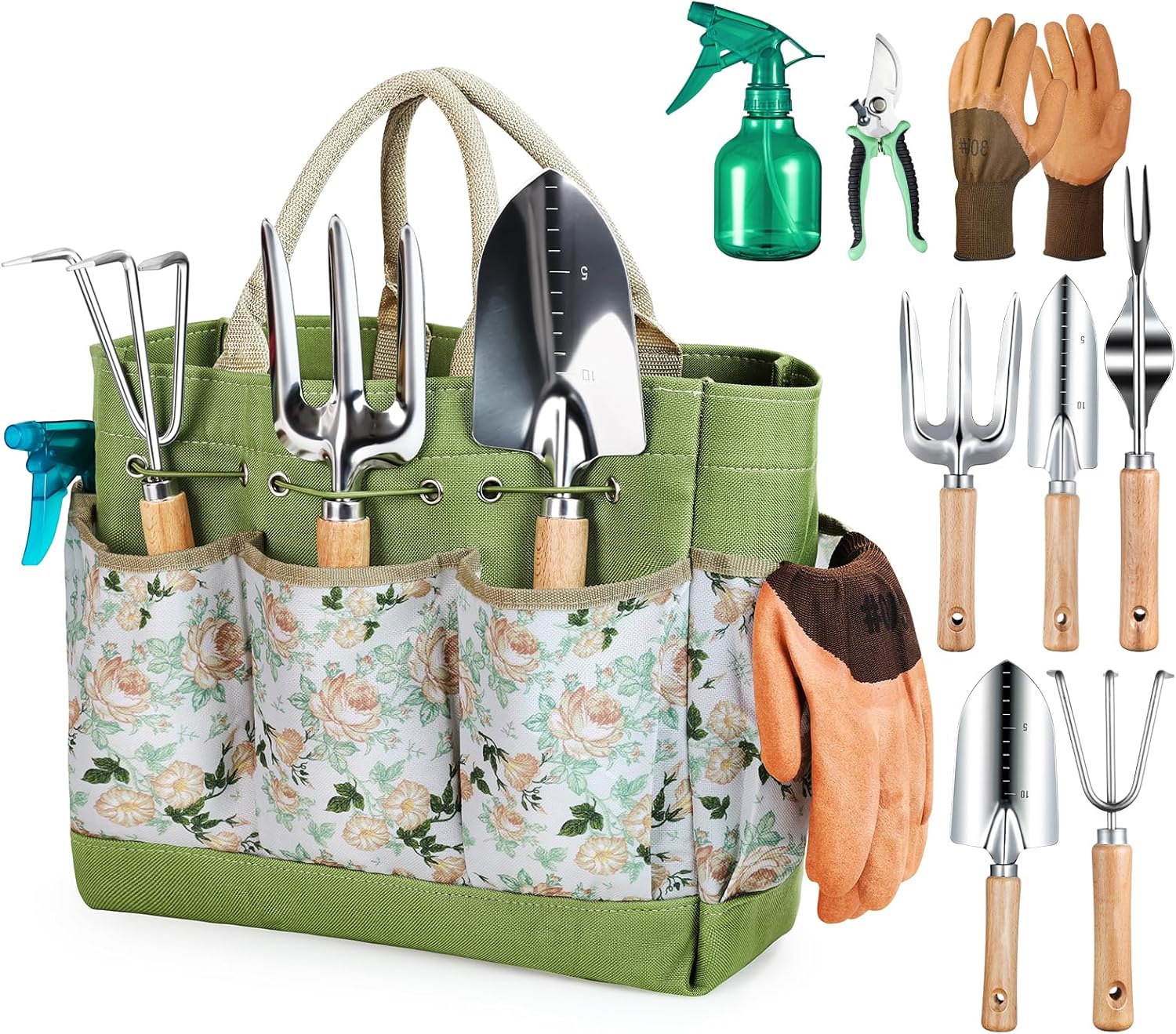
A multi-piece set can be convenient when you need several hand tools for planting and general maintenance. It may also be a practical way to organize your basic gardening equipment in one place.
For arthritis, however, the number of tools in a set is less important than the shape, weight and comfort of the individual handles.
Potential advantages
- Provides several tools for common hand-gardening tasks.
- Can be convenient for container gardening and raised beds.
- May reduce the need to purchase individual tools separately.
Limitations
- Not every tool in a set will necessarily suit your hands.
- Heavy or narrow handles can still require uncomfortable gripping.
- A set may be poor value if you only need one or two tools.
Buying tip: Check the included tool list and handle design before ordering. If possible, prioritize the tools you will use most often rather than choosing a set simply because it contains more pieces.
3. Lilyvane 45-Inch Garden Hoe and Cultivator — For Standing Garden Work
Best for: Gardeners who want to weed or loosen soil while standing rather than repeatedly bending toward the ground.

Short-handled tools can force you to bend at the waist or work close to the ground. A long-handled hoe and cultivator can help you reach soil from a more upright position.
The 45-inch handle is intended to provide extended reach, but the most comfortable length depends on your height, garden layout and the task being performed.
Potential advantages
- Allows some weeding and cultivating from a standing position.
- May reduce repeated bending and the need to kneel.
- Combines hoeing and cultivating functions in one tool.
Limitations
- Long handles can increase leverage and strain on the shoulders.
- Soil that is compacted or full of roots may still require substantial effort.
- A long tool may be awkward in small containers or tightly spaced beds.
Buying tip: Check the product’s weight, handle construction and dimensions. Use short, controlled movements and avoid repeatedly twisting your trunk while the tool is engaged in the soil.
For people with significant knee or hip stiffness, combining long-handled tools with raised beds or containers may be more helpful than relying on tools alone.
4. Cordless Electric Pruning Shears — For Repeated Cutting
Best for: Gardeners who find repeated manual squeezing difficult or who regularly prune plants that are within the tool’s rated cutting capacity.

Powered pruning shears use a motor to perform the cutting action, reducing the manual force needed for each cut. This can be helpful when ordinary pruning shears become tiring or uncomfortable.
They are not automatically the best option for every gardener. Battery-powered models can be heavier than manual shears, and their triggers, controls and safety locks must be manageable for the person using them.
Potential advantages
- Reduces the repeated squeezing needed for manual pruning.
- Can be useful for frequent trimming jobs.
- May make some cuts easier when the branch is within the tool’s rated capacity.
Limitations
- Usually costs more than a basic manual tool.
- Requires charging and appropriate battery care.
- Added weight may cause fatigue in the hand, wrist or shoulder.
- Powered blades can cause serious injury if handled carelessly.
Safety matters: Read the manufacturer’s instructions before use. Keep fingers clear of the cutting area, use the safety lock when appropriate, and switch off or isolate the power source before clearing a jam or cleaning the blades as directed. Store the tool securely away from children.
Buying tip: Check the tool’s weight, maximum cutting diameter, battery arrangements, safety features and whether the controls are easy for you to operate. If the trigger or lock is difficult to manage, a powered model may not be a suitable choice.
5. Garden Kneeler and Seat — For Working Near the Ground
Best for: Gardeners who need a padded surface for occasional kneeling or a low seat for planting and weeding.

Working close to the ground can put pressure on knees and make getting up difficult. A convertible garden kneeler and seat provides a padded surface for kneeling or a seat for lower-level tasks.
Models in this category often use a folding frame and side supports. Check the specific product listing for the frame design, weight limit, dimensions and how the unit converts between positions.
Potential advantages
- Provides padding between the knees and the ground when kneeling is comfortable.
- Can provide a seat for some low-level gardening tasks.
- May make transitions easier when the side supports offer suitable leverage.
Limitations
- Kneeling may remain uncomfortable even with padding.
- Standing up from a low seat can be difficult for some people.
- A folding frame needs to be positioned securely on stable ground.
Buying tip: If knee pain is significant, use the seat position only if you can get up safely, or consider raised beds and standing tools instead. Do not rely on the frame for support unless it is stable and used according to the manufacturer’s instructions.
6. Leather Gardening Gloves — For Hand Protection
Best for: General gardening tasks where protecting the hands from rough materials, minor scrapes and contact with plants is important.

Gardening gloves can improve comfort and provide a protective barrier during tasks such as handling branches, moving pots and working with rough materials. A well-fitting glove may also help you maintain a secure hold on tools.
Leather gloves are not necessarily padded or designed specifically for arthritis, so check the product’s fit, flexibility and construction rather than assuming the material will reduce joint strain.
Potential advantages
- Helps protect hands during general gardening.
- May provide a more secure grip when the gloves fit properly.
- Offers a barrier between the skin and rough materials.
Limitations
- Thick or stiff gloves can make it harder to handle small objects.
- Poorly fitting gloves may bunch up or make gripping more difficult.
- Gloves do not remove the force required to squeeze pruners or lift tools.
Buying tip: Look for a comfortable fit that lets you move your fingers without excessive effort. If swelling fluctuates, avoid gloves that become tight. For sensitive joints, compare flexible designs and padded options as well as leather gloves.
7. Folding Heavy-Duty Utility Wagon — For Moving Garden Supplies
Best for: Gardeners who need to move tools, pots, gloves and other supplies around the garden without carrying everything by hand.

Repeatedly carrying gardening supplies can strain the hands, wrists, shoulders and back. A folding utility wagon can reduce the number of items you need to carry and make it easier to transport equipment around a garden.
It can be useful for moving lighter supplies, but a wagon is not a substitute for safe lifting practices. Heavy loads may still be difficult to pull, particularly over grass, gravel or uneven ground.
Potential advantages
- Carries multiple supplies in one trip.
- Can reduce repetitive lifting and carrying.
- Folding designs can be easier to store when not in use.
Limitations
- Pulling a loaded wagon can still strain the shoulders and hands.
- Small wheels may struggle on rough or soft ground.
- A heavily loaded wagon can be difficult to steer or stop safely.
Buying tip: Check the wheel design, folded dimensions, handle comfort and stated load capacity. Keep loads manageable, distribute the weight evenly and avoid overloading the wagon. If pulling is uncomfortable, ask whether someone else can move heavier supplies or arrange storage closer to the garden.
Which Gardening Tools Should You Choose for Your Arthritis?
Your symptoms and the jobs you find difficult are better starting points than buying a complete collection of ergonomic tools.
| Your main difficulty | Tools worth considering | Why |
|---|---|---|
| Painful fingers or weak grip | Comfortable pruning shears, well-fitting gloves, selected hand tools | Focuses on grip comfort and the force required for each task |
| Repeated squeezing during pruning | Powered pruning shears, if safe to operate | Reduces the need for manual cutting force |
| Knee or hip stiffness | Long-handled hoe and cultivator, raised beds, suitable seat | Reduces bending and some kneeling |
| Difficulty getting up from the ground | Raised beds, standing tools, carefully selected seating | Avoids relying on repeated floor-level transitions |
| Shoulder discomfort or limited reach | Tools of suitable weight and length; supplies kept nearby | Helps limit awkward reaching and unnecessary carrying |
| Difficulty carrying pots and supplies | Folding utility wagon and smaller loads | Reduces the need to carry everything by hand |
| General planting and light maintenance | Selected tools from a gardening set | Gives you the tools needed for common jobs without unnecessary purchases |
If several joints are affected, think about the whole task. For example, a lightweight hand tool may help your fingers but still require bending that aggravates your knees. Changing the garden layout may solve more than buying another tool.
How to Choose Gardening Tools Before You Buy
Use this checklist when comparing products online or testing them in a store.
Check the grip and controls
- Can you hold the handle without clenching your fingers tightly?
- Can you open and close the tool without excessive force?
- Are the trigger, safety lock or adjustment controls easy to operate?
- Does the handle remain secure when your hands are sweaty or gloved?
Check the weight and working position
- Is the tool light enough for the length of time you plan to use it?
- Can you keep your wrist reasonably straight while working?
- Does the handle allow you to reach without leaning or twisting?
- Will the tool be manageable when held at its full working length?
Check the practical details
- Are the dimensions and weight listed clearly?
- Are batteries, accessories or other necessary components included?
- Are cleaning, maintenance and storage instructions available?
- Is the product return policy suitable if the grip or weight is uncomfortable?
When shopping online, do not rely on the word “ergonomic” or a claim such as “cuts three times easier” by itself. Look for specific design details and consider whether those details address the difficulty you experience.
Ways to Make Gardening Easier Without Buying More Tools
The right equipment helps, but small changes to your routine can be just as important.
- Work in shorter sessions. Stop before your hands or other joints become exhausted rather than trying to finish every task at once.
- Alternate activities. Switch between pruning, watering, planting and resting to avoid repeating the same movement for too long.
- Use raised beds or containers. Bring plants closer to a comfortable working height where possible.
- Keep supplies close by. Store frequently used tools and materials within easy reach.
- Avoid heavy loads. Divide soil, compost and pots into smaller amounts or ask for help with heavier jobs.
- Choose suitable conditions. Avoid working in extreme heat, and use tools that are manageable for your strength and balance that day.
- Stop when pain increases. Do not push through sharp pain, worsening symptoms or unusual fatigue.
For a fuller plan covering garden layout, tools, task pacing and practical adaptations, read our complete guide to gardening with arthritis.
Frequently Asked Questions
What are the best gardening tools for arthritis in the hands?
Start with tools that are comfortable to grip and require less squeezing. Depending on the task, that may mean easier-to-operate pruning shears, a well-fitting hand tool with a suitable handle, or powered pruning shears. Try to choose tools that let you work without forcing painful finger or thumb positions.
Are electric pruning shears better than manual pruners for arthritis?
They can be helpful for people who struggle with repeated squeezing or do a lot of pruning. However, powered shears may be heavier, more expensive and more complicated to operate safely. Consider your grip, shoulder strength, ability to use the controls and the type of pruning you do before deciding.
Do long-handled gardening tools help with knee arthritis?
They can reduce the need to bend or kneel for some tasks, which may make gardening more manageable. However, long handles can increase shoulder effort, particularly if the tool is heavy or used far from the body. Choose a suitable length and use controlled movements.
Are gardening gloves enough to reduce arthritis pain?
Gloves can protect your hands and may improve grip comfort, but they do not eliminate the force required to cut, dig or lift. If gripping is the main problem, combine suitable gloves with tools that require less force and a more comfortable working position.
Is a garden kneeler or seat useful for people with arthritis?
It may be useful if you can safely get into and out of the position. A padded kneeler can cushion the knees, while a seat allows some tasks to be done sitting down. If kneeling or standing up is difficult, raised beds and long-handled tools may be more suitable.
What is the most important feature to look for in an arthritis-friendly gardening tool?
Choose according to the task and the joint involved. For painful hands, grip comfort and the force required are important. For knee or hip limitations, reach and working height may matter more. For shoulder discomfort, weight and balance become especially important.
Should I buy a complete gardening tool set?
Only if you will use most of the included tools and can comfortably hold them. A smaller number of well-chosen tools may be better value than a large set containing handles or designs that do not suit your hands.
Final Thoughts
Gardening with arthritis is often about making small, practical adjustments rather than finding one perfect tool. Comfortable handles, suitable cutting mechanisms, longer reach and easier ways to move supplies can help reduce some of the physical demands of garden work.
Start with the task that causes you the most difficulty. If pruning is the problem, compare manual and powered shears. If bending is difficult, consider long-handled tools and a more accessible garden layout. If carrying supplies is tiring, try smaller loads or a wagon.
You do not need to buy all seven products. Choose the tools that solve real problems for you, work at a manageable pace, and adapt your garden so you can continue enjoying it.
Related reading
- Gardening with Arthritis: Complete Guide to Tools, Layout & Pacing
- Accessible Garden Design for Arthritis: Beds, Paths & Wheelchair Access
Medical Disclaimer: This article is for informational purposes only and does not constitute medical advice. Always consult your doctor, rheumatologist, or occupational therapist before making changes to how you manage your arthritis.
