

Living with arthritis can affect much more than a single joint. Pain, stiffness, fatigue, reduced mobility, sleep problems, and difficulty with everyday tasks can all make ordinary routines more challenging.
The good news is that managing arthritis does not have to depend on one treatment or one product. A practical approach may combine regular movement, appropriate medical treatment, pain-relief strategies, supportive tools, better sleep habits, and small changes that make daily activities easier.
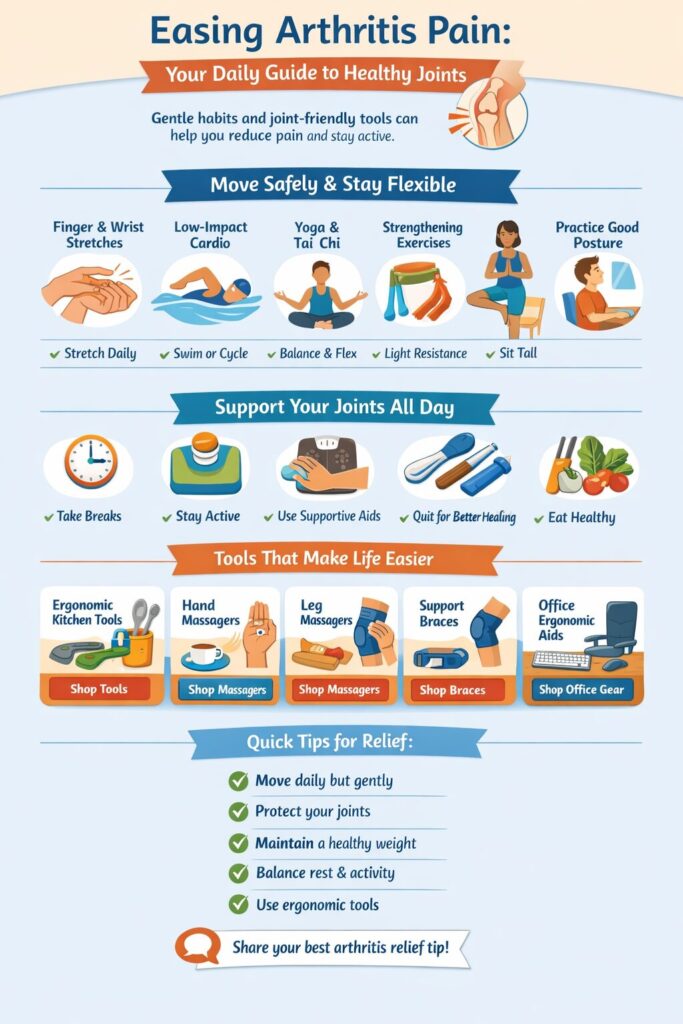
This guide brings those strategies together in one place. It focuses on practical ways to manage symptoms and stay as active and independent as possible, while recognizing that the right approach depends on the type of arthritis, the joints affected, and your individual health.
Quick answer: Living well with arthritis usually involves a combination of appropriate medical care, regular physical activity, symptom-management strategies, good sleep, and practical tools that make everyday tasks easier. You do not need to change everything at once. Start with the problems that interfere most with your daily life.
What Helps Most When Living With Arthritis?
There is no single strategy that works for everyone with arthritis. Osteoarthritis, rheumatoid arthritis, psoriatic arthritis, gout, and other forms of arthritis can require very different medical treatments.
However, several practical principles are useful across many types of arthritis:
- Keep moving: Regular physical activity can reduce pain and improve physical function and mood.
- Treat the type of arthritis you have: Inflammatory forms of arthritis may require medications that control the underlying disease, not just pain-relief products.
- Use heat or cold strategically: Heat may be useful for stiffness, while cold may help with pain or swelling for some people.
- Reduce unnecessary strain: Assistive devices can make gripping, reaching, walking, dressing, cooking, and bathing easier.
- Pay attention to sleep: Pain and poor sleep can reinforce each other, making both harder to manage.
- Pace demanding activities: Alternating activity with rest can help prevent doing too much on a good day and paying for it later.
- Get professional help when needed: A doctor, physiotherapist, occupational therapist, or other healthcare professional can help match treatment and equipment to your needs.
The goal is not to eliminate every symptom. It is to find practical ways to manage your condition while preserving the activities and independence that matter to you.
Understanding the Type of Arthritis You Have

“Arthritis” is an umbrella term covering many different conditions. The most appropriate treatment depends heavily on the type.
Osteoarthritis
Osteoarthritis (OA) is the most common form of arthritis. It affects the entire joint, including cartilage and other surrounding tissues, rather than being simply a matter of “wear and tear.”
It commonly affects the knees, hips, hands, spine, and other joints. Symptoms can include pain with activity, stiffness after resting, swelling, and reduced movement.
Exercise, weight management when appropriate, physical therapy, heat or cold, braces or orthotics in selected situations, medications, and assistive devices may all play a role in managing OA.
Rheumatoid Arthritis
Rheumatoid arthritis (RA) is an autoimmune inflammatory disease. It can cause joint pain, swelling, stiffness, and fatigue and may affect several joints.
Morning stiffness can be particularly noticeable and may last longer than the brief stiffness commonly associated with osteoarthritis.
Because RA can cause progressive joint damage, appropriate medical treatment is important. Pain-relief products and assistive tools can help with daily symptoms, but they do not replace treatment aimed at controlling the disease itself.
Psoriatic Arthritis
Psoriatic arthritis is an inflammatory form of arthritis associated with psoriasis. It can affect different joints and may also cause problems involving tendons, fingers, toes, or the spine.
Treatment is individualized. Managing skin disease, inflammation, pain, movement, and fatigue may all be part of the overall approach.
Gout
Gout is caused by uric acid crystal buildup in a joint. It often produces sudden, intense pain, swelling, redness, and warmth.
Gout requires a different approach from osteoarthritis. Medication and long-term management of uric acid levels are important for people who have recurrent gout.
Dietary changes may also be recommended, but there is no universal “arthritis diet” that applies equally to every form of arthritis.
Arthritis Pain Relief: Heat, Cold and Topicals
Pain can vary from day to day and from one joint to another. The strategy that helps with morning stiffness may not be the same one you use for a swollen joint after activity.
When Heat May Help

Heat can be useful for some people with arthritis-related stiffness and discomfort. Warmth may increase blood flow, improve flexibility, and make movement more comfortable.
Heat may be particularly useful:
- In the morning when joints feel stiff
- Before gentle stretching or movement
- For chronic aching or muscle tension
- During cold weather when joints feel uncomfortable
- Before activities that tend to leave you feeling stiff
Common options include:
- Heating pads
- Microwaveable heat wraps
- Warm baths or showers
- Heated gloves
- Heated clothing
- Heated blankets or mattress pads
Heat is not appropriate for every situation. If a joint is already very hot, swollen, or acutely inflamed, cold may be more comfortable.
Avoid excessive heat and protect your skin from burns. Do not fall asleep with a heating pad directly against your skin.
When Cold May Help
Cold can temporarily numb painful areas and may help with swelling.
Some people find it useful:
- After activity when a joint becomes sore
- When a joint feels hot or swollen
- During an acute flare of pain
- After overusing a particular joint
Use a cold pack according to its instructions and protect your skin with a cloth or other barrier.
Heat and cold are not competing treatments. Many people use them for different situations.
Topical Pain-Relief Products

Topical products are applied directly to the skin over a painful area. Depending on the product, ingredients may include:
- Diclofenac
- Capsaicin
- Menthol
- Lidocaine
Topical treatments can be useful when you want localized symptom relief. They are not completely free of side effects, however, and topical medications can still be absorbed into the body.
Diclofenac is a topical NSAID available in both over-the-counter and prescription products depending on the country and formulation.
Capsaicin can take repeated applications over time before its full effect becomes noticeable and may initially cause burning or irritation.
Always follow the product directions and check with a healthcare professional or pharmacist if you are unsure whether a topical medication is appropriate for you.
Related Reading:
Massage and Therapy Devices
Massage and electrical therapy devices are popular because they can provide another way to manage discomfort at home.
Their usefulness varies considerably from person to person, and they should be viewed as symptom-management tools rather than treatments that correct the underlying cause of arthritis.
Hand Massagers

Hand massagers may provide warmth, pressure, vibration, or compression. They can be appealing when hand stiffness makes ordinary massage difficult to perform yourself.
Look for controls that are easy to operate if you have limited finger strength or dexterity.
Related Reading: Best Hand Massagers for Arthritis
Foot and Leg Massagers
Foot and leg massagers can provide warmth, pressure, rolling, vibration, or compression.
They may feel soothing after standing or walking, but they should not automatically be considered a treatment for poor circulation, neuropathy, or vascular disease.
If you have reduced sensation, significant swelling, vascular problems, neuropathy, or unexplained leg pain, ask a healthcare professional whether a particular device is appropriate.
Percussion Massage Devices
Massage guns and other percussion devices can be useful for muscle tension around painful joints.
Avoid assuming that stronger pressure is better. Arthritis affects joints and surrounding tissues in different ways, so aggressive pressure directly over a painful or swollen joint may be inappropriate.
TENS Devices
Transcutaneous electrical nerve stimulation (TENS) uses mild electrical stimulation to influence pain perception.
TENS is different from muscle-stimulation products marketed for circulation or muscle activation. Whether TENS is appropriate depends on the individual and the device.
If you have an implanted electrical device, reduced sensation, certain medical conditions, or are unsure about using electrical stimulation, check the device instructions and ask a healthcare professional before use.
Related Reading:
Exercise and Movement: One of the Most Important Long-Term Strategies

Regular physical activity is one of the most consistently supported self-management strategies for arthritis.
The goal is not necessarily intense exercise. The most useful activity is often something you can perform regularly and adapt to your abilities.
The CDC recommends that adults, including people with arthritis, work toward at least 150 minutes of moderate-intensity aerobic activity per week plus muscle-strengthening activity on at least two days. However, activity can be divided into smaller sessions, and some movement is better than none.
Low-Impact Aerobic Activities
Options include:
- Walking
- Cycling
- Swimming
- Water aerobics
- Tai chi
- Dancing
- Light gardening
Water-based exercise can be particularly useful for people who find weight-bearing activity uncomfortable.
Strength Training
Strengthening the muscles around affected joints can make everyday activities easier.
Examples include:
- Resistance bands
- Light weights
- Body-weight exercises
- Chair exercises
- Supervised strength programs
Start gradually. If an exercise repeatedly produces significant pain or swelling rather than becoming easier with adaptation, discuss it with a healthcare professional.
Flexibility and Balance

Gentle range-of-motion exercises can help maintain movement.
Balance exercises are especially useful for older adults or anyone who has become less steady because of pain, weakness, or reduced activity.
Yoga and tai chi can combine movement, flexibility, balance, and relaxation, although individual exercises may need to be modified.
You Do Not Have to Start With 30 Minutes
If 30 minutes of exercise feels unrealistic, start smaller.
Five- or ten-minute periods of activity can add up throughout the day. The important thing is finding a level you can repeat consistently and gradually building from there.
Related Reading: Arthritis Exercise Guide
Supportive Tools That Can Make Daily Life Easier
Arthritis can make ordinary tasks difficult even when the activity itself seems simple.
A jar may be too difficult to open. A button may be frustrating. A heavy pan may hurt your hands. Standing for long periods may aggravate knee or hip pain.
Assistive devices can help reduce the amount of force, gripping, reaching, or balance required.
Kitchen Aids

Useful examples include:
- Electric jar openers
- Easy-grip utensils
- Lightweight cookware
- Reacher tools
- One-handed cutting aids
- Automatic can openers
- Large-button appliances
The best tool is usually the one that solves a specific problem you encounter regularly.
Bathroom Aids
Depending on your mobility and balance, useful equipment may include:
- Grab bars
- Shower seats
- Handheld showerheads
- Long-handled sponges
- Raised toilet seats
- Easy-grip faucets
- Bathing aids
Safety equipment should be selected and installed appropriately, especially if you have balance problems.
Dressing Aids
Dressing can become difficult when finger movement or shoulder mobility is limited.
Possible solutions include:
- Button hooks
- Long-handled shoehorns
- Sock aids
- Reachers
- Elastic shoelaces
- Magnetic or simplified closures
Related Reading:
- Arthritis-Friendly Kitchen Tools
- Arthritis Bathing Tools
- Arthritis-Friendly Dressing Aids
- Arthritis Supplies & Tools: Complete Guide to Daily Living Aids
Braces, Compression Gloves and Joint Supports
Support products can sometimes make movement or everyday activities more comfortable, but there is no single brace or support that is right for every type of arthritis.
Knee Braces

Different knee braces serve different purposes.
Some provide compression or warmth. Others provide more substantial stabilization. Certain unloading braces are designed for specific patterns of knee osteoarthritis.
A brace should match the problem you are trying to address rather than simply being labeled an “arthritis brace.”
If you have significant instability, persistent swelling, or uncertainty about which type of brace you need, professional guidance can be useful.
Compression Gloves
Compression gloves are commonly used by people with hand arthritis who want warmth, light compression, or support.
Some people find them particularly comfortable during activities or when their hands feel stiff.
Fit matters. Gloves that are excessively tight may be uncomfortable and may not be appropriate for everyone.
Copper-infused gloves are often marketed as having special arthritis benefits. Copper itself should not be assumed to provide a therapeutic effect simply because it is included in the fabric.
Wrist and Thumb Supports
Wrist and thumb braces range from flexible supports to more restrictive splints.
The appropriate amount of support depends on the joint involved and the reason for using the brace. A flexible support may be preferable for some activities, while a more stabilizing splint may be appropriate in other situations.
Related Reading:
- Best Compression Gloves for Arthritis
- Knee Braces for Arthritis
- Wrist and Thumb Supports for Arthritis
Foot Pain, Shoes, Insoles and Walking Aids
Foot problems can affect how you stand and walk, and changes in the way you walk can make other joints feel different.
Choosing Shoes for Arthritis

There is no single shoe that is best for everyone with arthritis.
Depending on the joint involved, useful features may include:
- Adequate cushioning
- A comfortable, roomy toe box
- Appropriate stability
- Good traction
- Adjustable closures
- A sole that feels comfortable during walking
- Enough room for orthotics or swelling when needed
Some people with arthritis of the big toe may prefer a rocker-style sole, while others may need a different combination of stability and flexibility.
Fit is more important than choosing a shoe simply because it is marketed as an “arthritis shoe.”
Related Reading:
Insoles
Insoles may improve comfort or support for some people, but they are not universally helpful.
The appropriate insole depends on factors such as foot shape, arch height, footwear, symptoms, and the reason for using the insert.
Some people do well with a cushioned insole, while others may need more structured support. Custom orthotics may be recommended for particular foot problems.
If an insole increases pain, pressure, numbness, or instability, stop using it and reassess the fit.
Related Reading: Best Insoles for Arthritis Pain Relief
Canes and Walkers
A properly fitted cane or walker can provide stability and make walking easier.
A cane is commonly used in the hand opposite the affected leg, but correct fitting and technique matter.
A walker or rollator may be more appropriate when you need greater stability or support.
If you are unsure which mobility aid is appropriate, a physiotherapist or occupational therapist can help assess your walking pattern and fit the equipment.
Related Reading: Mobility Aids for Arthritis
Making Everyday Tasks Easier
One of the most overlooked parts of arthritis management is changing the way you perform everyday tasks.
You do not necessarily need to stop doing an activity you enjoy. Sometimes the better solution is to change the tool, position, technique, or amount of effort involved.
Examples of Joint-Friendly Changes
Instead of:
- Twisting a tight lid with painful fingers → use a jar opener.
- Carrying a heavy pan with one hand → use two hands or lighter cookware.
- Bending repeatedly to reach low items → move frequently used items higher.
- Standing for a long period → sit for part of the task or use a supportive stool.
- Gripping a small handle tightly → choose a larger, padded handle.
- Reaching overhead repeatedly → reorganize frequently used items.
These changes are not about avoiding activity. They are about making activity more manageable.
Occupational therapists can be particularly helpful when arthritis interferes with cooking, dressing, bathing, working, hobbies, or other daily activities.
Sleep and Nighttime Arthritis Pain

Pain and poor sleep can affect each other. Pain can make it harder to sleep, while inadequate sleep can make pain and fatigue more difficult to manage.
There is no single sleep setup that works for everyone, but several practical changes are worth trying.
Find a Comfortable Sleeping Position
Pillows can sometimes reduce pressure on painful joints.
Depending on your symptoms, you might try:
- A pillow between the knees when sleeping on your side
- A pillow supporting the affected arm
- A pillow under the knees when lying on your back
- A pillow that keeps your neck in a comfortable position
Consider Mattress Comfort
There is no universally correct mattress firmness.
A mattress that feels supportive without creating uncomfortable pressure points is generally more useful than choosing a firmness level based solely on a label.
If you regularly wake with increased pain or stiffness, consider whether your mattress, pillow, sleeping position, room temperature, or nighttime routine could be contributing.
Warmth Before Bed
A warm shower or other gentle heat may help some people relax before bed.
If you use an electric blanket or heated mattress pad, follow its safety instructions and avoid excessive heat.
Do not sleep directly on a heating pad unless the product is specifically designed and approved for that use.
Related Reading: Sleep With Arthritis
Lifestyle Habits That Can Support Arthritis Management
Lifestyle changes cannot replace appropriate medical treatment, but they can complement it.
Weight Management
Weight management is particularly relevant to people with overweight or obesity who have osteoarthritis affecting weight-bearing joints such as the knees or hips.
Even relatively modest weight loss can reduce stress on these joints and may improve pain and mobility.
This does not mean that body weight explains every case of arthritis. Many forms of arthritis are not caused by excess weight.
Stress and Pain

Stress can affect sleep, muscle tension, coping, and the way pain is experienced.
Rather than looking for a single “stress cure,” consider practical ways to reduce the overall load on your body and schedule:
- Regular movement
- Adequate sleep
- Time for enjoyable activities
- Relaxation exercises
- Social connection
- Pacing demanding tasks
Food and Arthritis
There is no single food list that applies to every type of arthritis.
A balanced eating pattern that includes vegetables, fruits, whole grains, protein sources, and healthy fats can support overall health.
A Mediterranean-style eating pattern is often discussed in relation to general health and inflammation, but it should not be presented as a cure for arthritis.
Gout is different. Because gout is associated with uric acid, certain dietary and alcohol-related factors can contribute to attacks in susceptible people. If you have gout, discuss diet and long-term uric acid management with your healthcare professional.
Pace Yourself
Pacing is especially useful when fatigue or pain makes it easy to overdo things.
Instead of completing a large task all at once, divide it into smaller steps.
For example:
Instead of: Cleaning the entire house in one afternoon.
Try: Cleaning one room, taking a break, and spreading the remaining work across several days.
The goal is to remain active without repeatedly pushing yourself beyond what your body can comfortably recover from.
Quick Reference: Where to Start
| If your main problem is… | A practical starting point |
|---|---|
| Morning stiffness | Gentle movement, warmth, stretching, and an appropriate exercise routine |
| Pain after activity | Reduce the intensity, allow recovery, and consider cold if it feels helpful |
| Hand stiffness or weak grip | Easy-grip tools, jar openers, compression gloves, and activity modifications |
| Knee or hip discomfort | Regular appropriate exercise, weight management when relevant, supportive footwear, and professional assessment if needed |
| Foot pain | Check footwear fit, consider appropriate insoles, and seek assessment for persistent problems |
| Difficulty walking | Properly fitted cane, walker, or rollator when appropriate |
| Trouble cooking | Lightweight cookware, larger handles, jar openers, and other kitchen aids |
| Difficulty bathing | Grab bars, shower seats, handheld showerheads, and long-handled aids |
| Difficulty dressing | Button hooks, reachers, sock aids, elastic laces, and easier closures |
| Nighttime discomfort | Comfortable positioning, pillows, sleep habits, and appropriate warmth |
| Frequent flares or worsening symptoms | Review the diagnosis and treatment plan with a healthcare professional |
Think of this table as a starting point, not a universal treatment plan.
When Should You Talk to a Healthcare Professional?
You do not have to manage persistent arthritis symptoms on your own.
Consider making an appointment if:
- Your joint pain is persistent or getting worse.
- Pain is interfering with sleep or everyday activities.
- You have unexplained swelling or stiffness.
- You are having repeated flares.
- You are having difficulty walking or using your hands.
- A brace, insole, mobility aid, or other device is causing problems.
- You are not sure what type of arthritis you have.
- You are struggling to manage symptoms despite your current treatment.
A suddenly very painful, hot, swollen joint—particularly if accompanied by fever or feeling unwell—can require urgent medical assessment because infection and other conditions can sometimes resemble an arthritis flare.
If you have inflammatory arthritis such as rheumatoid arthritis or psoriatic arthritis, regular medical follow-up is especially important because treatment may need to address the underlying inflammation rather than symptoms alone.
Frequently Asked Questions
What is the best way to live well with arthritis?
There is no single best strategy for everyone. A combination of appropriate medical treatment, regular movement, symptom-management techniques, good sleep habits, and practical adaptations can help many people manage arthritis.
The right combination depends on the type of arthritis and how it affects you.
Is exercise good for arthritis?
For most people with arthritis, appropriate physical activity is beneficial. It can reduce pain and improve physical function and overall health.
Start gradually and choose activities that fit your abilities. Walking, cycling, swimming, water exercise, strength training, and tai chi are examples of activities many people can adapt to their needs.
Should I use heat or cold for arthritis?
It depends on the situation and the individual.
Heat may be useful for stiffness and muscle tension, while cold may be useful when a joint feels painful or swollen.
You can experiment with both, provided they are used safely and comfortably.
What foods should I avoid if I have arthritis?
There is no universal list of foods that everyone with arthritis needs to avoid.
Gout is an important exception because dietary and alcohol-related factors can influence uric acid levels and attacks.
For other forms of arthritis, focus on an overall nutritious eating pattern rather than assuming that one particular food is responsible for symptoms.
Can arthritis be cured?
Some forms of arthritis can be effectively controlled, but there is no single cure for all types.
Treatment depends on the specific condition. Osteoarthritis, rheumatoid arthritis, gout, psoriatic arthritis, and other forms require different approaches.
How do I know what type of arthritis I have?
Diagnosis usually involves your medical history, symptoms, and physical examination. Depending on the situation, a healthcare professional may also use imaging, blood tests, or other testing to distinguish arthritis from other causes of joint pain.
Do compression gloves really help arthritis?
Some people find compression gloves useful for warmth, comfort, or a feeling of support around stiff or painful hands.
They are not a treatment for the underlying cause of arthritis, and they will not work equally well for everyone.
Can arthritis tools really make a difference?
The right tool can make a difficult task easier by reducing gripping, reaching, twisting, lifting, or balancing demands.
For example, a jar opener does not treat hand arthritis, but it may allow someone with painful fingers to open a jar independently.
That distinction is important: many arthritis tools are designed to improve function and reduce task difficulty rather than treat the disease itself.
When should arthritis pain be checked by a doctor?
Make an appointment when pain is persistent, worsening, interfering with sleep or daily activities, or accompanied by unexplained swelling or stiffness.
Seek urgent medical attention for a suddenly hot, very swollen, extremely painful joint, particularly if you also have a fever or feel unwell.
Explore Arthritis by Goal
You do not need to read every section of this guide. Start with the problem that affects you most.
Pain Relief
Hands and Grip
- Best Hand Massagers for Arthritis
- Best Compression Gloves for Arthritis
- Arthritis-Friendly Kitchen Tools
- Arthritis-Friendly Craft Tools
Feet and Walking
- Best Shoes for Arthritis Pain Relief
- How to Choose Shoes for Arthritis
- Best Insoles for Arthritis Pain Relief
- Mobility Aids for Arthritis
Daily Living
- Arthritis Bathing Tools
- Arthritis-Friendly Dressing Aids
- Arthritis Supplies & Tools: Complete Guide to Daily Living Aids
Sleep and Recovery
Movement
The purpose of these individual guides is to go deeper into specific problems without making this broad overview unnecessarily long.
Reliable Medical Resources
For additional medical information, consider these organizations:
- Centers for Disease Control and Prevention (CDC): Physical activity and arthritis self-management
- National Institute of Arthritis and Musculoskeletal and Skin Diseases (NIAMS): Arthritis diagnosis, treatment, and living with arthritis
- World Health Organization (WHO): Global information about osteoarthritis and musculoskeletal conditions
- Arthritis Foundation: Arthritis education, exercise, self-management, and practical resources
- NHS: General information about arthritis symptoms and treatment
These resources can provide medical information, but your own healthcare professional is the appropriate source for diagnosis and individualized treatment.
Final Thoughts
Living well with arthritis is not about finding one perfect product, exercise, diet, or treatment.
It is about building a practical system that helps you move, sleep, manage symptoms, and handle everyday tasks as comfortably and independently as possible.
For some people, that may mean a better exercise routine. For someone else, it may mean finding a shoe that fits properly, using a cane, changing how they open jars, improving their sleep setup, or working with a healthcare professional to adjust treatment.
Start with the problems that interfere most with your life. Make one useful change at a time, keep what helps, and adjust what does not.
Practical tools. No hype.
Medical Disclaimer: This article is for informational purposes only and does not constitute medical advice. Always consult your doctor, rheumatologist, or occupational therapist before making changes to how you manage your arthritis.
