

Waking up with a stiff, sore, or painful neck can be frustrating—especially when you went to bed feeling fine. In many cases, morning neck pain is related to how your head and neck are positioned during sleep, pillow support, muscle tension, or simply staying in one position for several hours.
For people living with arthritis, morning stiffness can have additional causes. But waking with neck pain does not automatically mean your arthritis is getting worse. Your sleep setup, daily posture, and the way you sleep can all contribute.
The good news is that several of the most common contributors are simple to check before you buy anything.
Quick Answer: Why Does My Neck Hurt When I Wake Up?
Morning neck pain is often associated with an awkward sleeping position, a pillow that does not support your head and neck comfortably, muscle tension, or staying in one position for a long time.
A useful first step is to look at your pillow height, sleep position, and how your neck feels immediately after waking. If changing your position or pillow support consistently changes your symptoms, your sleep setup may be contributing.
However, persistent, severe, or unusual neck pain can have other causes and should not automatically be blamed on a pillow.
7 Common Causes of Morning Neck Pain
1. Your Pillow Is the Wrong Height
Pillow height can affect the position of your head and neck while you sleep.
A pillow that is too high may push your head forward or sideways. A pillow that is too low may leave your head unsupported. The right height depends partly on your sleeping position, shoulder width, mattress, and the shape and firmness of the pillow.
A useful goal is to keep your head and neck in a comfortable, relatively neutral position rather than noticeably bent upward or downward. Cleveland Clinic recommends choosing pillow support that keeps the head and neck aligned with the body.
Signs your pillow height may be contributing:
- You regularly wake with neck stiffness
- Your neck feels better after you get up and move around
- You frequently reposition or fold your pillow during the night
- Your head feels tilted upward or downward when lying in your usual position
- You wake with more neck discomfort than you had at bedtime
If the problem appears to be primarily pillow-related, see our Best Cervical Pillows for Neck Pain and Arthritis guide.
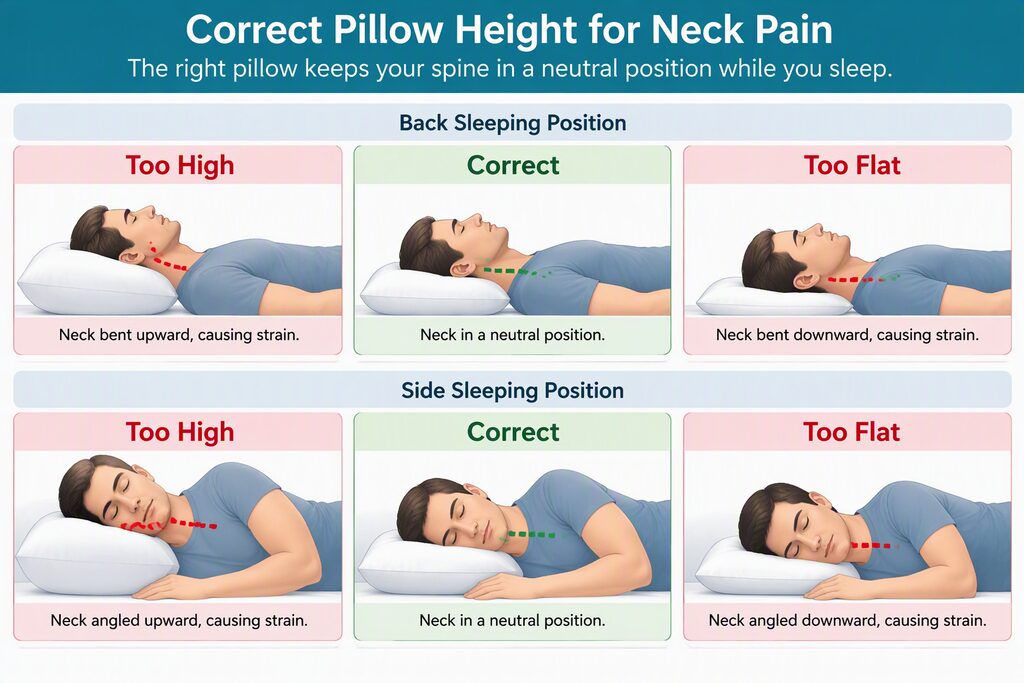
2. Your Sleeping Position May Be Straining Your Neck
The position you stay in for several hours can affect how your neck feels in the morning.
| Sleep Position | What to Watch For |
|---|---|
| Back sleeping | Pillow should support the head without pushing the chin toward the chest |
| Side sleeping | Pillow should fill the space between the head and mattress without tilting the head sharply |
| Stomach sleeping | Head usually has to remain turned to one side, which can place the neck in a rotated position for an extended period |
There is no single sleeping position that is ideal for everyone. However, back or side sleeping generally makes it easier to keep the neck in a more neutral position than stomach sleeping. Cleveland Clinic specifically notes that stomach sleeping can contribute to neck pain because the head remains turned to one side.
If you are comfortable sleeping on your side or back, experiment with pillow height and positioning rather than assuming you need to completely change your preferred sleeping position.
See our guide to Best Sleeping Positions for Arthritis Pain for more positioning tips.
3. Your Pillow May Be Worn Out
A pillow can gradually lose its shape and support.
You do not necessarily need to replace a pillow simply because it has reached a particular age. Instead, look at how it performs now.
Signs a pillow may be past its useful life include:
- It stays flattened after use
- It has developed a permanent dent or lump
- You have to fold it to get enough height
- The filling has become uneven
- It no longer feels supportive
- You consistently sleep more comfortably with a different pillow
Cleveland Clinic notes that many pillows may need replacement after roughly a year or two, but condition and support are more useful considerations than treating a specific lifespan as a rule.
If your pillow is worn out, replacing it may be worthwhile—but a more expensive pillow is not automatically a better pillow for your neck.
4. Arthritis or Other Joint Problems Can Contribute
Arthritis affecting the cervical spine can cause neck pain and stiffness. Symptoms may be particularly noticeable after remaining in one position for a long period.
Morning neck stiffness can occur with osteoarthritis and other conditions affecting the neck, but it is important not to assume that every episode of morning pain is caused by arthritis.
Pay attention to the pattern:
- Is the pain mainly stiffness?
- Does it improve after you start moving?
- Is there swelling or unusual warmth?
- Does the pain continue throughout the day?
- Is there numbness, tingling, or weakness?
- Is your range of motion becoming increasingly limited?
If your symptoms are new, persistent, worsening, or accompanied by neurological symptoms, talk with a healthcare professional rather than trying to solve the problem with a pillow alone.
If arthritis pain tends to be worse overnight, see How to Relieve Arthritis Pain at Night (What Actually Helps).
5. Muscle Tension Can Build Up Before or During Sleep

Morning neck pain is not always caused by the pillow.
Muscle tension accumulated during the day can carry into the night. Long periods at a computer, looking down at a phone, poor daytime posture, stress, or repetitive activity can all contribute to neck and shoulder tension.
An awkward sleeping position can then add to the problem.
This is one reason it can be useful to look at your entire day, rather than assuming the pillow is the only cause.
Try asking:
Did my neck already feel tight before I went to bed?
If the answer is yes, your sleep setup may be only one part of the problem.
Gentle movement after waking may help loosen ordinary stiffness, provided the movement does not increase your pain.
6. Your Mattress May Affect Your Sleeping Position
Your mattress can influence how your body settles during sleep.
A mattress that allows one area of your body to sink considerably more than another may change your overall sleeping position. That can make it harder to keep your head, neck, and body comfortably positioned.
However, a new mattress is not automatically the answer to morning neck pain.
Before replacing a mattress, look for simpler explanations first:
- Is your pillow still supportive?
- Does the mattress sag or feel uneven?
- Are you comfortable in your usual sleeping position?
- Does your neck hurt only in this bed?
- Does the pain improve when you sleep somewhere else?
If your mattress appears to be part of the problem, see Best Mattresses for Arthritis Pain Relief.
7. Stress and Tension Can Affect Your Neck
Stress can contribute to muscle tension in the neck and shoulders.
You may notice that your shoulders are raised, your jaw is clenched, or your neck feels tight during stressful periods. That tension can make morning soreness more noticeable.
A relaxing bedtime routine may help if stress is contributing to your symptoms. Options include gentle stretching, breathing exercises, a warm shower, or simply reducing stimulating activities before bed.
These approaches are not a treatment for an underlying neck condition, but they may be useful additions to a comfortable bedtime routine.
Quick Troubleshooting Guide
Before buying a new pillow, work through these questions:
| What you notice | What to check first |
|---|---|
| Neck pain is worst immediately after waking | Pillow height and sleep position |
| Pain is worse after sleeping on one side | Pillow height and shoulder position |
| You wake with a stiff neck but improve after moving | Prolonged positioning and general stiffness |
| Your pillow is flat or lumpy | Pillow condition |
| Pain began after changing pillows | Whether the new pillow is too high, low, firm, or soft |
| Neck was already tight before bed | Daytime posture, activity, and muscle tension |
| Pain occurs regardless of pillow or position | Consider other causes and seek medical advice if persistent |
| Pain includes numbness, tingling, or weakness | Seek medical evaluation |
A Simple Pillow and Neck Alignment Check

You can do a basic check of your sleeping position without buying anything.
Lie in your normal sleeping position with your usual pillow.
For side sleeping, look at whether your head appears to tilt noticeably upward or downward relative to your body.
For back sleeping, notice whether the pillow pushes your chin toward your chest or leaves your head falling too far backward.
The goal is not to achieve a perfectly measured spinal angle. You are simply looking for obvious positioning problems and asking whether the position feels comfortable and supported.
If you are unsure, having someone take a side-view photo while you are lying in your normal position can make obvious tilting easier to spot.
What Should You Try First?
If you regularly wake with neck pain, start with the simplest changes.
1. Check your pillow
Try adjusting the height or temporarily using a different pillow. You may learn more from a simple comparison than from immediately buying an expensive specialty pillow.
2. Check your sleeping position
If you sleep on your stomach and regularly wake with neck pain, experiment with side or back sleeping if those positions are comfortable for you.
3. Look at your daytime posture
Consider how much time you spend looking down at a phone, working at a computer, reading, or holding your head in one position.
4. Try gentle morning movement
If your neck is simply stiff, gentle movement can help you gradually get moving. Avoid forcing painful stretches or movements.
5. Consider heat for ordinary stiffness
A warm shower or heating pad may feel comfortable when the main problem is stiffness or muscle tightness. Follow the product’s safety instructions and avoid excessive heat.
For more information, see Heat vs Cold Therapy for Arthritis: Which One Works Best?.
When Should You See a Healthcare Professional?
Morning neck pain is often temporary, but not every case should be treated as a pillow problem.
Consider seeking medical advice if:
- Pain is severe or getting worse
- Pain persists or repeatedly returns despite reasonable changes to your sleep setup
- You have numbness or tingling
- You develop weakness in an arm or hand
- Pain travels into your arm
- Your neck movement becomes significantly restricted
- The pain follows an injury
- You develop other unusual symptoms along with neck pain
Cleveland Clinic notes that common neck stiffness can result from sleeping in an unusual position, muscle or ligament problems, or other causes, and recommends medical evaluation when symptoms do not improve or when more concerning symptoms are present.
Frequently Asked Questions
Can the wrong pillow cause neck pain?
Yes. A pillow that is too high, too low, or poorly matched to your sleeping position can leave your neck in an uncomfortable position for hours. A worn-out pillow can also lose the support it once provided.
However, a pillow is only one possible cause of morning neck pain.
What type of pillow is best for neck pain?
There is no single pillow that works for everyone.
A useful starting point is a pillow that supports your head and neck without forcing them noticeably upward, downward, or sideways. Cervical contour pillows are one option, but traditional and adjustable pillows can also work depending on your body, sleeping position, and preferences.
See our Best Cervical Pillows for Neck Pain and Arthritis guide if you want to compare specific cervical pillow options.
Should I sleep on my back or side if I have neck pain?
Both can work. The important factor is whether your pillow and position allow your head and neck to remain comfortably supported.
If you sleep on your side, your pillow needs to fill the space between your head and the mattress. If you sleep on your back, avoid a pillow that pushes your head too far forward.
Stomach sleeping can be more difficult for people with neck pain because the head generally has to remain turned to one side.
Should I replace my pillow every one or two years?
Not necessarily.
Pillow lifespan varies by material and use. Instead of replacing a pillow simply because it has reached a particular age, check whether it has become flat, lumpy, uneven, or less supportive.
If it no longer supports you comfortably, replacement may be worthwhile.
Is morning neck pain always caused by arthritis?
No.
Arthritis can contribute to neck pain and stiffness, but morning neck pain can also be associated with sleeping position, pillow support, muscle tension, prolonged positioning, injury, and other conditions.
If the pattern is new, persistent, or accompanied by symptoms such as numbness or weakness, seek medical advice rather than assuming arthritis is responsible.
Is heat or cold better for morning neck pain?
It depends on what the neck feels like.
If the main problem is ordinary stiffness or muscle tightness, gentle heat may feel more comfortable. If the area feels acutely painful, hot, or swollen, cold may be more comfortable for some people.
See our Heat vs Cold Therapy for Arthritis guide for more information.
Final Thoughts
Waking with neck pain does not necessarily mean you need a new pillow—or that your arthritis is getting worse.
Start by looking at the basics: pillow height, sleeping position, pillow condition, daytime posture, and muscle tension. Small adjustments can sometimes make a meaningful difference in how your neck feels when you get out of bed.
If the problem continues despite changing your sleep setup, or if you develop symptoms such as numbness, tingling, weakness, significant loss of movement, or worsening pain, look beyond the pillow and talk with a healthcare professional.
For readers who determine that pillow support really is part of the problem, our Best Cervical Pillows for Neck Pain and Arthritis guide is the next step for comparing specialized options.
Related Reading
- Best Neck Pain Relief Devices for Arthritis
- Best Cervical Pillows for Neck Pain and Arthritis
- Best Pillows for Arthritis Pain Relief
- Is Your Pillow Making Arthritis Worse at Night?
- Best Sleeping Positions for Arthritis Pain
- Sleep With Arthritis: A Complete Guide to Better Rest and Less Night Pain
- Heat vs Cold Therapy for Arthritis: Which One Works Best?
Medical Disclaimer: This article is for informational purposes only and does not constitute medical advice. Always consult your doctor, rheumatologist, or occupational therapist before making changes to how you manage your arthritis.
