
Disclosure: As an Amazon Associate, Arthritis Wares earns from qualifying purchases at no extra cost to you. We are not paid or sponsored by any manufacturer. Affiliate links help support our work.
Knee arthritis can make ordinary movements—walking, climbing stairs, getting out of a chair, or standing for longer periods—more uncomfortable. A knee sleeve or brace may help some people move more comfortably, but the right choice depends on what is bothering your knee, not simply how severe your arthritis sounds.
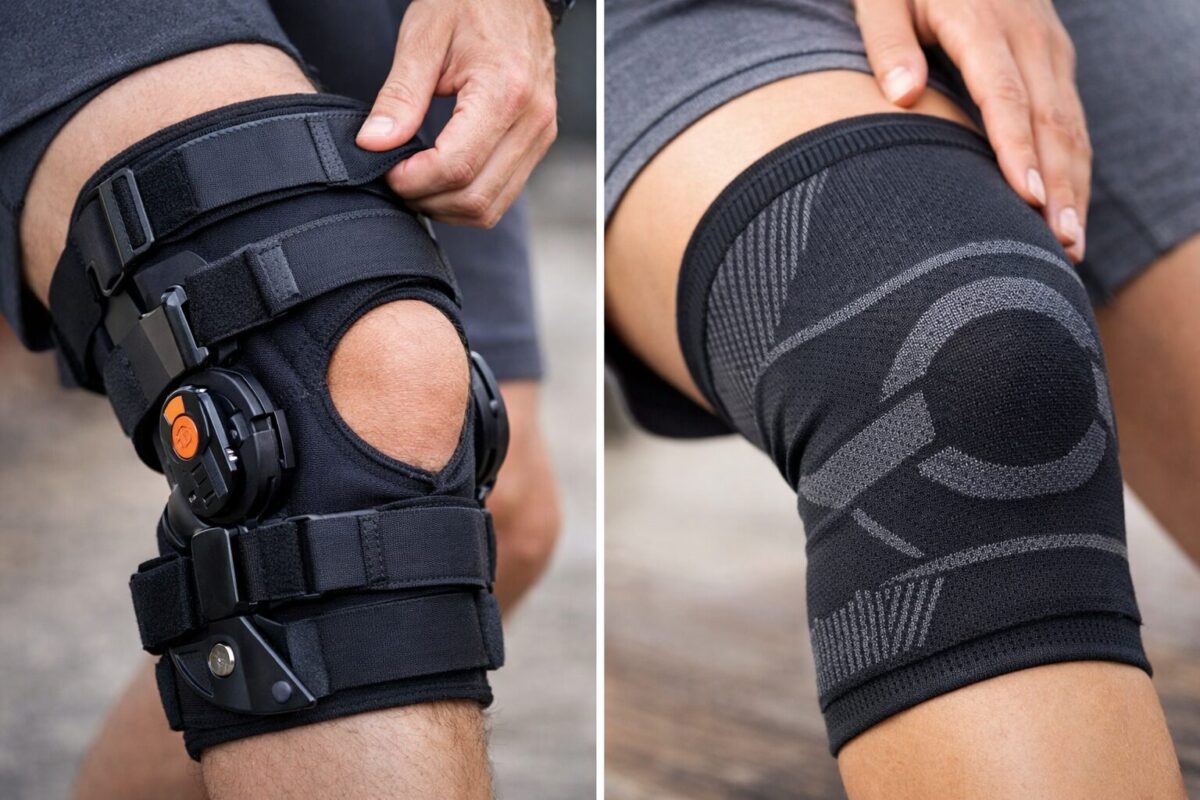
A compression sleeve is very different from a hinged brace. An OA unloader brace is different again. Some supports are designed mainly for compression and warmth, while others are intended to provide mechanical support or redistribute load within the knee.
This guide explains the main types of knee supports, what each is designed to do, what to look for when buying one, and how the seven Amazon-available options below differ.
Quick Answer: Which Knee Support Is Right for You?
There is no single knee brace that is best for everyone with arthritis.
As a starting point:
| If your main problem is… | A support to consider |
|---|---|
| Mild stiffness, swelling, or discomfort | Compression sleeve |
| Knee pain but the joint feels stable | Compression sleeve or lighter support |
| Knee feels unstable or occasionally gives way | Hinged brace |
| You need more lateral support during activity | Hinged brace |
| Arthritis mainly affects one compartment of the knee | OA unloader brace |
| Front-of-knee symptoms or kneecap-related discomfort | Patellar/patellofemoral support |
| Difficulty pulling a sleeve over your foot | Wraparound brace |
| You want a simple, inexpensive option | Compression sleeve |
Important: If your knee repeatedly buckles, locks, becomes significantly swollen, or is becoming progressively more painful, a brace should not be used as a substitute for finding out why. A physiotherapist, doctor, or other qualified healthcare professional can help determine whether the problem is arthritis, instability, an injury, or something else.
For people with knee osteoarthritis whose pain, walking, or joint stability warrants an assistive device, the American College of Rheumatology/Arthritis Foundation guideline recommends tibiofemoral knee bracing, provided the person can tolerate the inconvenience and burden of wearing a brace. Patellofemoral bracing is conditionally recommended for patellofemoral knee OA.
Knee Sleeve vs. Knee Brace: What’s the Difference?
The terms knee sleeve and knee brace are often used interchangeably when shopping online, but they can describe very different products.
Knee Sleeves
A knee sleeve is generally a flexible, pull-on support made from materials such as elastic fabric or neoprene.
Depending on the design, a sleeve may provide:
- Gentle compression
- Warmth
- A feeling of support during movement
- Proprioceptive feedback—the sensation that helps you recognize where your knee is positioned
- A relatively slim profile under clothing
Sleeves are often worth considering when the knee is uncomfortable but does not feel unstable.
They are also convenient for people who want something simple for walking, standing, or everyday activities.
The limitation: a basic compression sleeve does not provide the same structural support as a hinged brace.
Hinged Knee Braces
Hinged braces add a more rigid structure around the knee, usually with hinges positioned along the sides.
They can be useful when the main issue is stability or unwanted side-to-side movement, rather than simply wanting compression.
Many hinged braces are also wraparound designs, which can make them easier to put on than a tight pull-on sleeve.
OA Unloader Braces
An OA unloader brace is designed for a more specific situation: osteoarthritis that predominantly affects one compartment of the knee.
These braces use a mechanical design intended to redistribute forces within the knee rather than simply compressing it.
They are more specialized than ordinary sleeves and hinged braces, and correct fitting is particularly important.
Types of Knee Supports for Arthritis
Compression Sleeves
Best suited to: mild pain, stiffness, swelling, warmth, and everyday support.
Compression sleeves are generally the simplest option. They are relatively lightweight and discreet, although some people find tighter sleeves difficult to pull over a swollen knee or foot.
Hinged Braces
Best suited to: people who need more support because the knee feels unstable or because they want additional support during activity.
A hinged brace can provide more mechanical support than a sleeve while still allowing the knee to bend.
OA Unloader Braces
Best suited to: osteoarthritis that primarily affects the medial or lateral compartment of the knee.
An unloader brace is a more specialized choice. The goal is to alter how load is distributed through the knee rather than simply squeezing the joint.
The evidence for unloader braces is not uniformly positive, and studies have used different brace designs and treatment schedules. A 2024 scoping review found substantial variation among knee-bracing studies and noted inconsistent findings and guideline recommendations overall.
Patellar or Patellofemoral Supports
Best suited to: certain types of front-of-knee or kneecap-related symptoms.
These braces are designed around the patella and are different from a brace intended to stabilize the entire knee.
If you have been diagnosed with patellofemoral osteoarthritis, this category may be worth discussing with a healthcare professional.
Wraparound Braces
Best suited to: anyone who has difficulty pulling a tight sleeve over the foot or knee.
Wraparound designs use straps or hook-and-loop closures rather than requiring the entire brace to be pulled over the foot.
For someone living with hand arthritis, this can be an important consideration. A brace that provides excellent support but is frustrating or painful to put on may not be practical for everyday use.
How to Choose a Knee Brace for Arthritis
Instead of starting with the most supportive brace you can find, start with the problem you are trying to solve.
1. Consider Stability
Ask yourself:
- Does my knee generally feel stable?
- Does it sometimes buckle or give way?
- Do I feel insecure on stairs?
- Does the knee feel worse during turning or sideways movements?
A compression sleeve may be sufficient when the knee is uncomfortable but stable. Repeated buckling or significant instability deserves more attention than simply choosing a stronger brace.
2. Consider Where the Pain Is
Where you feel pain can provide useful information.
For example, arthritis affecting one compartment of the knee may lead someone to consider an OA unloader brace, while a person whose main complaint is generalized stiffness may prefer a simpler sleeve.
Pain location alone cannot diagnose which type of arthritis you have, however.
3. Think About How You Will Put It On
This is particularly important if you have arthritis in your hands.
Pull-on sleeves require enough grip and hand strength to stretch the material over the leg. Wraparound braces may be easier because the support opens and closes around the knee.
Look at:
- Strap size
- Closure type
- Number of straps
- How much adjustment is required
- Whether you can fasten it without excessive finger force
4. Think About When You Will Wear It
A brace for a short walk does not necessarily need the same characteristics as one you hope to wear during several hours of activity.
Consider whether you need the support for:
- Walking
- Stairs
- Gardening
- Hiking
- Exercise
- Work
- Standing
- Occasional flare-ups
5. Check the Sizing Instructions Carefully
Knee braces do not have standardized sizing.
One manufacturer’s medium may be quite different from another manufacturer’s medium.
Follow the specific measurement instructions provided for the product rather than assuming your usual clothing size will work.
6. Consider Bulk and Heat
More structure often means more material.
A heavy hinged brace may provide features you need but can also be warmer, bulkier, and more noticeable underneath clothing than a compression sleeve.
For some people, the most practical brace is the one they can comfortably put on and actually use.
Best Knee Braces & Supports Compared
The seven products below cover several different categories rather than seven versions of the same brace.
| Product | Type | Support | Main reason to consider it |
|---|---|---|---|
| Orthomen OA Unloader Knee Brace | OA unloader | High | Single-compartment knee OA |
| Shock Doctor Ultra Hinged Knee Brace | Hinged wraparound | Moderate–High | Activity and additional stability |
| Z1 K2 Hinged Knee Brace | Heavy-duty hinged | High | More substantial instability support |
| McDavid 429X Knee Brace | Hinged | Moderate–High | Stability for activity and everyday use |
| Vive Hinged Knee Brace | Hinged | Moderate | Everyday hinged support at a lower price point |
| Dr. Arthritis Compression Sleeve | Compression sleeve | Mild | Mild symptoms and simple daily support |
| Modvel Compression Sleeve 2-Pack | Compression sleeve | Mild | Budget-friendly sleeve rotation |
1. Orthomen OA Unloader Knee Brace
Best suited to: people with osteoarthritis primarily affecting one compartment of the knee.
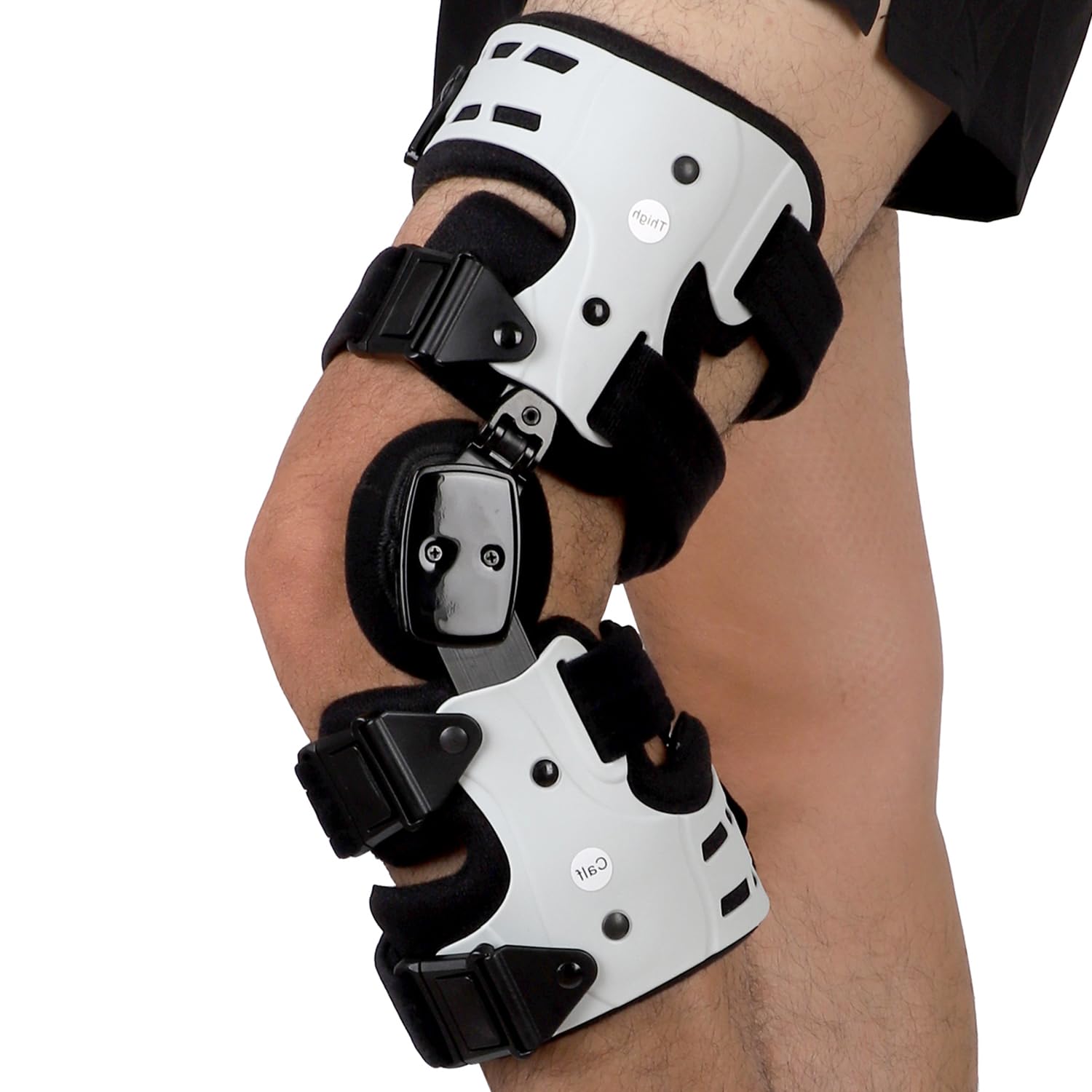
An OA unloader brace is a different type of knee support from a standard compression sleeve or hinged brace. Its purpose is to alter how forces are distributed through the knee.
The Orthomen design is intended for medial or lateral compartment osteoarthritis and uses an adjustable brace structure rather than relying on compression alone.
This makes it a more specialized option for someone whose knee problem fits that pattern.
Consider it if:
- You have been diagnosed with compartment-specific knee OA
- Your symptoms are concentrated more on one side of the knee
- You need more than the compression provided by a sleeve
- You are willing to spend more time getting the fit right
Potential drawbacks:
- More complicated than a sleeve
- Bulkier than a compression support
- Proper positioning and adjustment matter
- May not be appropriate for arthritis affecting the knee more generally
2. Shock Doctor Ultra Hinged Knee Brace
Best suited to: people looking for a wraparound hinged brace for activity and additional knee support.
The Shock Doctor Ultra Hinged Knee Brace uses a wraparound design with side hinges. Compared with a pull-on sleeve, the wraparound format can be easier to position and adjust.
That may be particularly useful if pulling a tight sleeve over the foot is difficult because of hand arthritis or limited mobility.
The hinged construction makes this a more substantial support than a compression sleeve, while still allowing the knee to bend.
Consider it if:
- You want a hinged rather than compression-only support
- You are active and want additional stability
- A wraparound design is easier for you to put on
- You need more support than a sleeve provides
Potential drawbacks:
- More noticeable than a sleeve
- Straps require some hand dexterity
- May feel warm during extended wear

3. Z1 K2 Hinged Knee Brace
Best suited to: people who need a more substantial hinged support.
The Z1 K2 is a larger, heavy-duty hinged brace intended for situations where a simple sleeve or lightweight support is not enough.
Its rigid hinged structure provides considerably more support than a compression sleeve.
That extra structure comes with trade-offs, however. A brace of this type is bulkier and can be more complicated to put on and adjust.
Consider it if:
- You need substantial mechanical support
- Your knee has significant instability
- You are looking for a heavier-duty hinged design
Potential drawbacks:
- Bulkier than lighter braces
- More noticeable under clothing
- More involved to put on correctly
If your knee frequently gives way, it is worth addressing the underlying cause rather than simply moving to a heavier brace.

4. McDavid 429X Hinged Knee Brace
Best suited to: people who want a hinged brace for activity and everyday stability.
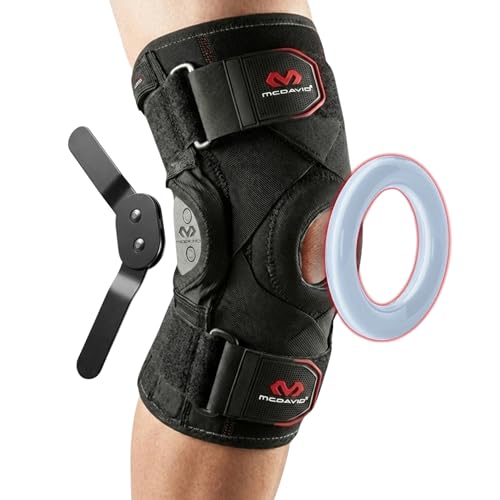
The McDavid 429X uses a hinged design with adjustable straps. It sits between a simple compression sleeve and a more substantial heavy-duty brace.
For someone who wants more structure than a sleeve but does not want to start with the largest brace available, this type of design can be worth considering.
Consider it if:
- You want hinged support
- You need something for both daily activity and exercise
- Adjustable straps are preferable to a pull-on design
- You want a middle-ground option between a sleeve and heavier brace
Potential drawbacks:
- More bulky than a sleeve
- May become warm during extended use
- Provides less substantial support than some heavy-duty designs
5. Vive Hinged Knee Brace
Best suited to: people looking for an everyday hinged support without moving to a more specialized OA brace.
The Vive Hinged Knee Brace uses a wraparound format with side hinges. The design makes it possible to adjust the fit around the knee rather than pulling the entire brace over the foot.
That can be useful for people who find tight pull-on sleeves difficult to manage.
It is a more straightforward option for someone who wants hinged support for everyday activities.
Consider it if:
- You want a hinged brace for daily use
- A wraparound design is easier for you to handle
- You want a simpler alternative to a specialized unloader brace
Potential drawbacks:
- Not intended to replace a professionally fitted brace when substantial instability requires assessment
- Bulkier than a sleeve
- Hook-and-loop closures can require hand dexterity

6. Dr. Arthritis Compression Sleeve
Best suited to: people who want a simple compression sleeve for mild symptoms, stiffness, or swelling.
The Dr. Arthritis Compression Sleeve is considerably simpler than the hinged and unloader braces in this guide.
Its main appeal is the convenience of a lightweight sleeve rather than mechanical stabilization.
The open-patella design is also worth noting for people who prefer a sleeve that does not completely cover the kneecap.
Consider it if:
- Your knee generally feels stable
- You want compression rather than a hinged structure
- You prefer something relatively discreet under clothing
- You want a simpler option for everyday use
Potential drawbacks:
- Does not provide the structural support of a hinged brace
- Pull-on design may be difficult for some people with hand arthritis
- May not be enough when instability is the main problem

7. Modvel Compression Sleeve 2-Pack
Best suited to: people looking for a lower-cost way to have more than one compression sleeve.
The Modvel option is a two-pack, which can be practical if you want one sleeve available while another is being washed.
Like the Dr. Arthritis sleeve, this is a compression product rather than a structural hinged brace.
That makes it more appropriate for someone looking for mild support, compression, or a simple everyday option rather than someone dealing with significant instability.
Consider it if:
- You want two sleeves for rotation
- Your symptoms are relatively mild
- You prefer a simple pull-on design
- You want to keep the cost of having multiple sleeves down
Potential drawbacks:
- Not intended for significant instability
- Pull-on design may be difficult for some people with hand arthritis
- A compression sleeve cannot provide the same mechanical support as a hinged brace

How Long Should You Wear a Knee Brace?
There is no universal number of hours that applies to every knee brace.
The appropriate wearing schedule depends on the brace, why you are using it, your symptoms, and the manufacturer’s instructions.
A practical approach is to use the brace when it provides a useful benefit—such as during walking or an activity that causes discomfort or instability—rather than assuming that wearing it continuously is always better.
Pay attention to how your knee and skin respond.
Remove or adjust the brace if you develop:
- Increasing pain
- Numbness or tingling
- Skin irritation
- Pressure sores
- Excessive swelling
- Changes in circulation
- Significant discomfort from the brace itself
A brace should be a tool that helps you move, not something you have to tolerate regardless of how it feels.
Does a Knee Brace Weaken Your Muscles?
This is a common warning you’ll see online, but the issue is more complicated than simply saying that wearing a brace causes muscle weakness.
Research on knee bracing in osteoarthritis has used many different brace types and wearing schedules, and the evidence is not consistent enough to support a simple rule that wearing a brace automatically weakens the muscles. A 2024 review found substantial variation among studies and noted that the evidence surrounding knee bracing remains heterogeneous.
The more useful takeaway is that a brace should not be viewed as a replacement for appropriate movement and strengthening.
If you need a brace to walk more comfortably, using it may allow you to stay active. If you are relying on a brace because your knee repeatedly buckles, however, it is also worth having the underlying problem assessed.
When a Knee Brace May Not Be Enough
A knee brace can be useful for symptom management, but it cannot diagnose the reason your knee hurts or gives way.
Consider getting professional advice if:
- Your knee repeatedly buckles or gives way
- Your knee locks or catches
- You have substantial or persistent swelling
- Pain is getting progressively worse
- You cannot put normal weight on the leg
- Symptoms began after a significant injury
- You are uncertain which part of the knee is affected
- You are considering an OA unloader brace but have not been diagnosed with compartment-specific OA
This is especially important when instability is new or worsening.
Can a Knee Brace Help Arthritis Pain?
It can help some people, but results vary by brace type and by the individual.
The evidence base is not as simple as “braces work” or “braces don’t work.” Studies have evaluated many different designs, including sleeves, hinged braces, patellofemoral braces, and valgus/varus unloader braces. A 2024 scoping review identified 31 randomized trials involving 47 different bracing interventions and found substantial variation between studies.
The ACR/Arthritis Foundation guideline specifically recommends tibiofemoral knee braces for people with knee OA when pain, walking ability, or joint stability is affected enough to warrant an assistive device and the person can tolerate the brace.
That makes the type of problem you’re trying to address more useful than simply choosing the strongest brace.
Frequently Asked Questions
Is a knee sleeve or brace better for arthritis?
Neither is universally better.
A sleeve may be enough when the knee is generally stable and you mainly want compression, warmth, or a feeling of support.
A hinged brace may make more sense when instability is an important part of the problem. An OA unloader brace is a more specialized option for certain patterns of compartment-specific knee osteoarthritis.
Should I wear a knee brace if my knee gives way?
A hinged brace may provide additional support, but repeated giving-way episodes deserve attention rather than simply being treated with a stronger brace.
If your knee frequently buckles, a healthcare professional can assess whether arthritis, ligament problems, muscle weakness, or another issue is contributing.
What is the best knee brace for arthritis on the inside of the knee?
If you have been diagnosed with medial compartment osteoarthritis, an OA unloader brace may be worth discussing because these braces are designed to redistribute load within the knee.
A compression sleeve may be sufficient if your symptoms are mild and the knee remains stable.
Can I wear a knee brace while waiting for knee replacement?
Some people use knee braces to help manage symptoms and remain mobile while waiting for surgery.
An unloader brace may be considered when osteoarthritis is concentrated in one compartment of the knee. Your orthopedic specialist or physiotherapist can help determine whether that type of brace is appropriate for you.
How do I measure my knee for a brace?
Follow the measurements specified by the manufacturer.
Depending on the product, you may be asked to measure around the knee, above the knee, or below the knee. Do not assume that the same measurement works for every brand.
If your knee is swollen, consider measuring according to the manufacturer’s instructions at a time that represents your usual knee size.
Can I exercise while wearing a knee brace?
Some braces are specifically designed to be used during activity, while others may be intended for different purposes.
Follow the manufacturer’s instructions and pay attention to how your knee responds.
A brace should not be used to push through significant pain or to ignore repeated instability.
Are hinged braces better than compression sleeves?
They serve different purposes.
A compression sleeve is simpler and generally provides compression and a feeling of support. A hinged brace adds a structural component and may be more appropriate when stability is an important concern.
More support is not automatically better if you do not need it.
Bottom Line
The best knee support for arthritis is the one that addresses the specific problem you’re trying to solve without creating new problems of its own.
For a stable knee with mild stiffness or swelling, a compression sleeve may be a sensible starting point.
For instability or a need for additional mechanical support during activity, a hinged brace may be more appropriate.
For osteoarthritis concentrated in one compartment of the knee, an OA unloader brace is a more specialized option worth discussing with a physiotherapist or other healthcare professional.
And if a brace is difficult to put on because of hand arthritis, don’t overlook the importance of the closure system. A wraparound brace may be much more practical than a tight pull-on sleeve.
Knee braces are tools—not cures. The goal is to find a support that helps you move more comfortably while still paying attention to the underlying knee problem and maintaining appropriate activity and strengthening.
Related Reading
- Low-Impact Exercises for Knee Arthritis
- Best Knee Massagers for Arthritis & Knee Pain
- Best Hand Relief Tools for Arthritis
- Guide to Living Well with Arthritis
Medical Disclaimer: This article is for informational purposes only and does not constitute medical advice. Always consult your doctor, rheumatologist, or occupational therapist before making changes to how you manage your arthritis.
