

Yoga can be a useful way to add gentle movement, flexibility work, strength, balance, and relaxation to an arthritis-friendly routine.
But yoga for arthritis isn’t about forcing your body into difficult poses.
The most useful approach is to choose a style that matches your abilities, modify positions that put too much stress on painful joints, and work within a comfortable range of motion.
Research suggests yoga may help some people with arthritis improve pain, stiffness, physical function, flexibility, and quality of life. The evidence is more encouraging for some conditions, such as knee osteoarthritis, than others, and the type of yoga used in studies varies considerably.
This guide explains how yoga may fit into an arthritis exercise routine, which styles are worth considering, which poses can be modified, how to get started, and when chair yoga may be a better option.
Quick Answer: Is Yoga Good for Arthritis?
Yoga can be a useful complementary form of exercise for many people with arthritis, particularly when the practice is modified to accommodate painful or stiff joints.
Potential benefits include:
- Improved flexibility and range of motion
- Better physical function
- Gentle muscle strengthening
- Improved balance and body awareness
- Reduced stress and tension
- Possible improvements in pain and stiffness
- A low-impact way to stay active
However, yoga isn’t a cure for arthritis and shouldn’t replace prescribed treatment.
The Arthritis Foundation notes that yoga can improve flexibility, physical function, strength, balance, and relaxation for people with arthritis when appropriately modified.
How Yoga May Help When You Have Arthritis
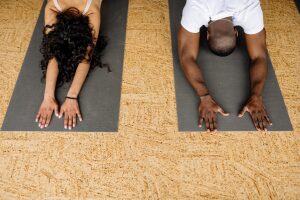
Yoga combines several things that can be useful for people with arthritis: physical movement, stretching, strengthening, breathing, and relaxation.
You don’t have to use every part of yoga to benefit from the practice.
1. Flexibility and Range of Motion
Stiff joints can make everyday movements more difficult.
Gentle yoga movements take joints through controlled ranges of motion while also stretching surrounding muscles.
Over time, regular flexibility work may help you maintain or improve your comfortable range of motion.
The goal isn’t to achieve a perfect pose.
A smaller, comfortable movement is often a better choice than forcing a stiff joint farther than it wants to go.
2. Physical Function
Exercise is an important part of managing arthritis.
Yoga can combine mobility with some strength and balance work, potentially making everyday movements easier.
Research on knee osteoarthritis has found that yoga may improve physical function as well as pain and stiffness, although the evidence isn’t considered high quality enough to guarantee the same result for everyone.
3. Strength and Support
Some yoga poses require your muscles to support your body.
Standing poses, modified chair poses, bridges, and other appropriately selected movements can provide light-to-moderate strengthening.
For someone with arthritis, strengthening the muscles around an affected joint can be an important part of staying active.
Yoga shouldn’t necessarily be your only form of strength training, however.
If you need significant strengthening for a particular joint, a physical therapist can help you develop a more targeted program.
4. Balance and Body Awareness
Yoga can involve controlled weight shifting, standing positions, and attention to posture.
That can make it useful as part of a broader approach to balance.
If you have significant balance problems, don’t assume that a standing yoga pose is automatically appropriate. Use a wall, sturdy chair, or other appropriate support, and consider working with a qualified instructor.
5. Stress and Relaxation
Living with persistent pain can be stressful.
Yoga’s breathing and relaxation components may help some people manage stress and improve their sense of well-being.
This doesn’t mean yoga directly treats the underlying arthritis.
Instead, relaxation may help you cope with symptoms and make physical activity more comfortable and sustainable.
What Does the Research Say?
The research on yoga and arthritis is encouraging but not as simple as saying “yoga reduces arthritis pain.”
For knee osteoarthritis, NCCIH reports that a 2019 review of nine studies involving 640 people found yoga may improve pain, function, and stiffness, although the studies were relatively small and the evidence quality was limited. A 2024 systematic review and meta-analysis also found that yoga may reduce pain and stiffness and improve physical function in people with knee osteoarthritis.
For rheumatoid arthritis, the evidence is less certain. Some studies have found improvements in physical or psychological outcomes, but there are fewer high-quality studies, so it isn’t possible to make the same level of claim about pain relief.
One reason the research can be difficult to interpret is that “yoga” isn’t one standardized exercise program.
Studies may use different styles, poses, session lengths, instructors, and levels of modification.
That means the results of one yoga study shouldn’t automatically be applied to every yoga class or online routine.
Which Type of Yoga Is Best for Arthritis?
There isn’t one yoga style that is universally best for everyone with arthritis.
For many beginners, the most practical choices are forms that emphasize controlled movement, modifications, and support.
Chair Yoga
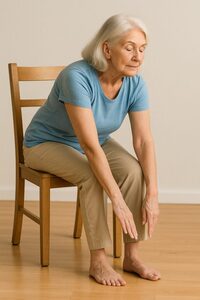
Chair yoga performs many movements while seated or uses a chair for support.
It can be particularly useful if you have:
- Difficulty getting onto the floor
- Limited mobility
- Balance concerns
- Pain with kneeling
- Difficulty standing for long periods
Our focused guide:
Chair Yoga for Arthritis: 10 Gentle Exercises for Stiff Joints and Mobility
That article provides a complete seated routine rather than repeating it here.
Gentle or Hatha Yoga
Gentle Hatha-style classes can provide a mixture of standing, seated, and supported poses.
Look for an instructor who is comfortable modifying poses for people with arthritis rather than assuming every participant can perform the standard version.
Restorative Yoga
Restorative yoga uses supported positions and generally emphasizes relaxation rather than strenuous movement.
It may appeal to people who want a slower practice, although individual poses still need to be appropriate for your joints.
Iyengar Yoga
Iyengar yoga places considerable emphasis on alignment and the use of props.
The Arthritis Foundation notes that modified Iyengar yoga has been studied in people with arthritis and that props can help make poses more accessible.
Styles to Approach More Carefully
Not every yoga class is appropriate for someone with painful or stiff joints.
If you’re new to yoga or have significant arthritis, be cautious about jumping into classes emphasizing:
- Extreme flexibility
- Rapid transitions
- Advanced inversions
- Long periods of weight-bearing through painful wrists
- Hot environments
- Forceful breathing
- Difficult balance positions
You don’t need an advanced class to receive the potential benefits of yoga.
6 Arthritis-Friendly Yoga Poses to Consider
The following aren’t meant to form a complete yoga class. They’re examples of movements that can often be modified for people with arthritis.
If a particular position isn’t comfortable for you, choose a different movement.
1. Cat-Cow
Cat-Cow moves the spine between gentle rounded and extended positions.
It can be performed on hands and knees or modified while seated.
Chair modification: Perform the movement with your hands on your thighs while sitting in a sturdy chair.
This is particularly useful if kneeling or putting weight through your hands is uncomfortable.
2. Seated Spinal Twist
Sit upright with both feet supported.
Slowly rotate your upper body to one side, return to center, and repeat on the other side.
Don’t pull yourself deeper into the twist.
A small rotation is enough.
3. Standing Side Bend
Stand near a sturdy support if necessary.
Raise one arm only as far as comfortable and gently lean to the opposite side.
You should feel movement through your side rather than a sharp sensation in your shoulder or back.
If standing isn’t appropriate, use a seated side stretch instead.
4. Supported Bridge
A bridge can work the hips and back while lying on the floor.
If getting onto the floor is difficult, skip this pose rather than forcing yourself into it.
A physical therapist or experienced instructor can suggest a standing or seated alternative.
5. Gentle Forward Hinge
Instead of trying to touch your toes, sit or stand tall and hinge forward slightly from your hips.
Stop well before the movement becomes uncomfortable.
This is about comfortable movement, not flexibility testing.
6. Gentle Breathing
Sit comfortably with your shoulders relaxed.
Breathe in slowly and breathe out slowly without forcing either breath.
A few minutes of relaxed breathing can be a simple way to finish a yoga session or take a break during the day.
You Don’t Need to Be Flexible to Start Yoga
One of the biggest misconceptions about yoga is that you need to be flexible before you begin.
You don’t.
Yoga can be modified specifically because people have different levels of flexibility, strength, balance, and mobility.
A person with arthritis may need to:
- Bend the knee less
- Keep the hands higher
- Use a chair
- Use blocks or straps
- Avoid kneeling
- Shorten the range of motion
- Skip a particular pose
- Take more rest breaks
These aren’t failures.
They’re modifications.
The Arthritis Foundation specifically recommends choosing instructors who understand arthritis and can adjust poses to reduce unnecessary strain on vulnerable joints.
How to Start an Arthritis-Friendly Yoga Routine
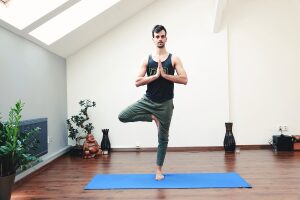
You don’t need to begin with a 60-minute class.
Step 1: Decide What You Want From Yoga
Your goal might be:
- Better flexibility
- More physical activity
- Gentle strengthening
- Balance practice
- Relaxation
- A way to move on days when conventional exercise feels difficult
Knowing your goal makes it easier to choose the right style.
Step 2: Start With a Short Session
Try 5 to 10 minutes at first.
If that feels comfortable, gradually increase the amount of time.
There’s no advantage to forcing yourself through a long session that leaves your joints unhappy.
Step 3: Use Support
A sturdy chair, wall, yoga block, strap, or folded blanket may make a movement easier to perform.
Props aren’t “cheating.”
They’re tools for adapting the exercise to your body.
Step 4: Modify Before You Need To
Don’t wait until a pose hurts before changing it.
If you already know that kneeling bothers your knees, use a chair-based alternative.
If putting weight on your hands hurts your wrists, choose a seated or standing modification.
Step 5: Pay Attention to Your Response
Notice how you feel during the session and later in the day.
If an exercise repeatedly causes significant or persistent pain, change or remove it.
A Simple 10-Minute Beginner Yoga Routine
If you want a very simple starting point, try:
Minute 0–1: Comfortable breathing
Minute 1–3: Gentle shoulder and neck movements
Minute 3–5: Cat-Cow, seated or on a comfortable surface
Minute 5–7: Seated side stretch and gentle spinal rotation
Minute 7–9: Gentle leg movement or supported standing poses
Minute 9–10: Relaxed breathing
If floor positions aren’t practical, perform the entire routine from a chair.
For a more detailed seated sequence, use our Chair Yoga for Arthritis guide.
What If You Have an Arthritis Flare?
You don’t have to treat exercise as an all-or-nothing decision.
During a flare, you may need to:
- Reduce the duration
- Reduce the number of repetitions
- Use a chair
- Avoid painful joints
- Reduce the range of motion
- Focus on breathing and relaxation
- Take a rest day
The Arthritis Foundation advises people not to overtax a joint that is flaring and recommends appropriate modifications.
If a joint is significantly swollen, hot, or unusually painful, don’t try to “stretch through” the problem.
If you’re uncertain whether movement is appropriate during your flare, ask your healthcare provider.
Yoga Safety for People With Arthritis
Yoga is generally considered a relatively low-impact form of exercise, but low-impact does not mean risk-free.
NCCIH notes that sprains and strains are among the more common yoga-related injuries and that older adults and people with health conditions may need to modify certain poses.
Keep these precautions in mind:
Use a stable support
Don’t rely on an unstable chair, lightweight table, or piece of furniture that can move.
Don’t force a joint
Avoid bouncing, pushing, or forcing a stiff joint into a deeper position.
Don’t chase the “perfect” pose
The standard yoga pose may not be the right version for your body.
Be careful with balance poses
Use a wall or sturdy support if balance is uncertain.
Don’t ignore sharp pain
Stop if you experience sharp, sudden, or significantly increasing pain.
Be cautious with hot yoga
Hot environments can create additional concerns, including overheating and dehydration. NCCIH specifically advises caution with hot yoga.
When Should You Talk With a Healthcare Professional?
Consider getting professional guidance before beginning yoga if you have:
- Significant balance problems
- A recent injury or surgery
- Major joint instability
- Significant spinal problems
- Severe or unexplained pain
- A condition that limits physical activity
- Questions about exercising during an arthritis flare
People with rheumatoid arthritis or other inflammatory arthritis may need particular modifications depending on which joints are affected.
A physical therapist can also help if you want yoga to complement a more structured strengthening or mobility program.
How to Find a Yoga Instructor Who Understands Arthritis
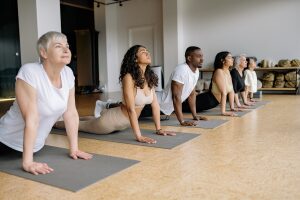
A general yoga instructor may be excellent at teaching yoga but may not understand the limitations caused by arthritis.
If you’re attending a class, ask whether the instructor has experience working with people who have arthritis or other mobility limitations.
A good instructor should be comfortable saying:
- “Use a chair instead.”
- “Reduce the range of motion.”
- “Skip that pose.”
- “Use a block.”
- “You don’t need to go as deeply.”
The Arthritis Foundation recommends finding an instructor who understands arthritis and can modify poses to reduce stress on affected joints.
If an instructor repeatedly pushes you to work through joint pain or insists everyone perform a pose the same way, that may not be the right class for you.
Yoga Props: What Do You Actually Need?
You don’t need a large collection of yoga equipment.
For most beginners, the basics may include:
| Prop | Why it may be useful |
|---|---|
| Yoga mat | Provides a more comfortable, non-slip surface |
| Yoga block | Brings the floor closer to you |
| Yoga strap | Provides additional reach in some poses |
| Sturdy chair | Useful for seated yoga and balance support |
| Folded blanket | Adds cushioning or support |
| Bolster | Provides support during restorative positions |
The important word is may.
If a prop doesn’t make an exercise more comfortable or accessible, you don’t necessarily need it.
Yoga vs. Chair Yoga for Arthritis
These two approaches overlap, but they’re not identical.
| Yoga | Chair yoga |
|---|---|
| May include standing, seated, kneeling, and floor positions | Primarily seated or chair-supported |
| Offers a wider range of poses | Focuses on accessibility and support |
| Can include more weight-bearing exercise | Reduces the need for floor transitions |
| May require greater balance or mobility | Useful when standing or floor work is difficult |
| Can be adapted with props | Naturally uses the chair as a support |
If getting onto the floor is difficult, start with chair yoga.
You can always explore other forms of yoga later.
Can Yoga Replace Walking or Strength Training?
Not necessarily.
Yoga can be one part of an overall exercise routine.
Walking or another aerobic activity can provide cardiovascular exercise, while strength training can provide more targeted resistance.
Yoga can contribute flexibility, balance, strength, movement, and relaxation depending on the style and routine.
Think of yoga as one useful tool in your exercise toolbox, rather than something that has to replace everything else.
Frequently Asked Questions
What type of yoga is best for arthritis?
There isn’t one universally best style.
Gentle, restorative, Hatha, Iyengar, and chair yoga can all be adapted for people with arthritis. The instructor’s ability to modify poses may be just as important as the name of the style.
Can yoga reduce arthritis pain?
It may help some people.
Research suggests potential improvements in pain, stiffness, and physical function, particularly in knee osteoarthritis, but results vary and yoga should be considered a complement to—not a replacement for—appropriate arthritis treatment.
Can yoga reduce inflammation?
It’s too strong to say that yoga directly treats or reduces the inflammation caused by arthritis.
Some studies have reported changes in inflammatory markers, but the evidence is not strong enough to present yoga as an anti-inflammatory treatment.
A more reliable reason to practice yoga is its combination of physical activity, mobility work, strength, balance, and relaxation.
How often should I practice yoga?
Start with a schedule you can maintain.
For a beginner, short sessions a few times a week can be a reasonable starting point.
You can gradually increase frequency or duration if your body responds well.
Is yoga safe for rheumatoid arthritis?
Yoga may be appropriate for some people with rheumatoid arthritis, but it should be modified according to your affected joints, mobility, and current symptoms.
Research on yoga specifically for RA remains limited and mixed.
If you’re uncertain which movements are appropriate, ask your rheumatologist or physical therapist.
Do I need to be flexible to do yoga?
No.
You can modify poses to fit your current flexibility.
The purpose of an arthritis-friendly practice isn’t to imitate the deepest version of a pose.
Is chair yoga easier than regular yoga?
For many people with limited mobility, chair yoga can be more accessible because it reduces floor transitions and provides additional support.
It can still provide meaningful movement and mobility work.
Can I do yoga during an arthritis flare?
Possibly, but you may need to reduce or change your routine.
Avoid forcing painful joints and don’t assume that every yoga pose is appropriate during a flare.
If symptoms are severe or you’re unsure what is safe for you, seek professional advice.
Bottom Line: Make Yoga Fit Your Body
Yoga doesn’t have to mean complicated poses, extreme flexibility, or sitting on the floor.
For someone with arthritis, it can simply mean gentle movement, appropriate strengthening, breathing, balance, and relaxation adapted to your abilities.
Start with a style that feels manageable.
Use props when they help.
Modify poses without hesitation.
And remember that the goal isn’t to look like a yoga instructor.
The goal is to find a form of movement that helps you stay active without unnecessarily aggravating your joints.
If floor-based yoga isn’t practical, start with our Chair Yoga for Arthritis: 10 Gentle Exercises for Stiff Joints and Mobility guide.
Practical tools. No hype.
Related Reading
Chair Yoga for Arthritis: 10 Gentle Exercises for Stiff Joints and Mobility
A dedicated seated routine for people who prefer chair-based exercise or have difficulty getting onto the floor.
Arthritis Exercise Guide: Safe Exercises for Strength, Mobility & Pain Relief
Explore different types of exercise and ways to stay active with arthritis.
Best Exercise Equipment for Arthritis: Tools for Strength, Mobility & Cardio
Practical equipment for making home exercise more accessible.
How to Sleep Better With Arthritis: Tips and Tools
Explore strategies for dealing with arthritis-related sleep difficulties.
Medical Disclaimer: This article is for informational purposes only and does not constitute medical advice. Always consult your doctor, rheumatologist, or occupational therapist before making changes to how you manage your arthritis.
