

Disclosure: As an Amazon Associate, Arthritis Wares earns from qualifying purchases at no extra cost to you. We are not paid or sponsored by any manufacturer. Affiliate links help support our work.
Choosing a walking cane for arthritis is less about finding one “best” cane and more about matching the design to the type of support you need.
A lightweight folding cane may be ideal for travel and occasional support. A freestanding cane with a wider base may be more useful if balance and stability are your main concerns. If stairs are your biggest challenge, a stair-specific cane can provide a different type of support.
In this guide, we compare three different cane designs and explain where each one fits best. We also cover cane height, grip comfort, stability, portability, and when a cane may not provide enough support.
Quick Answer: Which Cane Is Best for Arthritis?
There is no single best walking cane for everyone with arthritis. The right choice depends on where and why you need support.
- Best for travel and portability: Vive Folding Cane
- Best for balance and freestanding stability: HONEYBULL Walking Cane
- Best for stairs: Rock Steady Stair Climbing Assist Cane
If you are unsure which type you need, start with the comparison below and then consider the specific situations described later in this guide.
Quick Comparison: Best Walking Canes for Arthritis
| Cane | Best For | Main Advantage | Main Limitation | Folds? |
|---|---|---|---|---|
| Vive Folding Cane | Travel, errands and occasional support | Lightweight and compact | Not freestanding | Yes |
| HONEYBULL Walking Cane | Balance and everyday stability | Freestanding pivoting base | Bulkier than a single-tip cane | Yes |
| Rock Steady Stair Cane | Stairs and step transitions | Dual-step support | Bulkier for everyday walking | No |
Product specifications can change. Check the current manufacturer or retailer listing before purchasing.
Best Folding Cane for Travel: Vive Folding Cane
The Vive Folding Cane is the most portable option of the three. Its main advantage is convenience: it folds down for storage and transportation while still providing adjustable height and a more ergonomic handle than some basic straight canes.
It may be a good fit if you need a cane only at certain times of the day or want something easy to keep in a vehicle, bag, or luggage.
Why Consider the Vive Folding Cane?
- Folds for easier storage and transportation
- Lightweight aluminum construction
- Adjustable height
- Ergonomic handle designed to provide a more comfortable grip
- Rubber tip for traction
- Wrist strap helps keep the cane from being dropped
- Designed for users up to approximately 250 pounds
Best For
The Vive makes the most sense when portability is one of your highest priorities.
Consider it if you:
- Travel frequently
- Want a cane that can be stored in a vehicle or bag
- Need occasional rather than constant support
- Prefer a lighter cane for errands and everyday activities
- Want an adjustable cane with a more comfortable handle
What to Keep in Mind
The folding design comes with a tradeoff. The Vive does not stand on its own when you release it, and its relatively lightweight construction may not be appropriate for someone who needs substantial weight-bearing assistance.
It is better viewed as a convenient everyday or travel cane than as a heavy-duty mobility aid.
Vive Folding Cane: Pros and Cons
Pros
- Lightweight
- Folds for travel and storage
- Adjustable height
- Ergonomic handle
- Easy to carry
- Replacement cane tips are available
Cons
- Not freestanding
- Not intended for users requiring substantial weight-bearing support
- The folding mechanism adds complexity compared with a basic straight cane
Vive Folding Cane

Bottom line: The Vive is worth considering if you want a lightweight, adjustable cane that is easy to carry and store.
Best Freestanding Cane for Stability: HONEYBULL Walking Cane
The HONEYBULL is quite different from a traditional single-tip cane. Its wider, four-footed base and pivoting design are intended to provide a broader and more stable contact with the ground.
One particularly useful feature for people with arthritis is that the cane can stand upright on its own. That means you don’t necessarily have to lean it against something or bend down to retrieve it every time you let go.
Why Consider the HONEYBULL?
The HONEYBULL combines several features that can be useful for people who find conventional canes inconvenient:
- Freestanding quad-style base
- Pivoting base designed to maintain ground contact
- Ergonomic T-grip
- Adjustable height from approximately 30 to 37 inches
- Folding design for transportation
- Included travel bag
- Weight capacity of approximately 250 pounds
Freestanding Design
A conventional single-tip cane falls over when you release it.
That can be surprisingly inconvenient if bending down is difficult because of arthritis in your knees, hips, or back.
The HONEYBULL’s wider base allows it to remain upright when placed on the floor.
This can be useful when:
- Paying at a checkout counter
- Opening a door
- Sitting down
- Standing up
- Reaching for something
- Using both hands briefly
Pivoting Base
The base is designed to pivot as you walk rather than remaining completely rigid.
The goal is to keep the multiple feet of the base in contact with the ground as the cane changes angle during a normal walking stride.
This can be useful on surfaces such as flooring, carpeting, and some outdoor surfaces.
However, a wider base also makes the cane somewhat bulkier than a traditional single-tip cane.
Grip and Hand Comfort
The HONEYBULL has a contoured T-shaped handle intended to distribute pressure across the palm rather than concentrating it in a narrow gripping area.
That may be more comfortable for some people with hand arthritis, although it does not provide the same type of deep cushioning as a heavily padded or gel-style grip.
If hand pain or weak grip strength is your biggest limitation, handle shape and diameter deserve particular attention when choosing a cane.
Portability
Although the HONEYBULL has a wider base, the shaft folds into sections for transportation.
This makes it easier to take in a vehicle or store when not needed.
HONEYBULL: Pros and Cons
Pros
- Freestanding design
- Wider four-footed base
- Pivoting base
- Ergonomic handle
- Adjustable height
- Folds for transportation
- Useful when bending down to retrieve a cane is difficult
Cons
- Bulkier than a traditional single-tip cane
- Wider base may take some adjustment
- Not intended as a replacement for a walker or other higher-support mobility aid
- Approximately 250-pound weight capacity
HONEYBULL Walking Cane

Bottom line: The HONEYBULL is worth considering if balance and everyday stability are more important to you than having the lightest, most compact cane possible.
Best Cane for Stairs: Rock Steady Stair Climbing Assist Cane
The Rock Steady Stair Climbing Assist Cane addresses a different problem from the other two canes.
Rather than focusing primarily on portability or everyday walking, it is designed specifically to provide additional support when navigating stairs.
That makes it a particularly different choice for people whose biggest mobility challenge occurs between floors.
Why Consider a Stair-Specific Cane?
Stairs can be difficult when arthritis affects the knees, hips, or ankles. They also require repeated changes in balance and body position.
A standard cane provides a single point of contact with the floor. The Rock Steady uses a dual-step support design intended to provide contact across two steps.
Key Features
- Designed specifically for stair navigation
- Dual-step support
- Adjustable height of approximately 34 to 44.5 inches
- Aluminum construction
- Approximately 2 pounds, 8 ounces
- Weight capacity up to approximately 300 pounds
- Foam-covered handle
- Can also be used as a standard cane on flat surfaces
Who May Benefit From It?
The Rock Steady may be worth considering if:
- Stairs are your primary mobility challenge
- Your staircase has limited or inconvenient handrails
- You feel less stable during the transition between steps
- You want a cane specifically designed around stair navigation
What to Keep in Mind
This is not necessarily the best choice as your everyday cane.
The dual-step design makes it bulkier than a conventional cane, and it requires learning how to position it correctly on stairs.
It also should not be considered a replacement for a properly installed stair railing where a railing is needed.
If falls or significant balance problems are a concern, a physical therapist or other qualified healthcare professional can help determine whether a cane provides enough support.
Rock Steady Stair Cane: Pros and Cons
Pros
- Purpose-built for stairs
- Dual-step support
- Adjustable height
- Higher stated weight capacity than the other two options
- Can also be used on flat surfaces
Cons
- Bulkier than a standard cane
- Requires practice to use correctly on stairs
- Less convenient for extended everyday walking
- Does not replace a stair railing
Rock Steady Stair Climbing Assist Cane

Bottom line: The Rock Steady makes the most sense when stairs, rather than ordinary flat-ground walking, are the main reason you need additional support.
How to Choose the Right Cane for Your Arthritis
The most useful question isn’t simply “Which cane is best?”
Instead, ask:
What situation do I need the cane to help me with?
Choose a Folding Cane If Portability Matters Most
A folding cane is a practical choice if you:
- Need support only some of the time
- Travel or run errands frequently
- Want something that fits easily in a vehicle or bag
- Prefer a lightweight cane
- Don’t need the cane to stand upright by itself
The Vive Folding Cane fits this category.
Choose a Freestanding Cane If Stability Is Your Main Concern
A wider-base, freestanding cane may make more sense if you:
- Feel unsteady while walking
- Frequently need to release the cane
- Find bending down difficult
- Want the cane to remain upright when you put it down
- Walk on a mixture of indoor and outdoor surfaces
The HONEYBULL fits this category.
Choose a Stair Cane If Stairs Are the Problem
A stair-specific cane may be worth considering if:
- You have difficulty climbing or descending stairs
- Your staircase has limited handrail support
- You need additional stability during step transitions
The Rock Steady is designed around this particular situation.
Consider Another Mobility Aid If You Need More Support
A cane is generally intended to provide some assistance with balance and walking, not to provide complete body support.
If you need to place substantial weight through a mobility aid, have significant balance problems, or have been advised to use a walker or another device, a cane may not be the appropriate choice.
A physical therapist, occupational therapist, or other healthcare professional can help determine what type of mobility aid is appropriate for your situation.
Cane Height Matters
Even a well-designed cane can be uncomfortable or less useful if it is the wrong height.
A cane that is too tall can raise your shoulder and affect your posture. A cane that is too short can encourage you to bend or lean forward.
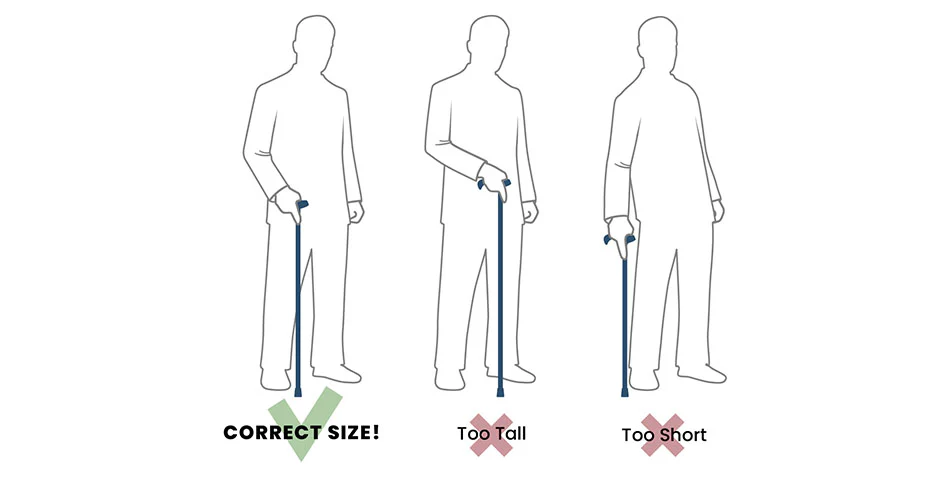
How to Check Cane Height
Stand upright in your normal walking shoes with your arms relaxed naturally at your sides.
The handle should generally line up with the crease of your wrist.
When you hold the handle, your elbow should have a slight bend rather than being completely straight.
Approximate Cane Heights
| Your Height | Approximate Cane Length |
|---|---|
| 4’10” – 5’2″ | 29″ – 31″ |
| 5’3″ – 5’6″ | 32″ – 34″ |
| 5’7″ – 5’10” | 35″ – 37″ |
| 5’11” – 6’2″ | 38″ – 40″ |
| 6’3″ and up | 41″+ |
These measurements are only starting points. Body proportions vary, so the wrist-crease method is a better way to check the fit.
For a complete walkthrough, see our guide:
How to Adjust and Use a Cane the Right Way
Which Hand Should Hold a Cane?
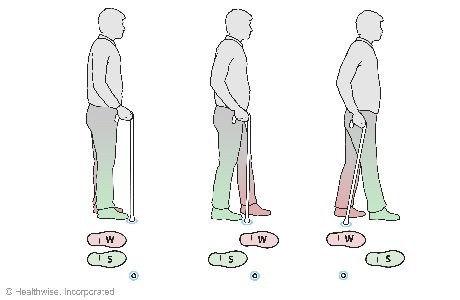
For many people, the cane is held in the hand opposite the weaker or more painful leg.
For example, if your right knee is the main problem, you would generally hold the cane in your left hand.
The cane and weaker leg move together, followed by the stronger leg.
However, gait and balance problems can vary considerably. If you’re uncertain about which hand to use, particularly after surgery or an injury, ask a physical therapist or other healthcare professional to assess your walking pattern.
Look for a Comfortable Cane Grip
Grip comfort becomes especially important when arthritis affects the hands or fingers.
When comparing canes, look for:
- A handle that fits comfortably in your hand
- A shape that doesn’t require excessive gripping force
- A diameter that feels secure without squeezing tightly
- Materials that don’t become slippery when your hands are damp
- A handle that allows you to maintain control without excessive wrist bending
A very soft handle isn’t automatically better. The shape, size, and amount of pressure needed to control the cane can matter just as much.
Don’t Ignore the Cane Tip
The cane tip is the part that actually contacts the ground, so inspect it regularly.
Look for:
- Flattened tread
- Cracks
- Uneven wear
- Hardening or deterioration of the rubber
- Reduced traction
Replace a worn tip rather than continuing to use it simply because the cane itself is still in good condition.
Cane Safety on Stairs and Uneven Ground
Extra caution is needed when using a cane on:
- Stairs
- Wet surfaces
- Snow and ice
- Loose gravel
- Uneven sidewalks
- Sloped surfaces
A cane can provide additional support, but it cannot eliminate the risk of slipping or falling.
If you regularly encounter difficult terrain or feel unstable even with a cane, it may be time to discuss whether another mobility aid would be more appropriate.
For additional strategies, see our Fall Prevention for Arthritis guide.
Frequently Asked Questions
What is the best walking cane for arthritis?
There isn’t one best cane for everyone. The best choice depends on the type of support you need. The Vive Folding Cane is geared toward portability, the HONEYBULL toward balance and freestanding stability, and the Rock Steady toward stair navigation.
Is a quad cane better than a regular cane for arthritis?
A wider-base or quad-style cane can provide more stability than a basic single-tip cane, but it is also generally bulkier. If you mainly need a lightweight cane for occasional support, a single-tip or folding cane may be more convenient.
Is a folding cane strong enough for everyday use?
A folding cane can be suitable for everyday walking when its weight rating and design match the user’s needs. However, folding canes are not automatically appropriate for people who require substantial weight-bearing support.
Are folding canes good for travel?
Yes. Portability is one of their main advantages. A folding cane can be stored more easily in luggage, a vehicle, or a bag than a full-length cane.
What cane is best for stairs?
A stair-specific cane such as the Rock Steady is designed for people who need additional support during stair navigation. However, stairs can present significant fall risks, so people with substantial balance problems should seek professional guidance rather than relying on a cane alone.
Should I use a cane on the same side as my painful knee?
Generally, a cane is held in the hand opposite the weaker or more painful leg. For example, a cane is commonly held in the left hand when the right knee is affected. Individual circumstances can vary, so a physical therapist can provide personalized guidance.
How high should my cane be?
When standing upright with your arms relaxed, the cane handle should generally align with the crease of your wrist. When holding it, your elbow should have a slight natural bend.
Can a cane help with arthritis pain?
A properly fitted cane can help reduce the amount of load placed through a painful leg and can provide additional balance support. It does not treat arthritis itself, and using the wrong cane or using it incorrectly can create additional strain.
When should I use a walker instead of a cane?
If you need substantially more stability or weight-bearing support than a cane can provide, a walker or another mobility aid may be more appropriate. A healthcare professional can help determine which device best matches your balance and mobility needs.
Final Thoughts
The best walking cane for arthritis is the one that matches how and where you need support.
For some people, that means a lightweight folding cane that is easy to take everywhere. For others, a freestanding base provides useful stability when walking or when the cane needs to be set down. And if stairs are the biggest challenge, a stair-specific design may make more sense than a conventional cane.
Our three featured options serve different purposes:
- Vive Folding Cane: Best for portability, travel, and occasional support
- HONEYBULL Walking Cane: Best for balance and freestanding stability
- Rock Steady Stair Climbing Assist Cane: Best for stairs and step transitions
Before buying, pay particular attention to cane height, handle comfort, weight capacity, base design, and the type of surfaces where you’ll use it.
If you’re unsure whether a cane provides enough support for your situation, a physical therapist or occupational therapist can assess your gait and help you choose the appropriate mobility aid.
Related Reading
- How to Adjust and Use a Cane the Right Way — Learn how to fit your cane, choose the correct hand, and use proper walking technique.
- Fall Prevention for Arthritis — Practical strategies for reducing fall risks at home and during everyday activities.
- Assistive Devices for Arthritis: A Complete Buying Guide — Compare different types of mobility and daily living aids.
Medical Disclaimer: This article is for informational purposes only and does not constitute medical advice. Always consult your doctor, rheumatologist, or occupational therapist before making changes to how you manage your arthritis.
