
Shopping for a TENS unit can be surprisingly confusing.
A quick search online reveals hundreds of devices ranging from under $30 to over $100. Many look nearly identical, with similar controls, electrode pads, treatment programs, and promises of pain relief.
If you have arthritis, you don’t necessarily need the most expensive machine or one with dozens of different settings. What matters more is finding a device that is comfortable, easy to operate, reliable, and suited to the areas where you experience pain.
TENS therapy may provide temporary pain relief for some people, although research specifically involving arthritis has produced mixed results. It isn’t a treatment for the underlying disease, but it may be worth discussing with your healthcare provider as one possible addition to your pain-management routine.
This guide explains how TENS units work, what to look for when buying one, and which features are worth paying for. We’ll also compare four popular devices to help you make a practical choice without overspending.
Quick Answer: What Should You Look for in a TENS Unit for Arthritis?
If you’re short on time, these are the features worth prioritizing:
- Rechargeable battery: Convenient and eliminates the need for disposable batteries.
- Dual-channel operation: Allows you to connect two sets of electrode pads.
- Easy-to-use controls: Important if arthritis affects your hands or fingers.
- Adjustable intensity: Lets you control the strength of the electrical stimulation.
- Available replacement pads: Helps keep long-term operating costs down.
- Different electrode pad sizes: Useful when treating different body areas.
- Clear display: Makes settings easier to read and adjust.
For most buyers, a straightforward dual-channel TENS unit with adjustable intensity and readily available replacement pads should be sufficient.
You don’t need to pay extra for dozens of treatment programs or combination features you may never use.
What Is a TENS Unit?
TENS stands for Transcutaneous Electrical Nerve Stimulation.
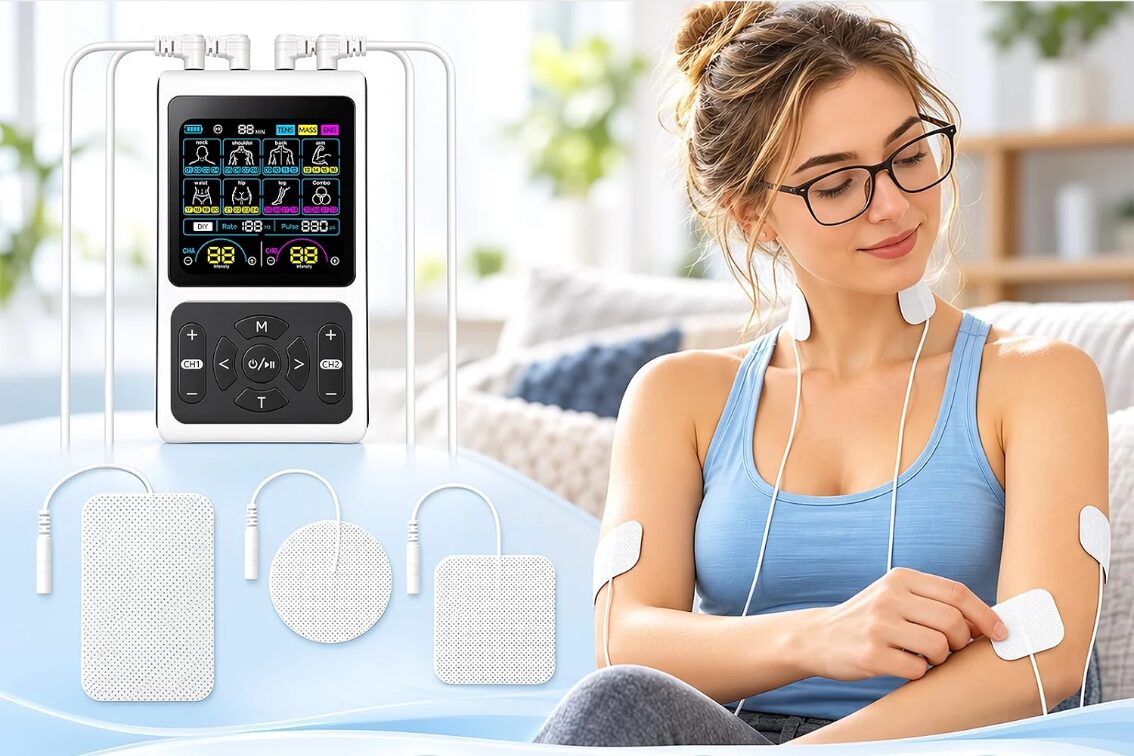
A TENS unit is a small electronic device that sends low-voltage electrical impulses through adhesive electrode pads placed on the skin.
The stimulation activates sensory nerves and may temporarily change how the body processes pain signals. Some explanations of TENS also involve the release of natural pain-relieving chemicals called endorphins.
The sensation is usually described as a mild tingling or buzzing feeling.
Most home TENS units include:
- A small handheld control unit
- Connecting wires or leads
- Adhesive electrode pads
- Adjustable intensity controls
- Several stimulation modes or programs
- A rechargeable battery or replaceable batteries
The pads are positioned on the skin near the painful area, following the manufacturer’s placement instructions.
TENS is a non-drug approach to pain management. However, it does not cure arthritis, rebuild cartilage, reduce joint damage, or stop the progression of the disease.
Can a TENS Unit Help Arthritis Pain?
It may help some people, but the results are not consistent.
Research into TENS for arthritis has produced mixed findings. Some studies involving knee osteoarthritis have reported improvements in pain and function, while other clinical evidence reviews have found insufficient evidence of a meaningful benefit.
For example, a 2022 systematic review of studies involving knee osteoarthritis reported potential improvements in pain and walking ability. However, the quality and consistency of the available research remain important limitations.
The Arthritis Society Canada also notes that TENS may benefit some people with osteoarthritis, but its effectiveness has not been firmly established.
This means it’s best to approach TENS with realistic expectations.
Some people may experience temporary relief during or shortly after treatment. Others may notice little difference.
TENS should be viewed as a possible complementary pain-management tool rather than a replacement for established arthritis treatments.
Areas Where People Commonly Use TENS
Depending on the device, electrode placement instructions, and advice from a healthcare professional, TENS may be considered for discomfort associated with:
- Knee osteoarthritis
- Hand and wrist arthritis
- Shoulder pain
- Hip pain
- Certain types of neck and back pain
The suitability of TENS depends on the location and cause of the pain. Not every area of the body is appropriate for electrode placement.
TENS vs. EMS: What’s the Difference?
Some electrical stimulation devices offer both TENS and EMS functions. Although the two technologies may look similar, they serve different purposes.
| Feature | TENS | EMS |
|---|---|---|
| Full name | Transcutaneous Electrical Nerve Stimulation | Electrical Muscle Stimulation |
| Primary purpose | Pain management | Muscle stimulation |
| Main target | Sensory nerves | Motor nerves |
| Typical sensation | Tingling or buzzing | Muscle contraction |
| Common use | Temporary pain relief | Muscle activation and rehabilitation |
TENS is primarily used to help manage pain by stimulating sensory nerves.
EMS sends electrical impulses intended to produce muscle contractions. It is commonly used in certain muscle-training and rehabilitation applications.
If your main reason for purchasing a device is arthritis pain relief, the TENS function is the one that matters most.
A combination TENS/EMS machine may offer additional versatility, but you don’t necessarily need to pay extra for EMS if you don’t expect to use it.
Who Should Consider a TENS Unit?
A TENS unit may be worth considering if:
- You experience recurring joint or musculoskeletal pain.
- You want to explore a non-drug approach to temporary pain relief.
- You prefer having an additional pain-management option at home.
- You have discussed TENS with your healthcare provider.
- You want to see whether electrical stimulation makes everyday activities more comfortable.
It may be less suitable if you have sensitive or damaged skin in the intended treatment area, reduced sensation that makes it difficult to judge stimulation intensity, or a medical condition that makes electrical stimulation unsafe.
TENS Safety: Who Should Avoid It or Seek Medical Advice?
Although home TENS devices are generally straightforward to operate, they are not suitable for everyone.
Check with a healthcare professional before using a TENS unit if you:
- Have a pacemaker, defibrillator, or another implanted electronic medical device.
- Have epilepsy or a history of seizures.
- Are pregnant.
- Have a significant heart condition.
- Have reduced sensation in the area where you plan to place the electrode pads.
- Have unexplained pain or a medical condition affecting the intended treatment area.
Some of these circumstances may mean TENS should not be used at all, while others require individualized medical advice.
Important electrode placement precautions:
- Do not place electrodes on the front or sides of your neck.
- Do not place electrodes across your chest.
- Avoid the eyes, mouth, and head.
- Do not place pads over broken, infected, irritated, or numb skin.
- Avoid areas with known or suspected cancer unless specifically directed by a qualified healthcare professional.
Never use a TENS unit while bathing, showering, sleeping, driving, or operating machinery.
Follow the safety instructions supplied with your particular device. If you experience burning, pain, skin irritation, or an unusual reaction, turn the machine off and remove the pads.
When in doubt, ask a healthcare professional or physiotherapist to demonstrate safe electrode placement.
How to Use a TENS Unit for Arthritis Pain
If you’ve never used a TENS machine before, getting started is relatively straightforward. However, correct electrode placement and comfortable intensity settings are important.
Basic Steps for Using a TENS Machine
- Read the instructions: Familiarize yourself with the controls, settings, and safety precautions.
- Prepare your skin: Make sure the intended area is clean, dry, and free from lotions or oils.
- Position the electrode pads: Follow the manufacturer’s placement diagrams and any guidance provided by your healthcare professional.
- Connect the leads: Attach the electrode wires to the unit and pads as directed. Make sure the device is switched off during setup.
- Start with low intensity: Turn the machine on and gradually increase the intensity.
- Find a comfortable setting: You should feel a noticeable tingling sensation, not pain or an uncomfortable electrical shock.
- Follow the recommended treatment time: Use the duration specified in the manufacturer’s instructions or recommended by your healthcare professional.
TENS should not cause burning or painful muscle contractions during ordinary pain-relief use.
If the pads lose their adhesion, stimulation becomes uneven, or your skin becomes irritated, stop and replace or reposition the pads as appropriate.
Results can vary, so pay attention to whether the treatment actually makes a difference to your comfort or daily activities.
How to Choose the Right TENS Unit
You don’t need to spend a lot of money to get a useful home TENS machine. The following features are more important than the number of programs or promotional claims.
1. Rechargeable vs. Battery-Powered
One of the first decisions is whether to buy a rechargeable unit or one that uses replaceable batteries.
Rechargeable TENS Units
Advantages:
- No need to keep disposable batteries on hand.
- Lower ongoing battery costs.
- Convenient USB charging on many models.
- Often a good choice for regular home use.
Disadvantages:
- Must be recharged periodically.
- Battery replacement may be difficult or impossible if the built-in battery eventually wears out.
Battery-Powered TENS Units
Advantages:
- Batteries can be replaced when needed.
- No charging cable required.
- Useful when access to electrical power is limited.
Disadvantages:
- Ongoing battery expenses.
- Requires keeping spare batteries available.
Our recommendation: For most people, a rechargeable model is the more convenient choice. However, a traditional battery-powered device may be preferable if you want simple battery replacement or don’t want another device that needs charging.
2. Single Channel vs. Dual Channel
This is an important feature when comparing TENS machines.
A channel refers to the electrical connection used to deliver stimulation to electrode pads.
Single-channel units generally support one treatment circuit.
They may be sufficient if you only intend to treat one area at a time.
Dual-channel units allow two treatment circuits to be connected.
This can be useful if you want to:
- Treat both knees during the same session.
- Connect pads to two different treatment areas.
- Adjust stimulation independently between the two channels, if the model supports this feature.
Our recommendation: A dual-channel unit offers greater flexibility and is usually worth considering, particularly if you experience discomfort in more than one area.
Remember that dual-channel operation does not necessarily mean every model offers independent intensity controls. Check the specifications before buying.
3. Ease of Use
This feature deserves particular attention if arthritis affects your hands.
A machine may have excellent technical specifications but become frustrating if the controls are difficult to operate.
Look for:
- Large, clearly marked buttons.
- A readable display.
- Straightforward menus.
- Easy-to-adjust intensity controls.
- Clearly labelled channels.
- Simple charging or battery access.
Avoid devices with tiny buttons, complicated menus, or controls that require excessive finger pressure.
A straightforward design is often more useful than a long list of treatment programs.
4. Electrode Pad Sizes
Electrode pads come in different shapes and sizes.
Smaller pads can be useful when working around smaller treatment areas, while larger pads may be more practical for broader areas such as the knee or back.
Before buying, check which pads are included.
Some kits offer several pad sizes, while others include only one standard size.
Having options can be convenient if you intend to use the device on different body areas. However, pad size and placement should always follow the manufacturer’s instructions and appropriate safety guidance.
5. Replacement Pad Costs
This is one of the most overlooked buying considerations.
Electrode pads are consumable accessories. Their adhesive gradually loses effectiveness with use, cleaning, and storage.
Before purchasing a TENS machine, check:
- Whether replacement pads are readily available.
- How much replacement sets cost.
- Whether compatible generic pads can be used.
- Whether the device uses standard connectors or proprietary accessories.
Some machines are inexpensive initially but become less economical if replacement pads are difficult to find or unusually expensive.
6. Portability
Most home TENS units are relatively small, but size and convenience still matter.
For regular home use, prioritize:
- Easy-to-read controls.
- A comfortable handheld design.
- Convenient charging.
- Organized storage for wires and pads.
If you plan to travel with the machine, look for a compact design and a carrying case.
Portability is useful, but it should come after usability and reliable operation.
7. Build Quality and Reliability
You don’t necessarily get better pain relief by purchasing a more expensive machine.
However, the quality of the controls, connecting leads, connectors, and charging arrangements can affect everyday convenience.
Look for a product with:
- Clearly documented specifications.
- Replacement accessories that are easy to obtain.
- A reasonable warranty.
- Accessible customer support.
- Clear operating and safety instructions.
Don’t assume that a higher price guarantees better performance or durability.
Best TENS Units for Arthritis: Four Options Worth Considering
The following four devices offer different combinations of price, convenience, and functionality.
Rather than choosing solely on price, consider which features you are most likely to use.
Quick Picks
- Best Overall: AUVON Dual Channel TENS Unit
- Best Budget-Friendly Choice: Belifu Rechargeable TENS Unit
- Best Traditional Option: TENS 7000
- Best TENS and EMS Combination: NURSAL TENS EMS Unit
1. AUVON Dual Channel TENS Unit
Best Overall for Most Arthritis Users
The AUVON Dual Channel TENS Unit is a practical option for people looking for a rechargeable device with the flexibility of two treatment channels.
Its combination of adjustable stimulation, multiple electrode pads, and a portable design makes it a useful candidate for everyday home use.
What we like:
- Dual-channel operation.
- Rechargeable battery.
- Multiple electrode pad options.
- Adjustable stimulation settings.
- Good range of features for a home-use device.
Things to consider:
- The controls and treatment programs may take some getting used to.
- You’ll eventually need to replace the electrode pads.
- Check the exact package contents before ordering, as accessories may vary between listings.
Best for: People who want a versatile rechargeable TENS machine without paying for a premium-priced device.

2. Belifu Rechargeable TENS Unit
Best Budget-Friendly Choice
If you want to try TENS therapy without spending a lot, Belifu is another option worth considering.
Its rechargeable design and multiple stimulation settings provide many of the basic features buyers look for in an entry-level home TENS machine.
What we like:
- Budget-friendly price positioning.
- Rechargeable design.
- Compact and portable.
- Adjustable intensity.
- Multiple stimulation programs.
Things to consider:
- The display and controls may be smaller than some buyers prefer.
- Check the included electrode pads and accessories.
- Compare replacement pad availability and costs before purchasing.
Best for: Budget-conscious buyers who want a basic rechargeable TENS unit for home use.

3. TENS 7000
Best Traditional, Battery-Powered Option
The TENS 7000 takes a more traditional approach to electrical stimulation.
Rather than emphasizing a modern touchscreen or extensive electronic features, it offers straightforward controls and a conventional battery-powered design.
This may appeal to people who prefer a simple machine without needing to navigate complicated menus.
What we like:
- Traditional, straightforward design.
- Simple controls.
- Dual-channel operation.
- Adjustable stimulation settings.
- No built-in rechargeable battery to maintain.
Things to consider:
- Uses replaceable batteries.
- Less convenient if you prefer USB charging.
- The traditional control layout may not suit everyone.
- Check that replacement pads and connecting leads are available.
Best for: Buyers who prefer a traditional battery-powered TENS machine with straightforward controls.

4. NURSAL TENS EMS Unit
Best for Buyers Who Want Both TENS and EMS
The NURSAL combination unit offers both TENS and EMS functions.
This provides more versatility than a basic TENS-only device, although not everyone with arthritis will need the additional muscle-stimulation features.
The TENS function is the main consideration if your objective is temporary pain relief. EMS may be useful for other muscle-stimulation purposes when appropriate.
What we like:
- TENS and EMS functions.
- Rechargeable design.
- Dual-channel operation.
- Multiple stimulation options.
- Versatility beyond basic TENS functionality.
Things to consider:
- Additional programs can make the controls more complicated.
- You may never need or use the EMS function.
- Check the exact model specifications and included accessories.
Best for: Buyers who specifically want a combination TENS and EMS device rather than a basic pain-relief machine.

TENS Unit Comparison: Which Features Matter Most?
Here’s a quick comparison of the four devices.
| Feature | AUVON | Belifu | TENS 7000 | NURSAL |
|---|---|---|---|---|
| Rechargeable | Yes | Yes | No | Yes |
| Dual channel | Yes | Yes | Yes | Yes |
| TENS function | Yes | Yes | Yes | Yes |
| EMS function | Not a primary feature | Not a primary feature | No | Yes |
| Main advantage | Overall versatility | Budget option | Traditional design | TENS + EMS |
| Best for | Everyday use | Budget buyers | Simplicity | Extra functionality |
Product specifications and package contents can vary by model and Amazon listing. Confirm the exact version before purchasing, particularly battery type, pad quantities, and replacement accessory compatibility.
Which TENS Unit Should You Buy?
The best choice depends on your budget and how you intend to use the machine.
Choose AUVON if:
You want a versatile rechargeable device with dual-channel operation and a good selection of features for regular home use.
Choose Belifu if:
You want a more budget-conscious way to try TENS therapy without paying for additional features you may not need.
Choose TENS 7000 if:
You prefer traditional controls and a replaceable-battery design rather than a rechargeable unit.
Choose NURSAL if:
You specifically want both TENS and EMS functionality in one machine.
For most people primarily interested in arthritis pain relief, I would start by comparing the AUVON and Belifu models. Both offer the basic features worth prioritizing without making additional muscle-stimulation functions a major part of the purchase decision.
Frequently Asked Questions
Does a TENS unit really help arthritis?
It may provide temporary pain relief for some people, but results vary. Research specifically involving arthritis has produced mixed findings, and TENS does not treat the underlying disease or repair damaged joints.
What is the difference between TENS and EMS?
TENS primarily stimulates sensory nerves and is used for pain management. EMS stimulates motor nerves to produce muscle contractions. Some machines combine both functions.
Can I use a TENS unit every day?
Some people use TENS regularly, but the appropriate frequency and duration depend on the device, treatment area, and individual circumstances. Follow the manufacturer’s instructions and seek professional guidance if you intend to use it regularly.
What is the best TENS unit for knee arthritis?
A dual-channel rechargeable model with adjustable intensity and suitable electrode pads is a practical starting point. However, the quality of the device doesn’t guarantee pain relief. Discuss electrode placement and suitability with a healthcare professional.
What is the best TENS unit for hand arthritis?
Look for a device with straightforward controls, easily adjusted intensity, and suitable electrode accessories. Smaller pads may be useful, but placement around the hands and fingers should be discussed with a qualified professional.
Are expensive TENS units worth it?
Not necessarily.
Many affordable home units provide the basic features needed for TENS treatment. Higher prices may reflect additional programs, accessories, design, or brand positioning rather than better arthritis pain relief.
For most buyers, ease of use, reliable operation, and affordable replacement pads are more important than having dozens of treatment modes.
How long do TENS electrode pads last?
Pad lifespan varies depending on usage, storage, skin preparation, and the quality of the adhesive.
Replace pads when they no longer stick properly, stimulation becomes uneven, or the manufacturer recommends replacement. Always follow the care instructions supplied with the pads.
Can a TENS unit make arthritis worse?
TENS is not known to accelerate joint damage, but it can cause discomfort or skin irritation if used incorrectly. Stop treatment if you experience increased pain, burning, or an adverse skin reaction.
It is important to use the device only on appropriate areas and follow its safety instructions.
Final Verdict: You Don’t Need to Overpay for a TENS Unit
Many home TENS machines look similar because they share the same basic purpose and technology.
Rather than chasing the device with the most treatment programs or the highest price tag, concentrate on the features that make everyday use easier:
- Rechargeable battery.
- Dual-channel operation.
- Easy-to-use controls.
- Adjustable intensity.
- Affordable replacement pads.
- Suitable electrode pad options.
For most people with arthritis, these practical features matter more than having 24 different treatment programs or a premium-looking display.
The AUVON Dual Channel TENS Unit is a reasonable starting point if you want a versatile rechargeable device. Belifu is worth considering if price is your main concern, while the TENS 7000 and NURSAL offer different approaches for buyers with more specific preferences.
Remember that TENS doesn’t work for everyone, and the evidence for arthritis pain relief remains mixed. If you decide to try one, consider it an additional pain-management option rather than a replacement for established arthritis care.
Practical tools. No hype.
Related Arthritis Guides
- Best Heating Pads and Wraps for Arthritis
- Heat vs. Cold Therapy for Arthritis
- Red Light Therapy for Arthritis: What the Research Shows
- Best Hand Therapy Tools for Arthritis
- Best Knee Braces and Supports for Arthritis
- Best Massagers for Arthritis Pain Relief
Medical sources
- Arthritis Society Canada – Drug-Free Pain Management Tool. Particularly relevant to your Canadian audience and the limitations of TENS evidence.
- NHS – TENS: How it works, safety and usage. Useful for practical instructions and safety precautions.
- VA/DoD – 2026 Osteoarthritis Clinical Practice Guideline. Its review found very low-certainty evidence and made neither a recommendation for nor against TENS for knee or hip osteoarthritis.
Medical Disclaimer: This article is for informational purposes only and does not constitute medical advice. Always consult your doctor, rheumatologist, or occupational therapist before making changes to how you manage your arthritis.
