
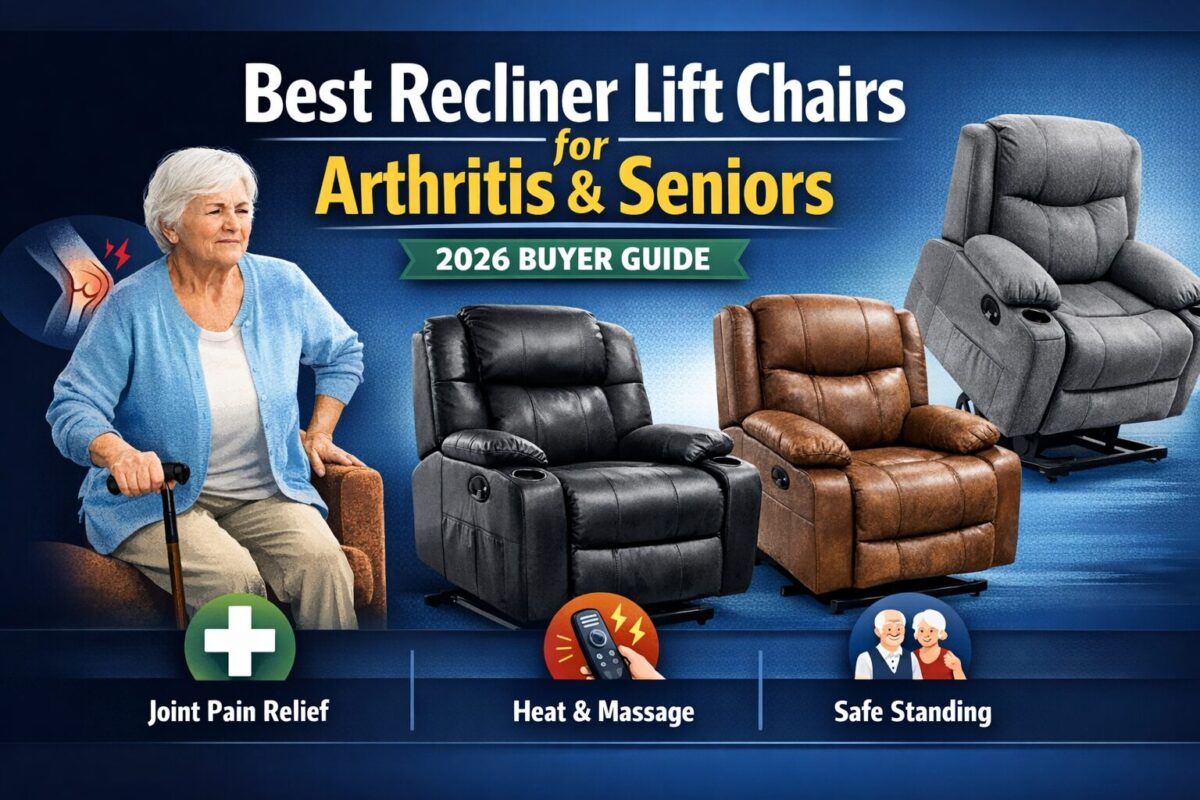
For many people with arthritis, the hardest moments of the day aren’t the obviously demanding ones — they’re the small, repeated ones. Lowering yourself into a chair. Pushing up from a seat. Shifting position when one spot starts to ache. Done dozens of times a day, these movements put significant cumulative stress on arthritic hips, knees, and hands.
A power lift recliner addresses this directly. The motorised lift mechanism does the work of rising from seated to standing — eliminating the knee and hip strain of pushing up, reducing fall risk, and giving you back the independence of sitting and standing without needing to ask for help or brace yourself against the pain.
This guide explains what to look for in a power lift recliner for arthritis, how to choose the right size and features for your needs, and which specific chairs are worth considering across seven distinct categories — from best overall value to compact models for smaller spaces and fabric options for those who find leather uncomfortable. It also covers the question nearly every buyer asks: whether Medicare or insurance can help cover the cost.
Jump to a Section
Why Arthritis Makes Sitting and Standing So Difficult
Arthritis affects the joints involved in almost every basic movement — hips, knees, spine, shoulders, and hands. When inflammation is active, these joints lose their normal range of motion and become painful under load. The movements most affected by standard sitting and standing include:
- Lowering into a chair — requires eccentric muscle contraction in the quadriceps and significant hip flexion, both painful in lower-limb arthritis
- Pushing up from seated — the most demanding phase, requiring the knees and hips to extend under full body weight; often the primary reason people with arthritis begin using assistive furniture
- Maintaining posture over time — sitting for extended periods without adequate support causes spinal compression, hip flexor tightening, and increased lower back pain
- Shifting and adjusting position — something non-arthritic people do unconsciously; with arthritis, each positional change can require deliberate, painful effort
- Gripping chair arms to assist standing — for people with hand, wrist, or shoulder arthritis, the upper-body force needed to assist standing from a standard chair adds significant joint stress
A power lift recliner addresses all of these by automating the most demanding phase of movement — the transition between sitting and standing — and by providing optimised posture support, adjustable recline, and heat and massage features that reduce joint pain during periods of rest.
What Is a Power Lift Recliner?
A power lift recliner looks like a standard recliner but includes a motorised mechanism in the base that gently tilts the entire chair forward, raising the seat to bring you to a near-standing position with minimal effort. You control the lift and recline using a simple remote — typically with large buttons designed for easy use with arthritic hands.
Most power lift recliners also recline to multiple positions — from a slight recline for TV watching, through deeper reclines for napping or reading, to fully flat or zero-gravity positions that distribute body weight evenly and reduce pressure on painful joints. Many models include built-in heat, vibration massage, lumbar support, USB charging ports, and side pockets.
Power lift recliners are considered medical-grade mobility aids — not just furniture — and are commonly recommended by occupational therapists and physiotherapists for people with osteoarthritis, rheumatoid arthritis, chronic pain conditions, limited mobility, and post-surgery recovery.
Key Benefits of Power Lift Recliners for Arthritis
Safer, easier standing — the lift mechanism eliminates the need to push up from a seated position under your own strength. This dramatically reduces load on arthritic knees, hips, and hands and significantly lowers the risk of falls during the sit-to-stand transition — one of the highest-risk moments for older adults with mobility limitations.
Better joint alignment during rest — supportive cushioning and adjustable recline allow the spine, pelvis, and hips to be held in a neutral, supported position for extended periods. Standard sofas and chairs often cause the hips to drop below the knees and the spine to round — positions that worsen lower back and hip arthritis pain over time.
Zero-gravity and recline positions for pain relief — zero-gravity recline distributes body weight across the full length of the body rather than concentrating it at the hips and lower spine. This position reduces spinal compression and is one of the most effective positions for reducing leg and foot swelling.
Heat and massage for stiff joints — built-in heat and vibration massage provide the same benefits as a heating pad or massager without requiring a separate device. Warmth relaxes tight muscles around stiff joints; massage improves local circulation and reduces muscle tension that amplifies joint pain.
Independence and fall prevention — regaining the ability to sit and stand independently — without asking for help or gripping furniture for support — has significant practical and psychological value. It reduces fall risk, reduces dependence on caregivers, and improves confidence in daily movement.
How to Choose the Right Power Lift Recliner for Arthritis
Choosing incorrectly — particularly getting the wrong size — will undermine everything the chair is designed to do. Here’s what matters most:
Seat Height and Depth
This is the most critical sizing factor. When seated, your feet should rest flat on the floor with your knees at approximately 90 degrees. A seat that’s too deep forces the hips back but leaves the knees unable to bend comfortably. A seat that’s too shallow doesn’t support the full length of the thighs, creating pressure behind the knees. Most manufacturers provide seat height and depth measurements — always check these against your own measurements before buying. Petite users (under 5’4″) should specifically look for chairs marketed as small or petite models — standard chairs will often be too deep.
Single Motor vs. Dual Motor
A single-motor power lift recliner controls the backrest and footrest together — they move in a linked motion as you recline. A dual-motor chair controls them independently, allowing you to raise the footrest while keeping the backrest upright (ideal for leg elevation without reclining), or recline the back while keeping the footrest lower. For arthritis sufferers who need precise positioning — particularly those with both lower back and leg symptoms — a dual-motor chair offers significantly more flexibility and is worth the additional cost.
Recline Range and Positions
For arthritis specifically, look for chairs offering at least three positions: upright, TV/reading recline, and full or zero-gravity recline. Lay-flat (180°) capability is valuable for people who nap in their chair or whose back arthritis means lying flat provides more relief than any seated position. Infinite position adjustment — available on most dual-motor models — allows fine-tuning to find your exact comfort point rather than stepping between preset positions.
Cushion Firmness
Medium-firm cushioning provides the best balance for arthritis: firm enough to support the hips and spine without allowing sinking or asymmetrical posture, but soft enough to cushion pressure points. Very soft cushioning feels comfortable initially but causes the hips to sink below the knees over time, worsening lower back pain. High-density foam seats maintain their support better than standard foam over years of daily use.
Weight Capacity and Chair Size
Power lift recliners come in small, standard, large, and tall/wide configurations. Using a chair that’s too large means the seat is too deep and the lift mechanism may not position you correctly for standing. Using one that’s too small causes pressure and restricts movement. Many manufacturers now offer extended weight capacities (up to 400–500 lbs) with reinforced frames — essential if standard chairs have felt unstable.
Fabric vs. Leather Upholstery
PU leather and genuine leather are easy to wipe clean, durable, and hygienic — practical advantages for a chair used many hours daily. However, leather can feel cold in winter, which is counterproductive for people with cold-sensitive arthritic joints. Fabric upholstery feels warmer, softer, and more breathable — better for people who sit in the chair for extended periods or who find leather uncomfortable against sensitive skin. The trade-off is that fabric stains more easily and requires more maintenance. If warmth and skin comfort are priorities, a fabric model is worth seeking out specifically.
Heat and Massage Features
Built-in lumbar heat is particularly valuable — it’s the area most people apply a heating pad to anyway, and having it integrated means you don’t need a separate device. Vibration massage provides gentle stimulation effective for relaxation and mild circulation improvement. Look for adjustable heat and massage intensity levels — fixed settings that are too warm or too strong will go unused.
Quick Comparison: Best Power Lift Recliners for Arthritis
| Chair | Best For | Heat | Massage | Motor | Recline |
|---|---|---|---|---|---|
| Best Choice Products PU Leather | Best overall value | ✅ | ✅ | Single | Multiple positions |
| CANMOV Large Power Lift Recliner | Larger / taller users | ✅ | ✅ | Single | Multiple positions |
| MCombo Electric Power Lift Recliner | Pain relief & relaxation | ✅ | ✅ Full body | Single | Multiple positions |
| MEROUS Dual Motor Power Lift Recliner | Dual motor / lay flat | ✅ Lumbar | ✅ 8-point | Dual (OKIN) | Lay flat 180° |
| Couchus Large Dual Motor Power Lift | Premium / medical-grade | ✅ | ✅ | Dual | Zero-gravity + infinite |
| Cfvyne Small Power Lift Recliner | Compact / petite users | ✅ Lumbar | ✅ 8-point | Single | 3 positions |
| MCombo 7287 Fabric Power Lift Recliner | Fabric upholstery option | ✅ | ✅ | Single | Multiple + extended footrest |
Full Reviews: Best Power Lift Recliners for Arthritis
1. Best Choice Products PU Leather Electric Power Lift Recliner — Best Overall Value
The Best Choice Products power lift recliner is the most popular entry point in this category, and for good reason — it delivers the core features that matter most for arthritis at a price point that makes lift chair ownership accessible. The smooth power lift is quiet and gradual enough to feel safe and comfortable for stiff joints, and the combination of heat and vibration massage provides genuine daily value rather than feeling like a gimmick.
The PU leather upholstery is easy to wipe down — a practical advantage for a chair in heavy daily use — and the built-in cup holders, side pockets, and USB ports make it a genuinely functional living room chair, not just a mobility aid. The remote has large, clearly labelled buttons that are easy to operate with arthritic hands. If you want a reliable, well-featured power lift recliner without spending a premium, this is the natural starting point.
Best for: People with mild to moderate arthritis who want a reliable, feature-complete power lift recliner at an accessible price
Pros:
- Smooth, quiet lift mechanism — gradual and stable
- Heat and vibration massage included — particularly useful for lumbar stiffness
- Easy-clean PU leather upholstery
- USB charging port, cup holders, and side pockets
- Large-button remote suitable for arthritic hands
- Strong value for the feature set
Cons:
- Single motor — backrest and footrest move together rather than independently
- PU leather can feel cold in winter if heat isn’t activated first
- Not ideal for taller or heavier users — check seat dimensions carefully

2. CANMOV Large Power Lift Recliner Chair — Best for Larger and Taller Users
The CANMOV is designed specifically for users who find standard power lift recliners too narrow, too shallow, or too low — a common and frustrating problem for taller or broader people who need the benefits of a lift chair but can’t find one that fits correctly. The wider seat, higher weight capacity, and deeper cushioning provide the proper fit that makes all the difference to comfort and the effectiveness of the lift mechanism.
The lumbar heat and massage system covers the lower back and seat with even warmth that’s particularly effective for hip and spinal arthritis. The motor is quiet and the lift motion is smooth and gradual. If previous power lift recliners have felt too small or the armrests have been too close together, this is the model to look at.
Best for: Taller or heavier individuals who need a wider seat, higher weight capacity, and deeper cushioning for proper fit and support
Pros:
- Wide seat and generous proportions — suits taller and broader users
- Higher weight capacity with reinforced frame
- Lumbar heat and massage with even coverage
- Smooth, quiet lift system
- User-friendly remote with large buttons
- Deep, supportive cushioning that maintains its shape
Cons:
- Larger footprint — measure your space carefully before ordering
- Heavier than standard models — delivery and positioning may require assistance
- Higher price than entry-level options
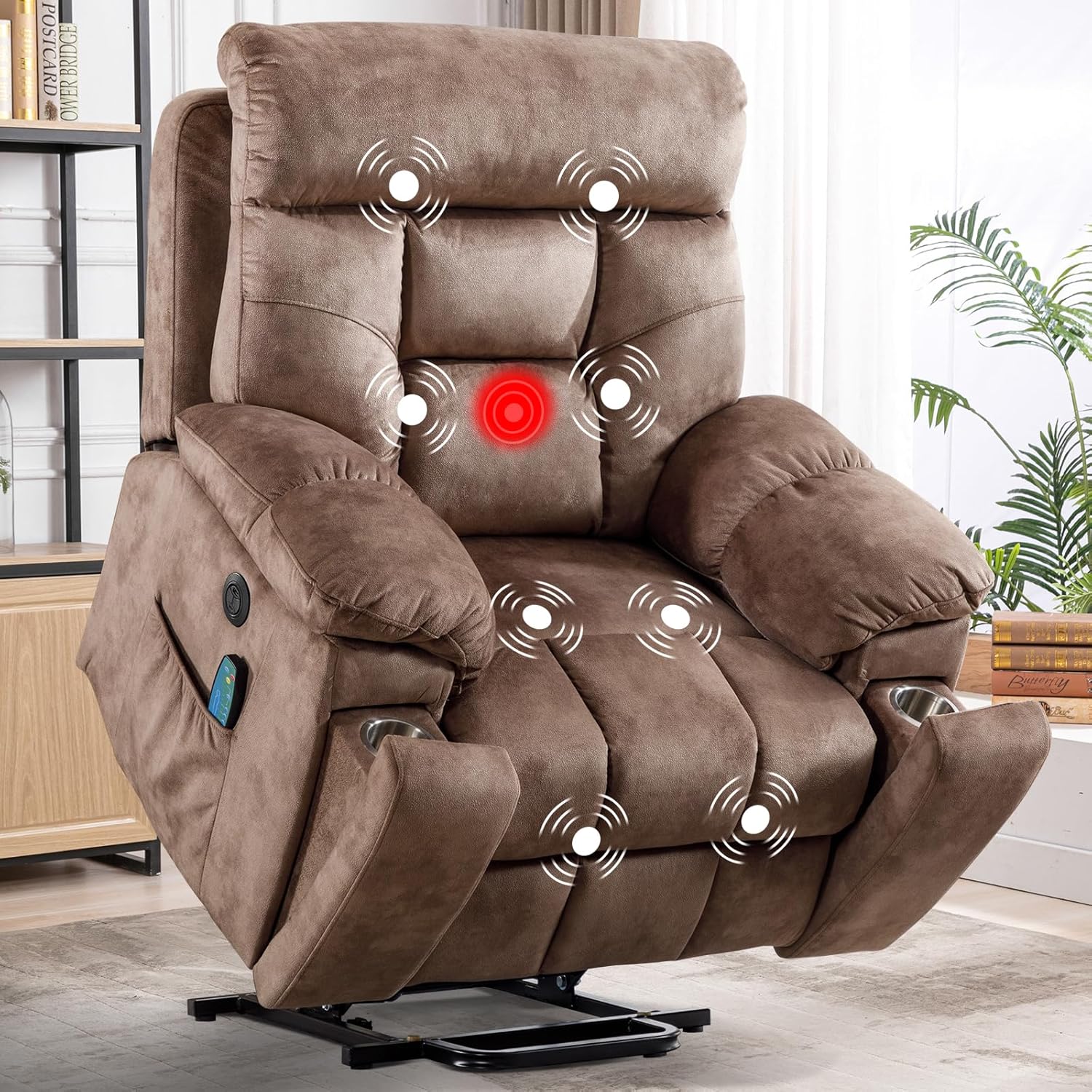
3. MCombo Electric Power Lift Recliner Chair — Best for Pain Relief and Relaxation
The MCombo is the most feature-rich option on this list from a pain-relief perspective — it offers full-body vibration massage with multiple modes and intensities, heat coverage across both the seat and backrest, and a gentle, stable lift motion that makes it particularly well-suited for people with more significant pain or those who use their chair for extended rest periods.
The eco-leather upholstery is softer and more comfortable than standard PU leather and holds warmth better — a meaningful advantage for people with cold-sensitive joints. The padding is generous without being excessively soft, providing the medium-firm support that arthritic joints benefit from most. If stiffness and muscle tension are your primary concerns and you want a power lift recliner that functions as a daily heat and massage therapy tool as well as a seat, this is the strongest single-motor option on the list.
Best for: People with significant muscle tension or frequent arthritis flare-ups who want a chair that doubles as a daily heat and massage therapy tool
Pros:
- Full-body vibration massage with multiple modes
- Heat across both seat and backrest — more coverage than lumbar-only options
- Soft eco-leather retains warmth better than standard PU leather
- Gentle, stable lift motion — particularly smooth for sensitive joints
- Generous, medium-firm padding that maintains support over time
Cons:
- Larger and heavier — not ideal for smaller rooms
- Single motor — independent backrest/footrest control not available
- Higher price reflects the additional features

4. MEROUS Dual Motor Power Lift Recliner — Best for Lay-Flat and Independent Position Control
The MEROUS is the step up to dual-motor control at a mid-range price point — and for people with arthritis affecting both the back and legs, the ability to adjust the backrest and footrest independently makes a meaningful practical difference. Powered by dual OKIN motors — among the most reliable and quietest in this category — the chair moves smoothly and gradually through its full range without jolting or hesitating.
The full 180-degree lay-flat capability is genuinely useful for people who nap in their chair or whose back arthritis means lying flat is significantly more comfortable than any seated position. Five massage modes with 8 vibrating nodes cover the back, lumbar, thighs, and legs — one of the most comprehensive massage systems in this price range. Lumbar heat with three intensity settings targets the most commonly painful area for arthritis sufferers.
Best for: People who want independent backrest and footrest control, full lay-flat capability, and a step up in positioning flexibility from single-motor chairs
Pros:
- Dual OKIN motors — independent backrest and footrest control for precise positioning
- Full 180° lay-flat recline — one of the most complete recline ranges available
- 5 massage modes with 8 vibrating nodes across back, lumbar, thighs, and legs
- Lumbar heat with 3 intensity levels and timing options (15, 30, 60 minutes)
- Quiet, low-failure-rate OKIN motors trusted across the industry
- Available on Amazon with straightforward assembly
Cons:
- Check sizing carefully — available in medium and large variants
- Faux leather upholstery runs cooler in winter than fabric options
- Larger footprint than compact models

5. Couchus Large Dual Motor Power Lift Recliner — Best Premium Option
The Couchus is the most medically considered power lift recliner on this list — designed with specific attention to the ergonomic and safety needs of people with arthritis and mobility limitations. The dual-motor system provides independent control across the full recline range, and the zero-gravity lift assist is engineered to reduce knee pressure during the sit-to-stand transition specifically. The 27-inch backrest is longer than most chairs in this category, designed to support the full length of the spine rather than leaving the lower back unsupported.
The high-density foam adapts to body shape over time rather than compressing flat — meaning the support it provides on day one is largely maintained over years of daily use. If budget allows and arthritis is significantly affecting daily mobility and comfort, this is the chair that most closely resembles what an occupational therapist would specify.
Best for: People with significant arthritis-related mobility limitations who want the most ergonomically considered option with zero-gravity lift assist
Pros:
- Dual-motor system with independent backrest and footrest adjustment
- Zero-gravity lift assist specifically engineered to reduce knee pressure during standing
- Extended 27″ backrest provides full spinal support including the lower back
- High-density foam maintains its support shape over years of daily use
- USB ports and remote control included
Cons:
- Higher price point — reflects the premium engineering
- Larger footprint — measure your space carefully before ordering
- Check weight capacity variant for your needs before purchasing

6. Cfvyne Small Power Lift Recliner — Best for Petite Users and Small Spaces
One of the most overlooked problems in the lift chair market is that standard-sized chairs simply don’t fit smaller or shorter users correctly — the seat is too deep, the feet don’t reach the floor, and the lift mechanism doesn’t position you correctly for standing. The Cfvyne Small is specifically designed to solve this: built for users typically under 5’4″, with a reduced seat depth and height that puts petite users in the correct ergonomic position rather than leaving them perched awkwardly in an oversized chair.
Despite the compact footprint, it doesn’t compromise on features — high-density memory foam, breathable leather upholstery, 8-point vibration massage covering the back, lumbar, thighs, and calves, lumbar heat, dual cup holders, side pockets, and USB ports are all included. The motor is quiet, the controls are straightforward, and reviewers consistently highlight how well it suits smaller frames compared to standard models. It also works well for anyone needing a power lift recliner in a smaller room or apartment where a full-sized chair wouldn’t fit comfortably.
Best for: Petite users (typically under 5’4″), people in smaller rooms or apartments, anyone who has found standard lift chairs too large or poorly fitting
Pros:
- Specifically designed for petite users — correct ergonomic fit for smaller frames
- Compact footprint suits smaller rooms and apartments
- High-density memory foam — comfortable and supportive without being too firm
- 8-point massage covering back, lumbar, thighs, and calves
- Lumbar heat, dual cup holders, side pockets, and USB ports included
- Quiet motor with straightforward, easy-to-use remote
Cons:
- Not suitable for taller or heavier users — designed specifically for petite frames
- Single motor — backrest and footrest move together
- 3-position recline rather than infinite adjustment

7. MCombo 7287 Fabric Power Lift Recliner — Best Fabric Upholstery Option
Every other chair on this list uses leather or faux leather upholstery — which is durable and easy to clean but can feel cold, stiff, and uncomfortable against sensitive or inflamed skin, particularly in winter. The MCombo 7287 fills this gap with a textile fabric upholstery that feels warmer, softer, and more breathable — making it significantly more comfortable for people who sit in their chair for long stretches or who find leather irritates their skin.
The extended footrest is a genuine differentiator — nearly 5 inches longer than standard models, it provides proper leg support for taller users and improves circulation by elevating the lower legs more effectively. The lift mechanism is smooth and reliable, the heat and massage functions match the standard MCombo quality, and the “Home” button that resets the chair to its upright lift-ready position in one touch is a thoughtful detail that makes daily use significantly easier for people with limited hand dexterity.
Best for: People who find leather cold or uncomfortable against sensitive skin, those who prioritise warmth and breathability, taller users who benefit from the extended footrest
Pros:
- Fabric upholstery — warmer, softer, and more breathable than leather alternatives
- Extended footrest — nearly 5 inches longer than standard, improves leg circulation
- Smooth, reliable lift and recline mechanism
- “Home” button resets to upright position in one touch — ideal for limited dexterity
- Heat and massage functions consistent with MCombo’s well-reviewed quality
- Available in multiple fabric colours
Cons:
- Fabric stains more easily than leather — less practical for users who eat meals in the chair or have incontinence concerns
- Requires more maintenance than wipe-clean leather upholstery
- Single motor — standard linked backrest and footrest movement

Does Medicare Cover Power Lift Recliners?
This is one of the most common questions power lift recliner buyers ask — and the answer is: partially, in some cases.
Medicare Part B may cover the lift mechanism of a power lift recliner as Durable Medical Equipment (DME) — but typically not the chair itself. In practice, this means Medicare may reimburse a set amount toward the motorised lifting component if a doctor certifies that you have a medical condition that makes standing from a seated position a documented functional limitation.
To explore Medicare coverage:
- Ask your GP or specialist for a written prescription or letter of medical necessity specifically mentioning difficulty with sit-to-stand due to your arthritis or mobility condition
- Ensure the supplier is Medicare-approved — not all Amazon sellers qualify for this
- Check the current Medicare DME reimbursement rates, as these change annually
In the UK, power lift recliners are not routinely provided by the NHS but may be available through social services equipment assessments or Disabled Facilities Grants for eligible individuals. An occupational therapy assessment is the recommended starting point.
FSA (Flexible Spending Account) and HSA (Health Savings Account) funds can typically be used to purchase power lift recliners in the US — check with your account provider to confirm eligibility before purchasing.
Caring for Your Power Lift Recliner
A power lift recliner used daily will last significantly longer with basic regular maintenance:
- Wipe down PU or genuine leather weekly with a slightly damp cloth — avoid harsh cleaners that degrade the surface coating. Use a leather conditioner every few months to prevent cracking
- Vacuum fabric upholstery weekly using an upholstery attachment to prevent dust and debris from working into the fibres. Treat stains promptly — fabric is significantly harder to clean once a stain has set
- Keep the motor area clear — never block the mechanism under the chair with rugs, cables, or objects. The motor needs clear airflow and unobstructed movement at all times
- Check the power cord and remote cable periodically for wear, fraying, or damage — particularly important if the chair is used many hours daily
- Test the lift mechanism monthly — run the chair through its full range of motion even if you don’t use the full recline regularly. This keeps the motor and mechanism in good working order and helps identify any developing issues early
- Don’t overload side pockets or cup holders — these are convenience features, not structural storage. Heavy items placed repeatedly in side pockets can stress the chair frame over time
Frequently Asked Questions
Are power lift recliners good for arthritis?
Yes — for people whose arthritis significantly affects the hips, knees, or hands, a power lift recliner can be one of the most impactful home mobility aids available. The lift mechanism removes the most demanding phase of daily movement (standing from seated), the adjustable recline supports optimal joint positioning during rest, and heat and massage features provide ongoing comfort during use. Occupational therapists and physiotherapists frequently recommend power lift recliners as part of arthritis home management plans.
What size power lift recliner should I choose?
Sizing is the most critical factor in power lift recliner selection. When seated, your feet should rest flat on the floor, your knees should be at approximately 90 degrees, and your back should be fully supported by the backrest. Measure your height and weight, then compare against the manufacturer’s seat height, seat depth, and weight capacity specifications. Petite users (under 5’4″) should specifically look for small or petite models — standard chairs are typically too deep and too high for comfortable, safe use. If you’re between sizes, prioritise getting the seat height right above all other dimensions.
What is the difference between a single-motor and dual-motor power lift recliner?
A single-motor power lift recliner controls the backrest and footrest together — they move in a linked motion as you recline or use the lift function. A dual-motor chair controls them independently, allowing you to raise the footrest while keeping the backrest upright for leg elevation, or recline the back while keeping the footrest lower. For arthritis sufferers who need precise positioning — particularly those with both lower back and leg symptoms — a dual-motor chair offers significantly more flexibility. If budget allows, dual-motor is worth the upgrade for anyone who will use the chair for extended daily rest periods.
Do power lift recliners help with leg and foot swelling?
Yes — the reclined and zero-gravity positions available in most power lift recliners elevate the legs above the level of the heart, which encourages fluid drainage from the lower limbs and can significantly reduce swelling in the ankles and feet. This is particularly beneficial for people with arthritis-related oedema, venous insufficiency, or conditions where fluid retention in the legs is a daily problem. Models with an extended footrest — like the MCombo 7287 — are particularly effective at this, as the longer footrest elevation provides better lower-leg support.
Should I choose fabric or leather upholstery?
It depends on your priorities. Leather and faux leather are easier to wipe clean, more durable, and more hygienic — better for heavy daily use or for anyone with incontinence concerns. However, leather can feel cold and stiff, particularly in winter, and may be uncomfortable against sensitive or inflamed skin. Fabric upholstery is warmer, softer, and more breathable — significantly more comfortable for people who sit in their chair for long periods or who find leather irritating. The trade-off is that fabric stains more easily and requires more care. If warmth and skin comfort are your priorities, the MCombo 7287 fabric model is specifically designed for this.
Can I use a power lift recliner if I live alone?
Yes — and for people who live alone, a power lift recliner is particularly valuable precisely because it allows safe, independent sit-to-stand transitions without needing to call for assistance. The lift mechanism effectively replaces the role that a caregiver or family member might otherwise play in helping someone with limited mobility stand safely. For anyone living alone with significant mobility limitations, a power lift recliner can meaningfully extend the period during which independent living at home remains safe and sustainable.
How long do power lift recliners last?
With regular maintenance, a good-quality power lift recliner typically lasts 7–10 years of daily use. The motor and lift mechanism are the components most likely to require attention over time — most manufacturers offer replacement parts and some provide warranties of 1–3 years on the mechanism. High-density foam seats maintain their support significantly longer than standard foam. Buying from a brand with accessible customer service and available spare parts is worth factoring into the purchase decision alongside the upfront price.
Do doctors recommend power lift recliners?
Occupational therapists and physiotherapists commonly recommend power lift recliners for people with arthritis, significant mobility limitations, or post-surgical recovery needs. GPs and orthopaedic specialists may also recommend them and can provide the written medical necessity documentation needed for Medicare or insurance reimbursement. If you’re considering a power lift recliner and want professional guidance on whether it’s appropriate for your specific condition, an occupational therapy home assessment is the ideal starting point — and may also identify funding or equipment provision options you weren’t aware of.
Final Thoughts
A power lift recliner is one of those purchases that people with arthritis often delay longer than they should — waiting until standing has become genuinely difficult rather than treating it as the practical mobility tool it is. The difference a well-chosen chair makes to daily comfort, independence, and fall risk is significant, and most people who make the switch say they wish they’d done it sooner.
The key is matching the chair to your body and your primary needs. Here’s the quick summary:
- Best overall value — Best Choice Products PU Leather
- Larger or taller users — CANMOV Large Power Lift Recliner
- Pain relief and massage focus — MCombo Electric Power Lift Recliner
- Dual motor and lay-flat capability — MEROUS Dual Motor Power Lift Recliner
- Premium ergonomics and zero-gravity lift — Couchus Large Dual Motor
- Petite users and small spaces — Cfvyne Small Power Lift Recliner
- Fabric upholstery and extended footrest — MCombo 7287 Fabric
If you’re unsure which is right for you, or whether a power lift recliner is appropriate for your specific condition, an occupational therapy assessment is the most efficient route to a confident decision — and may also open the door to funding or equipment provision you weren’t aware of.
👉 Related reading:
- Best Hand Relief Tools for Arthritis: Complete Guide
- Best Mobility Aids for Seniors with Arthritis
- Arthritis-Friendly Home Modifications
- Best Walking Aids for Arthritis
- Ultimate Guide to Living Well With Arthritis