
Disclosure: As an Amazon Associate, Arthritis Wares earns from qualifying purchases at no extra cost to you. We are not paid or sponsored by any manufacturer. Affiliate links help support our work.
Arthritis can make walking, standing, getting out of a chair, climbing stairs, or getting in and out of a car more difficult. The right mobility aid can make these everyday tasks easier and help you stay independent.
But choosing a mobility aid isn’t simply a matter of buying the most supportive device you can find.
A cane, walker, rollator, wheelchair, and mobility scooter all solve different problems. And sometimes the most useful aid isn’t a walking device at all—it may be a grab bar, shower chair, reacher, dressing aid, or vehicle support handle that makes a difficult task safer.
This guide explains the main types of mobility and mobility-related aids that can help people living with arthritis, what each one is designed to do, and when it makes sense to get professional help with fit or selection.
Quick Answer: Which Mobility Aid Do You Need?
Start with the task that is difficult rather than the name or severity of your arthritis.
| Your main difficulty | Aid to consider |
|---|---|
| You need a little extra balance or support while walking | Cane |
| One or both legs need more support | Walker |
| You can walk but fatigue limits distance | Rollator |
| Knee pain or instability is the main problem | Knee brace or sleeve |
| You need help getting up from a chair or toilet | Grab bars or transfer equipment |
| Bending or reaching is painful | Reacher/grabber |
| Getting dressed is difficult because of stiffness or limited movement | Dressing aids |
| Getting in and out of a car is painful | Vehicle support handle |
| Walking longer distances is no longer practical | Wheelchair or mobility scooter |
| One foot or ankle needs to remain largely non-weight-bearing | Knee scooter, when appropriate |
There is no rule that says you need to progress from a cane to a walker to a wheelchair. The appropriate device depends on your current abilities, environment, and goals.
If you are unsure which walking aid you need, a physical therapist or occupational therapist can assess your gait, balance, strength, joint problems, and daily activities.
For people with lower-limb osteoarthritis, NICE recommends considering walking aids such as walking sticks. The ACR/Arthritis Foundation guideline also strongly recommends cane use when OA has enough impact on walking, stability, or pain to warrant an assistive device.
Mobility Aids vs. Arthritis Assistive Tools
Not everything in this guide is technically a mobility aid.
A mobility aid primarily helps you move from one place to another. Examples include:
- Canes
- Walkers
- Rollators
- Wheelchairs
- Mobility scooters
- Knee scooters
Other devices help you perform everyday activities more safely or with less joint strain:
- Grab bars
- Transfer boards
- Reachers
- Dressing aids
- Vehicle support handles
These tools belong in the same conversation because arthritis can affect independence in many ways—not just walking.
1. Canes: Simple Support for Walking
A cane is often the simplest walking aid to consider when you need some additional balance or support but can still walk independently.
A properly fitted cane can provide another point of contact with the ground and may help reduce the amount of weight placed through a painful lower-limb joint.
Canes are particularly useful when:
- One leg is more painful than the other
- You need occasional balance support
- Walking becomes more difficult during a flare
- You want something lightweight and portable
- You can safely control the cane with one hand
What to Look For in a Cane
If you have arthritis in your hands, don’t overlook the handle.
Look for:
- A comfortable grip
- An appropriate handle size
- Adjustable height
- A stable rubber tip
- A design you can comfortably carry
- A locking mechanism that is easy enough for you to adjust safely
A cane that is the wrong height can make walking less comfortable rather than more comfortable.
Recommended reading: Walking Canes for Arthritis: In-Depth Comparison & Buying Guide
Product to Consider: HONEYBULL Adjustable Walking Cane
The HONEYBULL is a freestanding cane with a quad-style base and adjustable height. Its design may appeal to someone who wants a cane that can stand upright rather than simply falling to the floor when released.
It is still a cane, however, rather than a substitute for a walker. If you need substantial two-handed support or have significant balance problems, a walker may be more appropriate.
Best suited to: people who want a portable cane with a wider base and freestanding design.
Check before buying: Make sure the height range and handle design work for you.

2. Walkers: More Support Than a Cane
A standard walker provides support through both arms and several points of contact with the floor.
That makes it substantially more supportive than a cane, but it also requires more space and can be less convenient outdoors.
Walkers may be useful when:
- Both legs need support
- Balance is a significant concern
- You need to take more weight through your arms
- A cane no longer provides enough stability
- You are recovering from an injury or procedure
Standard Walker vs. Wheeled Walker
A traditional walker is lifted slightly as you move it forward.
A two-wheeled walker can be easier to advance because you lift or move only part of the frame.
The right choice depends on your strength, balance, coordination, and environment.
Product to Consider: Drive Medical Two-Button Folding Walker With Wheels
This folding walker provides a two-handed support option while allowing the front wheels to move forward without requiring the entire frame to be lifted.
The folding design can also make storage and transportation easier.
Best suited to: people who need more support than a cane provides and prefer a walker with front wheels.
Important: Walker height and technique matter. If you are leaning heavily onto the walker or taking unsafe steps, professional fitting can be valuable.

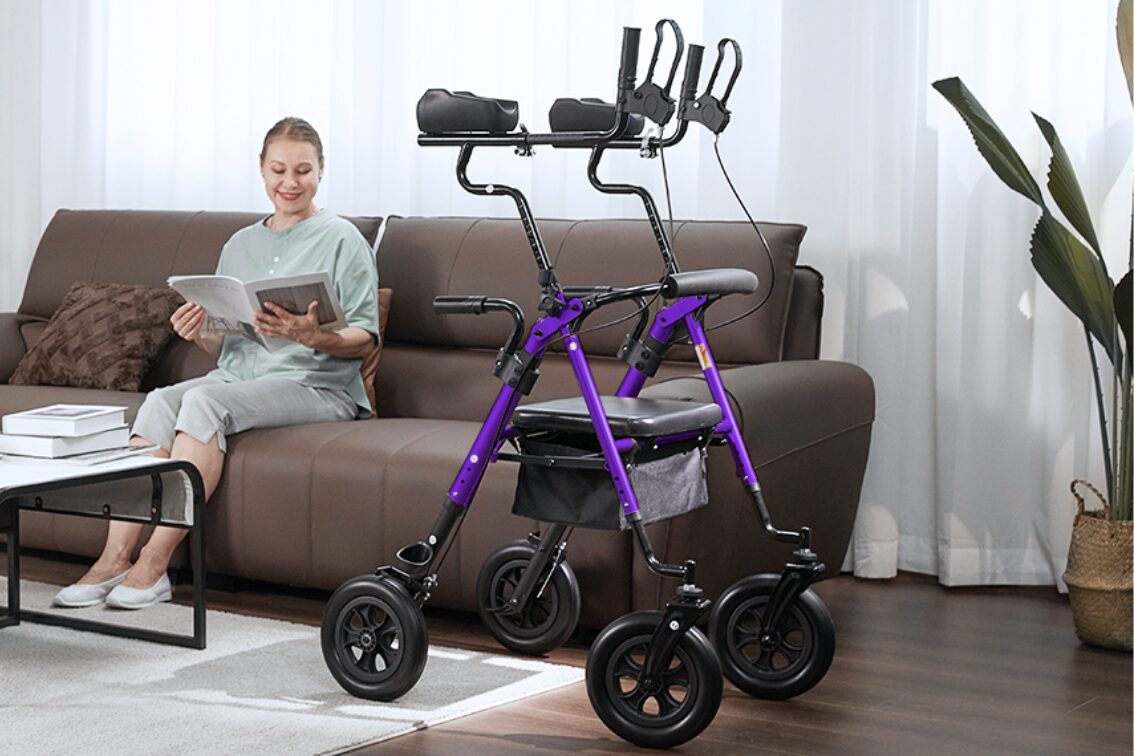
3. Rollators: Walking With a Seat and Storage
A rollator is different from a standard walker because it has wheels designed to roll continuously and typically includes hand brakes.
Many rollators also have:
- A built-in seat
- A backrest
- A storage basket or bag
- Hand-operated brakes
This combination can be particularly useful when fatigue or limited walking endurance is more of a problem than simply needing maximum stability.
A rollator may be useful for:
- Grocery shopping
- Longer walks
- Outdoor errands
- Shopping malls
- Community activities
- Situations where you need to sit down periodically
A Rollator Is Not Automatically Safer Than a Walker
The wheels make a rollator easier to move, but they also mean the device can move when you do not expect it to.
If you have significant balance problems or difficulty controlling the brakes, a standard walker may be more appropriate.
Product to Consider: Drive Medical Rollator With Seat and Backrest
This rollator combines four-wheel mobility with a seat and backrest, making it useful for people who need somewhere to rest during longer outings.
Best suited to: people who can safely control a wheeled device and whose walking distance is limited by fatigue or discomfort.
Check before buying: Consider overall width, seat height, weight capacity, wheel size, folded dimensions, and whether you can comfortably operate the brakes.

Recommended reading: Best Walkers and Rollators for Arthritis: A Complete Review
4. Knee Braces: Support for a Knee Problem
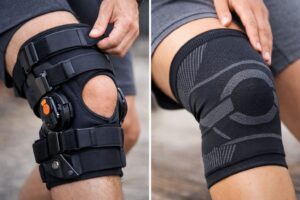
A knee brace isn’t technically a walking aid, but it can be useful when knee arthritis or instability is making walking difficult.
There are several different categories:
- Compression sleeves for mild support and compression
- Hinged braces for additional mechanical support
- OA unloader braces for certain compartment-specific knee problems
- Patellofemoral supports for certain kneecap-related problems
A brace should not automatically be considered a replacement for a cane or walker.
If your knee is painful but stable, a sleeve may be enough. If instability is affecting your walking, a hinged brace may be worth considering. If your knee repeatedly gives way, however, the underlying problem deserves assessment.
The ACR/Arthritis Foundation guideline strongly recommends tibiofemoral bracing in certain knee OA situations when pain, ambulation, or stability warrants an assistive device.
Recommended reading: Best Knee Braces & Supports for Arthritis Relief
5. Wheelchairs and Mobility Scooters: When Walking Distance Is the Limiting Factor
Using a wheelchair or mobility scooter does not mean you have stopped being independent.
For some people, the issue isn’t that they cannot walk at all. They may simply be unable to walk far enough to complete everyday activities comfortably.
A mobility device can allow someone to conserve energy for the parts of an outing that matter most.
Wheelchair
A wheelchair may be appropriate when:
- Walking is very limited
- You need to sit for most of an outing
- Standing for long periods is difficult
- Another person will assist with pushing, or you use a powered model
Mobility Scooter
A mobility scooter may be useful when you can transfer safely and operate the controls but cannot comfortably walk long distances.
Consider:
- Turning radius
- Seat comfort
- Weight capacity
- Battery range
- Portability
- Indoor vs. outdoor use
- Storage and transportation
Recommended reading: Best Mobility Scooters for Arthritis: Reviews and Buying Tips
Product to Consider: Drive Medical Cruiser III Wheelchair
The Drive Medical Cruiser III is a lightweight manual wheelchair option for people who need seated mobility rather than relying on walking for an entire outing.
Best suited to: people who need a wheelchair for community mobility and have appropriate assistance or the ability to propel and control the chair safely.

6. Knee Scooters: An Alternative When One Lower Limb Must Be Offloaded
A knee scooter is a very different device from a walker or rollator.
It allows one lower leg or foot to remain off the ground while you propel yourself with the other leg.
This can be useful in specific situations such as recovery after foot or ankle surgery.
It is not a general-purpose arthritis mobility aid.
If arthritis affects your foot or ankle but you can still safely bear weight, a cane, walker, or other device may be more appropriate.
A knee scooter also requires:
- Good balance
- Adequate strength in the supporting leg
- Ability to steer and brake
- Enough space to maneuver
Product to Consider: Drive Medical Knee Scooter
The Drive Medical Knee Scooter provides a wheeled platform for supporting one knee while moving with the other leg.
Best suited to: temporary situations where one lower limb needs to remain offloaded, rather than ordinary arthritis-related walking difficulty.

7. Grab Bars and Bathroom Safety Aids
Some of the most important mobility problems happen when you aren’t actually walking.
Bathrooms combine hard surfaces, water, narrow spaces, and difficult transfers.
Grab bars can provide a stable handhold near:
- Toilets
- Showers
- Bathtubs
- Other areas where standing or transferring is difficult
The CDC recommends grab bars inside and outside the tub or shower and next to the toilet as part of fall-prevention measures for older adults.
Don’t Treat Any Grab Bar as Automatically Safe
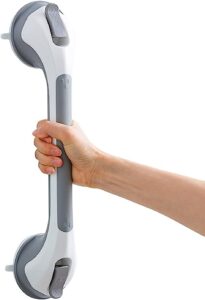
A grab bar needs to be properly installed into an appropriate structure and designed to support the forces placed on it.
A suction-cup product should not automatically be treated as equivalent to a permanently installed grab bar.
For a broader bathroom setup, see:
Recommended reading: Arthritis Tools for Safe Bathing and Showering
8. Transfer Boards and Pivot Aids
Getting from a bed to a wheelchair, or from one seat to another, can be difficult when the hips, knees, or feet are painful.
Transfer boards can help some people move between surfaces by sliding rather than taking repeated steps.
Pivot discs and similar transfer aids serve a different purpose and may assist with certain standing transfers.
These devices aren’t appropriate for everyone. Safe transfers depend on strength, balance, weight-bearing ability, the height of the surfaces, and the person’s ability to follow instructions.
If transfers are becoming difficult or unsafe, an occupational or physical therapist can help determine what equipment and technique are appropriate.
Product to Consider: DMI Transfer and Slide Board
The DMI Transfer and Slide Board is designed to assist with transfers between surfaces.
Best suited to: people who have been assessed as appropriate for board-assisted transfers and have the strength and technique needed to use one safely.

9. Reachers and Grabbers
A reacher doesn’t help you walk, but it can reduce the amount of bending, stretching, and reaching required during daily activities.
This can be especially useful when arthritis affects:
- Knees
- Hips
- Back
- Hands
- Shoulders
A long-handled reacher can help retrieve lightweight objects from the floor, shelves, or other hard-to-reach locations.
What Matters for Arthritic Hands?
Look for:
- A trigger that doesn’t require excessive squeezing
- A comfortable handle
- A lightweight design
- A gripping mechanism that securely holds the objects you commonly pick up
- A rotating or angled head if that makes positioning easier
Product to Consider: Vive Suction Cup Grabber Reacher
The Vive 32-inch reacher uses a long handle and suction-cup gripping mechanism.
Best suited to: people who want to reduce bending and reaching during everyday tasks.
Important: Long reachers are not intended to help you catch yourself during a fall or support your body weight.

Recommended reading: Best Arthritis Tools for Daily Living
10. Dressing and Sock Aids

Getting dressed can be a mobility problem too.
If bending toward your feet is difficult because of knee, hip, or back arthritis, dressing aids can reduce the amount of reaching and bending required.
Common options include:
- Sock aids
- Dressing sticks
- Long-handled shoehorns
- Button aids
- Zipper pulls
These tools can be particularly helpful during periods of morning stiffness.
Recommended reading: Arthritis Dressing Tips: Easier Mornings, Less Pain
11. Portable Vehicle Handles
Getting into and out of a low car can be surprisingly difficult when your knees or hips are stiff.
A portable vehicle support handle fits into the vehicle’s door-striker/latch area and provides a handhold while getting in or out.
This can be useful because it gives you something to push against rather than relying entirely on the door or the car seat.
Product to Consider: Car Assist Support Handle
The Car Assist Support Handle is designed to provide an additional handhold during vehicle transfers.
Best suited to: people who have difficulty getting in or out of a vehicle and have a compatible vehicle latch.
Important: Verify that the device is compatible with your vehicle and follow its instructions. A vehicle support handle should not be treated as a universal safety device.

Recommended reading: Driving With Arthritis: 10 Tools & Tips for Easier Trips
12. Stair Lifts and Larger Home Modifications
When stairs become a significant barrier, a stair lift can provide seated transportation between floors.
Unlike a cane or walker, this is a home modification, not a portable mobility aid.
A stair lift may be worth considering when:
- Stairs are consistently difficult or unsafe
- You need both floors of your home
- A temporary solution isn’t enough
- Moving to a single-level home isn’t practical
Stair lifts require appropriate assessment, installation, and maintenance. They are not a simple Amazon purchase.
Recommended reading: 8 Easy Home Upgrades That Help With Arthritis Comfort & Safety
How Do You Know When You Need a Mobility Aid?
You don’t have to wait until walking becomes extremely difficult.
Consider discussing a mobility aid with a healthcare professional if you:
- Avoid activities because walking is painful
- Hold onto furniture or walls while walking
- Feel unsteady
- Have fallen or nearly fallen
- Need frequent rest breaks
- Have difficulty walking from the parking lot to a store
- Struggle with stairs
- Have one leg that feels substantially weaker or less stable
- Are using an old cane or walker that no longer feels comfortable
- Find that your current aid causes pain in your hands, shoulders, back, or other joints
A change in walking ability can also be a reason to have your current equipment reassessed.
How to Choose the Right Mobility Aid
Think through these five questions before buying anything.
1. What Task Are You Trying to Make Easier?
Is the problem:
- Walking?
- Standing?
- Getting up from a chair?
- Getting into a car?
- Using the bathroom?
- Reaching?
- Getting dressed?
- Walking longer distances?
The answer may point to a completely different device.
2. How Much Support Do You Actually Need?
A cane offers less support than a walker.
A walker generally offers more stability than a cane, while a rollator prioritizes rolling mobility and the ability to rest.
More support isn’t automatically better. A device that is unnecessarily large, heavy, or difficult to maneuver may create new problems.
3. Can You Operate the Device Safely?
Think about:
- Hand strength
- Grip ability
- Balance
- Vision
- Reaction time
- Ability to use brakes
- Ability to fold or adjust the equipment
- Ability to maneuver through your home
This is particularly important if arthritis affects your hands as well as your legs.
4. Where Will You Use It?
A device that works well inside the house may not be ideal outdoors.
Consider:
- Doorway width
- Stairs
- Carpets
- Uneven sidewalks
- Snow and ice
- Vehicle transportation
- Storage space
5. Has the Device Been Properly Fitted?
Fit matters.
A cane that is too tall or short, a walker that encourages excessive leaning, or a rollator adjusted incorrectly can make movement less comfortable or less stable.
If you’re unsure about fit or technique, ask a physical or occupational therapist to check it.
Why Mobility Aids Can Help With Arthritis
The main benefit of an appropriate walking aid is not that it “cures” arthritis. It is that the device can help you move more safely and comfortably despite the limitations arthritis may create.
For lower-limb osteoarthritis, NICE notes that walking aids can help with walking function, stability, weight-bearing, confidence, and independence. Evidence supporting walking aids is stronger than the evidence for routinely using many other types of braces and supports.
A mobility aid may also make it possible to continue activities that would otherwise be too difficult.
That distinction matters.
The goal isn’t to avoid movement. It is to find a practical way to move safely enough to remain active.
Mobility Aids and Fall Prevention
A mobility aid is only one part of fall prevention.
Other useful steps include:
- Removing loose rugs and trip hazards
- Improving lighting
- Keeping pathways clear
- Installing appropriate grab bars
- Using stair railings
- Wearing properly fitting, nonslip footwear
- Addressing vision problems
- Reviewing medications that may contribute to dizziness or drowsiness
- Working on strength and balance when appropriate
The CDC recommends removing trip hazards, improving lighting, installing bathroom grab bars, and using stair railings as part of fall prevention.
When to Get Professional Help
A physical therapist or occupational therapist can do more than tell you which device to buy.
They can assess:
- Walking pattern
- Balance
- Strength
- Joint range of motion
- How much weight you can safely place through a limb
- Cane or walker height
- Transfer technique
- Home hazards
- Whether a particular device fits your daily activities
This is particularly worthwhile if you are moving from a cane to a walker, considering a wheelchair or scooter, having repeated falls, or struggling with transfers.
Frequently Asked Questions
What is the best mobility aid for arthritis?
There isn’t one best mobility aid for everyone.
A cane may be appropriate when you need modest support while walking. A walker can provide more two-handed stability. A rollator can be useful when walking endurance is limited and you need the ability to sit and rest.
If walking isn’t your main problem, a bathroom aid, reacher, dressing aid, or vehicle support handle may be more useful.
Is a cane or walker better for arthritis?
It depends on how much support you need.
A cane provides one-sided support and is easier to carry. A walker provides more points of contact and generally more stability.
If you aren’t sure which one is appropriate, having your gait assessed is preferable to choosing based solely on arthritis severity.
Can a mobility aid reduce arthritis pain?
It can reduce the physical demands of walking and may reduce pressure or weight-bearing through a painful lower-limb joint.
That doesn’t mean every mobility aid will reduce pain, or that the device treats the underlying arthritis.
The goal is improved comfort, function, stability, or endurance.
Should I use a cane if I only have arthritis in one knee?
Possibly.
A cane is commonly used when knee or hip osteoarthritis has enough of an effect on pain, stability, or walking to warrant an assistive device. Proper side, height, and technique matter.
If you’re unsure how to use one, see our guide to adjusting and using a cane correctly.
Does using a walker mean my arthritis is getting worse?
Not necessarily.
People use walkers for many reasons, including temporary injuries, balance problems, weakness, fatigue, or the need for additional stability.
Using an appropriate aid can be a practical way to remain mobile rather than something that should be viewed as a sign of failure.
Are rollators good for arthritis?
They can be useful when you can walk independently but need additional stability or frequent opportunities to rest.
The seat can be particularly useful for longer outings.
However, a rollator requires enough balance and coordination to control a wheeled device and use its brakes safely.
Are grab bars worth installing if I can still walk?
They can be.
Fall hazards aren’t limited to people who already need a walker. Bathrooms and transfers can be challenging even when ordinary walking is relatively easy.
The CDC specifically recommends grab bars in and around tubs or showers and next to toilets as part of fall prevention.
Can I use a knee scooter for arthritis?
A knee scooter is generally a specialized device for situations where one lower limb needs to remain offloaded, such as certain periods of post-surgical recovery.
It isn’t normally the first choice for ordinary arthritis-related walking difficulty.
When should I ask a physical therapist about a mobility aid?
Consider getting professional guidance if you are unsure which device to use, have significant balance problems, have fallen, are changing from a cane to a walker, are having difficulty with transfers, or cannot determine whether your current device is fitted correctly.
Bottom Line
Mobility aids aren’t a sign that you’ve given up your independence.
The right device can be a practical way to preserve independence by making movement more manageable.
For some people, that may mean a cane for occasional support. For others, a walker or rollator may make everyday activities possible. Someone who cannot comfortably walk long distances may benefit from a wheelchair or mobility scooter. And if the problem is getting into the shower, reaching the floor, or getting out of the car, an adaptive tool may solve the problem better than a walking aid.
The best place to start is with the activity that has become difficult and the type of support you actually need.
If you’re uncertain, a physical or occupational therapist can help match the device to your abilities, environment, and goals.
Related Reading
- Walking Canes for Arthritis: In-Depth Comparison & Buying Guide
- Best Walkers and Rollators for Arthritis
- Best Knee Braces & Supports for Arthritis
- Best Mobility Scooters for Arthritis
- Arthritis Tools for Safe Bathing and Showering
- Best Arthritis Tools for Daily Living
- Driving With Arthritis: Tools & Tips for Easier Trips
- 8 Easy Home Upgrades That Help With Arthritis Comfort & Safety
- Fall Prevention for Arthritis
- Mobility Aid Fit & Adjustment Checklist
Medical Disclaimer: This article is for informational purposes only and does not constitute medical advice. Always consult your doctor, rheumatologist, or occupational therapist before making changes to how you manage your arthritis.
