
Living with arthritis can make exercise challenging. Your joints may feel stiff, sore or uncomfortable during movement, yet regular physical activity can help maintain mobility, build supporting muscles and improve overall fitness.
The right exercise machine can make it easier to stay active without the repeated pounding associated with high-impact activities such as running or jumping. However, not every machine is suitable for every type of arthritis. A recumbent bike may be comfortable for someone with knee or balance concerns, while an elliptical may work better for someone who can comfortably stand and move through a longer stride.
This guide looks at seven exercise machines worth considering, including recumbent bikes, compact motorized ellipticals, rowing machines and seated steppers. You’ll find what each machine does, who may benefit from it, and what to consider before buying.
Disclosure: As an Amazon Associate, Arthritis Wares earns from qualifying purchases at no extra cost to you. We are not paid or sponsored by any manufacturer. Affiliate links help support our work.
Quick Answer: Best Exercise Machines for Arthritis
| Machine | Best For | Important Consideration |
|---|---|---|
| Recumbent exercise bike | Seated, supported cardio | Check seat comfort and pedal reach |
| Motorized under-desk elliptical | Gentle seated movement | Motorized movement may not suit everyone |
| Full-size elliptical | Standing, low-impact cardio | Requires balance and comfortable weight-bearing |
| Magnetic rowing machine | Full-body exercise | Requires comfortable hip, knee, back and hand movement |
| Seated recumbent stepper | Supported leg and arm movement | Larger and more expensive than compact machines |
| Under-desk pedal exerciser | Gentle movement while seated | May offer limited resistance and range of motion |
| Upright stationary bike | Traditional cycling in a compact footprint | Requires more upright posture and balance than a recumbent bike |
1. Recumbent Exercise Bike: Best for Supported Seated Cardio
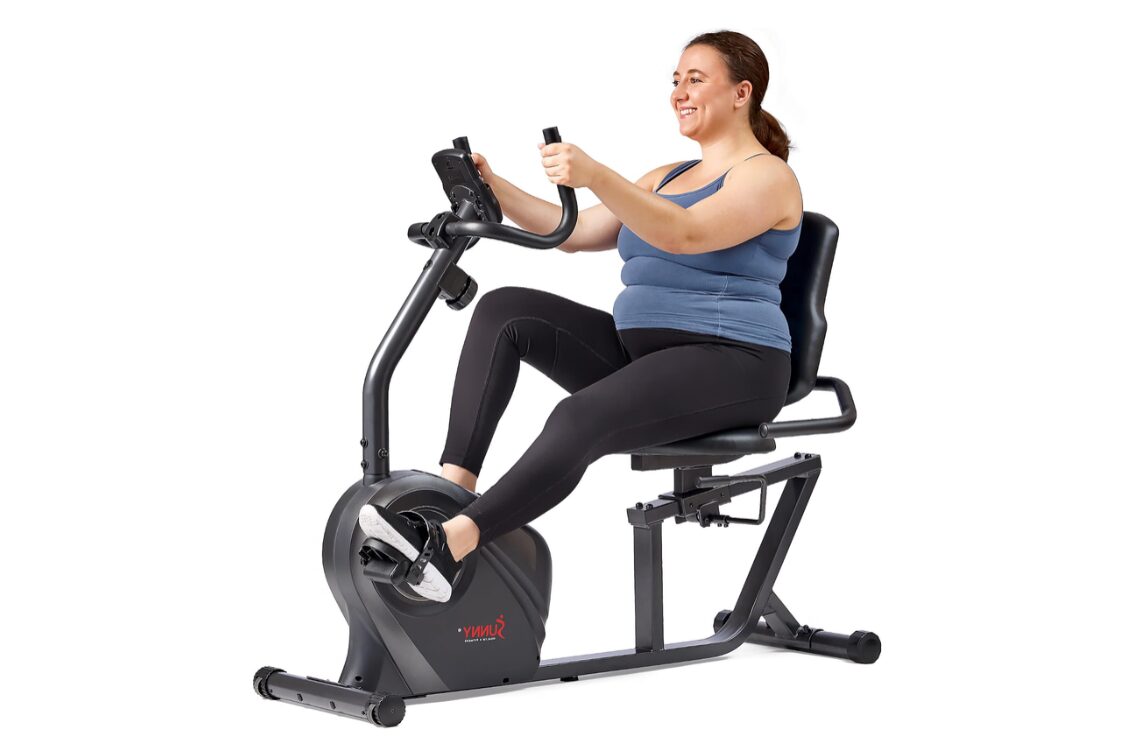
A recumbent exercise bike is often a practical starting point for people who want to exercise while keeping their body supported. Unlike a traditional upright bike, it has a wider seat, a backrest and pedals positioned in front of the body.
This design allows you to exercise in a more relaxed, reclined position. It may be easier to get on and off than some upright machines, although access still depends on the frame design and your mobility.
Why consider a recumbent bike?
- The backrest provides support while exercising.
- The seated position reduces the need to support your body weight while pedaling.
- Resistance can usually be adjusted to suit your current fitness level.
- You can begin with short sessions and gradually increase the time.
- Many models offer a step-through frame or a relatively low seat height.
A recumbent bike may be worth considering if you have difficulty standing for extended periods or prefer a supported exercise position. However, cycling still requires repeated bending and straightening of the knees and hips. If this movement causes discomfort, adjust the seat position or try a different activity.
Models to consider
- Sunny Health & Fitness Smart Recumbent Bike: A home exercise option with adjustable resistance and a supported seating position.

- Marcy NS-1206R: A recumbent bike option for people looking for a relatively straightforward home cycling machine.

What to check before buying: Look for an adjustable seat, a comfortable backrest, easy-to-reach controls and a frame that allows you to get on and off without excessive bending. The seat should be positioned so your knee remains slightly bent at the bottom of the pedal stroke.
2. Motorized Under-Desk Elliptical: Best for Gentle Seated Movement
A motorized under-desk elliptical is a compact machine designed to sit on the floor in front of a chair. It moves your feet through a small elliptical pattern while you remain seated.
Unlike a conventional elliptical, some motorized models move the pedals for you. This can be useful when you want gentle leg movement without having to generate all the motion yourself.
Why consider a motorized under-desk elliptical?
- You can use it while sitting in a regular chair.
- It takes up less space than a full-size exercise machine.
- Many models offer adjustable speed or resistance settings.
- Some include forward and reverse movement.
- It can provide an easy way to add movement to a sedentary day.
A motorized model may be worth considering if standing exercise is difficult or if you want a compact machine for use at home or under a desk.
However, powered movement is not automatically suitable for everyone. If your joints are painful or stiff, even passive movement may be uncomfortable. Start with the lowest setting and a short session. Stop if the movement increases pain.
Models to consider
- Sunny Health & Fitness Smart Motorized Mini Elliptical: A compact motorized option designed for seated use.

- Cubii Move: Compact seated elliptical options designed for use while sitting.

What to check before buying: Look at the pedal height, machine footprint, noise level, speed settings and whether the unit can move around on your floor. Check that your chair provides enough clearance and that your knees do not rise uncomfortably high.
3. Full-Size Elliptical: Best for Standing Low-Impact Cardio
A full-size elliptical allows you to exercise while standing, moving your feet through a smooth, continuous path. Your feet generally remain on the pedals rather than repeatedly striking the floor as they do when running.
Many ellipticals also have moving handles, allowing you to involve your arms and upper body.
Why consider a full-size elliptical?
- It provides a standing cardiovascular workout.
- The pedals follow a guided movement path.
- Resistance can often be adjusted.
- Some models offer moving handles for upper-body involvement.
- It can provide a longer exercise session without the impact associated with running.
An elliptical may be a good option if you can stand comfortably, maintain your balance and move your hips and knees through the machine’s stride.
It is not necessarily the best choice for someone with significant knee, hip, ankle or foot pain. The repeated bending and weight-bearing movement may still be uncomfortable. Some machines also have a stride length that does not suit shorter users or people with limited mobility.
Models to consider
- Niceday Elliptical: A full-size home elliptical option.

- NordicTrack AirGlide: An elliptical-style machine with adjustable workout settings, depending on the model.

What to check before buying: Pay attention to stride length, pedal spacing, step-up height, handle position and overall stability. If possible, try the machine before purchasing. A comfortable stride is more important than the number of workout programs.
4. Magnetic Rowing Machine: Best for Full-Body Exercise
A rowing machine works several major muscle groups at the same time. You push through your legs, move your torso and pull the handle toward your body. This creates a combination of cardiovascular and muscle-strengthening exercise.
Magnetic rowing machines use magnetic resistance, which is generally designed to provide a smooth and relatively quiet rowing motion.
Why consider a rowing machine?
- It works the legs, back, arms and core.
- Resistance can usually be adjusted.
- Magnetic models are often quieter than some other resistance systems.
- It provides a seated workout rather than requiring prolonged standing.
However, rowing is not automatically an arthritis-friendly activity. The movement requires repeated bending at the knees and hips, leaning forward and backward, and gripping a handle. It may be difficult for people with painful finger joints, wrist arthritis, limited hip movement or significant knee stiffness.
If you are considering a rower, try the movement carefully before buying. A short, gentle stroke may be more comfortable than a full rowing motion.
Models to consider
- Concept2 RowErg: A well-known rowing machine with adjustable resistance through its air-resistance system. It is not a magnetic rower, but it is a useful comparison when evaluating rowing machines.

- Sunny Corezy Magnetic Rower: A magnetic-resistance option for home rowing workouts.

What to check before buying: Look at seat height, handle grip size, foot support, resistance adjustment and the amount of knee bending required. A machine that is difficult to get on and off may not be practical for someone with limited mobility.
5. Seated Recumbent Stepper: Best for Supported Whole-Body Movement
A seated recumbent stepper is different from a standard exercise bike. It uses a stepping motion, often with handles that allow you to move your arms while exercising your legs.
Machines in the NuStep-style category are commonly used in rehabilitation and fitness settings. Some home models offer a similar supported exercise position.
Why consider a seated recumbent stepper?
- You exercise while seated with back support.
- The stepping movement can involve both arms and legs.
- Resistance can often be adjusted.
- It does not require you to maintain balance while standing.
- It may offer a useful alternative to conventional cycling.
This type of machine may be worth considering if you prefer a supported position but want to involve more of your body than a small pedal exerciser allows.
The stepping movement still requires hip and knee motion. Make sure you can move through a comfortable range without forcing your joints.
Model to consider
- Teeter FreeStep: A recumbent cross-trainer designed to combine a seated stepping motion with upper-body handles.

What to check before buying: Consider the machine’s overall size, step-through access, seat adjustment, handle movement and resistance range. These machines can take up considerable floor space, so measure your available area before ordering.
6. Under-Desk Pedal Exerciser: Best for Simple Everyday Movement
An under-desk pedal exerciser is a compact device with two pedals, similar to the lower portion of a stationary bicycle. It can be placed in front of a chair and used while sitting.
Some models are simple manual pedal units, while others offer electronic displays, adjustable resistance or additional features.
Why consider an under-desk pedal exerciser?
- It is generally smaller and less expensive than a full exercise bike.
- It can be used while watching television or reading.
- It allows you to add short periods of movement throughout the day.
- Resistance can often be adjusted.
- Some models can also be used for gentle arm pedaling when placed on a stable table.
A pedal exerciser is not a replacement for a full cardiovascular workout, but it can be a convenient way to reduce long periods of sitting.
It may be useful for people who want a simple seated movement option without purchasing a large machine. However, the pedals may sit too low or too close to the chair for some users. This can create an uncomfortable knee angle.
Models to consider
- LifePro FlexCycle: A compact pedal exerciser designed for seated use.

- DeskCycle: Another compact pedal exerciser option to compare.

What to check before buying: Look for adjustable resistance, a stable base, non-slip feet, comfortable pedal straps and a display that is easy to read. Check the recommended user position and make sure the machine will fit comfortably in front of your chair.
7. Upright Stationary Bike: Best for Traditional Indoor Cycling
An upright stationary bike resembles a conventional outdoor bicycle. You sit in a more vertical position, with the pedals positioned below your body.
It provides a familiar cycling movement and generally takes up less space than some larger recumbent machines.
Why consider an upright stationary bike?
- It offers a straightforward indoor cycling workout.
- Resistance can usually be adjusted.
- It can be a compact alternative to a recumbent bike.
- Many models include basic workout displays.
- You can begin with low resistance and short sessions.
An upright bike may suit someone who can sit comfortably in a more vertical position and does not need the additional back support of a recumbent model.
However, it may be less comfortable if you have difficulty bending forward, maintaining balance or getting onto a higher seat. People with painful hands or wrists may also find the handlebar position uncomfortable.
Models to consider
- Merach Exercise Bike: Whisper-quiet magnetic resistance won’t disturb roommates or family. Reinforced frame handles up to 300 lbs with zero wobble or flex.

- Barwing Stationary Bike: Three riding positions. Super quiet magnetic resistance. Folds to 1.8 sq ft for tiny apartment storage.

What to check before buying: Look for an adjustable seat and handlebars, a stable frame, easy-to-use resistance controls and a comfortable pedal position. Make sure you can get on and off safely.
If you are unsure between an upright and recumbent bike, a recumbent model generally offers more back support and may be easier to use for people who prefer a reclined position.
Comparing the Seven Exercise Machines
| Machine | Exercise Position | Main Advantage | Possible Limitation |
|---|---|---|---|
| Recumbent bike | Seated, reclined | Back support and adjustable cycling | Repeated knee and hip movement |
| Motorized mini elliptical | Seated | Compact, powered foot movement | May not suit sensitive joints |
| Full-size elliptical | Standing | Guided, weight-bearing cardio | Requires balance and standing tolerance |
| Magnetic rower | Seated, sliding | Works several muscle groups | Requires bending, pulling and gripping |
| Recumbent stepper | Seated, supported | Arm and leg movement | Larger footprint and cost |
| Pedal exerciser | Seated | Simple everyday movement | Limited resistance and range |
| Upright stationary bike | Seated, upright | Familiar cycling movement | Less back support |
Which Exercise Machine Is Best for Different Types of Arthritis?
There is no single machine that works for everyone. The most suitable option depends on the joints affected, your mobility and the movements you can perform comfortably.
If You Have Knee Arthritis
A recumbent bike or seated pedal exerciser may be worth trying because you can remain seated and control the pace. However, both require repeated knee movement.
A shorter pedal range, lower resistance and properly adjusted seat may make cycling more comfortable. Avoid forcing your knees through a movement that causes pain.
If You Have Hip Arthritis
A recumbent bike may provide a supported position, but the amount of hip bending can vary between machines. A model with an adjustable seat may allow you to find a more comfortable position.
A full-size elliptical or rower may require a larger range of hip movement, so try the motion carefully before committing to a purchase.
If You Have Hand or Wrist Arthritis
Machines with minimal gripping requirements may be easier to use. A pedal exerciser or recumbent bike with simple controls may be worth considering.
Rowing machines and ellipticals with moving handles require more hand and arm involvement. Check whether the grips are comfortable and whether you can hold them without increasing discomfort.
If You Have Balance or Mobility Difficulties
A recumbent bike, motorized under-desk elliptical or seated pedal exerciser may be more practical than a standing elliptical.
Look for a low step-through design, stable construction and easy access to the seat. If getting on and off a machine is difficult, consider having someone help you assess it before buying.
How to Choose an Exercise Machine for Arthritis
Before spending money on an exercise machine, consider these practical points.
1. Choose a movement you can perform comfortably
The machine should allow you to move without forcing a painful joint through a large range of motion. A machine with many features is not useful if its basic movement is uncomfortable.
2. Look for adjustable resistance
Start with very light resistance. Being able to make small adjustments is more useful than having a machine with a high maximum resistance that you may never need.
3. Check the seat and access
If you have difficulty bending, standing or balancing, seat height and step-through access matter. A comfortable seat and backrest can make a significant difference.
4. Consider the machine’s footprint
A full-size elliptical or recumbent stepper needs considerably more space than a compact pedal exerciser. Measure the area where you plan to use it, including room to get on and off.
5. Check the controls and display
Large, easy-to-read controls are helpful if you have finger stiffness or reduced hand dexterity. Avoid machines that require complicated adjustments during exercise.
6. Consider noise and storage
If you live in a smaller home or apartment, a quiet machine may be preferable. Foldable or compact models can also be easier to store, although they should still feel stable during use.
7. Don’t buy based on features alone
A machine does not need dozens of programs, digital screens or app connections to provide useful movement. Comfort, stability, adjustability and ease of use should come first.
How to Start Exercising With Arthritis
If you have been inactive or are returning to exercise after a flare-up, start slowly.
- Begin with a few minutes at a comfortable pace.
- Use the lowest practical resistance.
- Avoid trying to match the workout duration of someone without your limitations.
- Increase your time gradually if the movement feels comfortable.
- Allow recovery time between sessions when needed.
- Stop if you experience sharp pain, unusual swelling or a significant increase in symptoms.
Some mild muscle tiredness can occur when starting a new activity. However, exercise should not leave your joints significantly more painful or swollen. If symptoms remain worse after exercise, reduce the duration or intensity and consider asking a physiotherapist or healthcare professional for guidance.
If you have severe joint symptoms, recent surgery, significant balance problems or other health concerns, get advice before beginning a new exercise program.
Frequently Asked Questions
What is the best exercise machine for someone with arthritis?
There is no single best machine for everyone. A recumbent exercise bike is a reasonable starting point for people who prefer supported seated exercise. A motorized under-desk elliptical or pedal exerciser may be more practical for someone who wants a compact seated option. The best choice is the one that allows comfortable movement without aggravating your symptoms.
Are exercise bikes good for knee arthritis?
They can be, provided the cycling movement is comfortable. A recumbent bike offers back support and adjustable positioning. Start with low resistance and make sure the seat is positioned correctly so your knee is not excessively bent at the top of the pedal stroke.
Is an elliptical machine good for arthritis?
An elliptical provides a guided movement pattern without the repeated foot impact associated with running. However, it still requires standing, balance and repeated movement of the hips and knees. It may not be suitable for everyone with arthritis, particularly those with significant weight-bearing pain or balance difficulties.
Is a rowing machine suitable for people with arthritis?
It depends on the joints affected. Rowing involves bending the knees and hips, leaning the torso and gripping a handle. It may be difficult for people with hand, wrist, hip or knee arthritis. Try the movement before buying a rowing machine.
Are under-desk ellipticals and pedal exercisers worth buying?
They can be useful for adding short periods of seated movement to your day. They are generally more compact than full-size exercise machines, but they provide a different type of workout. They should not be viewed as a complete replacement for other physical activity.
Should I exercise during an arthritis flare-up?
It depends on the severity of the flare and the type of movement involved. Gentle movement may help some people avoid becoming overly stiff, but painful or swollen joints may need a break from certain activities. Avoid pushing through increased pain. A healthcare professional or physiotherapist can help you determine what is appropriate during a flare.
How long should I use an exercise machine if I have arthritis?
Start with a short session, even just a few minutes, and increase gradually if you tolerate it well. Your starting point will depend on your fitness, symptoms and the machine you choose. Consistent, manageable activity is generally more practical than occasional long workouts.
Final Thoughts
The best exercise machine for arthritis is not necessarily the most expensive or the one with the most features. It is the machine that fits your mobility, feels comfortable to use and makes it easier to stay active.
For supported seated exercise, consider a recumbent bike or compact pedal machine. If you can stand comfortably, a full-size elliptical may offer another option. A rowing machine or recumbent stepper can provide more whole-body movement, but both require specific joint movements that may not suit everyone.
Take time to compare the machines, check their dimensions and consider trying the movement before purchasing. Starting gently and choosing an activity you can maintain is more important than buying a machine that promises an intense workout.
Related Reading
- Best Exercise Equipment for Arthritis: Strength, Mobility & Cardio
- Arthritis Exercise Guide: Safe Ways to Stay Active
- Best Hand Therapy Tools for Arthritis
- Morning Stiffness and Arthritis: Ways to Get Moving
Medical Disclaimer: This article is for informational purposes only and does not constitute medical advice. Always consult your doctor, rheumatologist, or occupational therapist before making changes to how you manage your arthritis.
