
Disclosure: As an Amazon Associate, Arthritis Wares earns from qualifying purchases at no extra cost to you. We are not paid or sponsored by any manufacturer. Affiliate links help support our work.
Bathing can become more difficult when arthritis affects your hands, knees, hips, back, or balance. Standing for the length of a shower may be tiring, while stepping over a bathtub wall, lowering onto a low seat, or pushing yourself upright can put extra strain on painful joints.
A suitable shower chair, stool, or transfer bench can provide a place to sit while bathing and may make parts of the routine easier to manage. The right option depends on your bathroom layout, how much support you need, and how comfortably you can sit down and stand up.
This guide compares several types of bathing seats, explains what to look for, and highlights features that may be particularly useful for people with arthritis.
Quick Answer: Which Shower Seat Is Best for Arthritis?
- Best starting point for everyday support: A height-adjustable shower chair with a backrest and armrests.
- Best for stepping over a bathtub wall: A bathtub transfer bench that lets you sit down before moving your legs over the tub edge.
- Best if turning is difficult: A compatible swivel-seat bathing chair, provided the user can operate and lock the mechanism safely.
- Best for higher weight-capacity needs: A heavy-duty chair or transfer bench with a verified rating that comfortably accommodates the user.
- Best for a small shower: A compact shower stool, if the user has enough balance and does not need a backrest or armrests.
A chair’s weight rating alone does not determine whether it is suitable. Seat dimensions, height, leg stability, arm support, bathroom space, and the user’s ability to transfer safely are equally important.
Shower Chair Comparison at a Glance
| Type or example | Main advantage | Best suited for |
|---|---|---|
| Medline shower chair with padded armrests and back | Back and arm support for sitting and rising | People who need support during a seated shower |
| Drive Medical PreserveTech 360° Swivel Bath Chair | Rotating seat design | People who have difficulty turning their body |
| Heavy-duty shower chair, such as a model rated for 500 lb or more | Higher stated weight capacity on selected models | People who need a higher-capacity seat |
| Medline Bariatric Transfer Bench | Extended support across a bathtub edge | People who struggle to step into a bathtub |
| Medline Shower Stool | Compact seating without a full backrest | People who need a place to sit but require less upper-body support |
Before buying: Product configurations, weight limits, dimensions, and availability can vary by model and retailer. Check the exact listing and manufacturer’s instructions rather than relying on a product-family name alone.
1. Medline Shower Chair With Padded Armrests and Back
Best for: Everyday seated showering with additional support
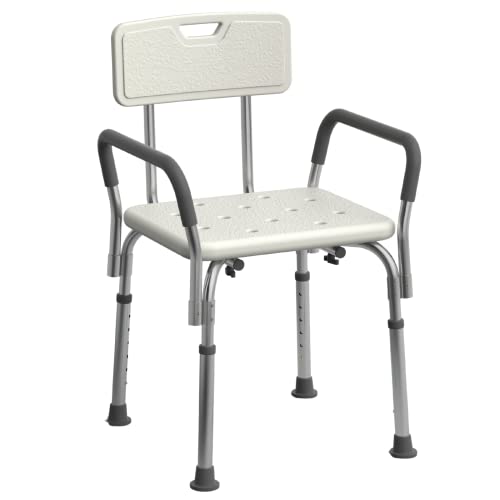
A shower chair with both a backrest and armrests is a sensible starting point for many people with arthritis. The backrest provides support while sitting, and the armrests offer places to rest the hands or push against when changing position.
This style may be useful when knee or hip stiffness makes standing for several minutes uncomfortable, or when hand pain makes gripping a narrow seat edge difficult.
What to look for
- Height adjustment that allows the feet to rest securely on the floor.
- Armrests that are comfortable to hold and positioned appropriately for the user.
- A backrest that supports the person without forcing an awkward posture.
- Drainage openings and a seat surface that is easy to clean.
- A frame that fits the available shower or bathtub floor.
Potential drawbacks
A chair with arms and a back takes up more room than a stool. Armrests can also get in the way if the user needs to transfer sideways from a wheelchair or another seat. Measure the bathing area before ordering.
Check Price on Amazon: Search for the Medline shower chair with padded armrests and back, then confirm the exact model, dimensions, and weight capacity.
2. Drive Medical PreserveTech 360° Swivel Bath Chair
Best for: People who find turning or repositioning difficult
A swivel-seat bathing chair allows the seat to rotate. Depending on the person’s mobility and the bathroom layout, this may make it easier to change direction without twisting the hips or trunk as much.
The Drive Medical PreserveTech 360° Swivel Bath Chair is one option to investigate. Its swivel mechanism is the main reason to consider this style, rather than assuming it is automatically safer than a fixed chair.
Potential benefits
- May make repositioning easier for some users.
- Can reduce the need for a large twisting movement.
- May be helpful when stiffness affects the hips, back, or knees.
What to check before buying
- Confirm that the particular model fits the intended shower or bathtub.
- Check its exact weight capacity and seat-height range.
- Make sure the user can operate the swivel and understand how it locks.
- Confirm that the seat is locked as instructed before sitting down or standing up.
A swivel seat introduces a moving mechanism that needs to be used correctly. It may not suit someone who has difficulty understanding the locking action or maintaining their balance during transfers. A physiotherapist or occupational therapist can help determine whether a swivel design is appropriate.
Check Price on Amazon: Search for the Drive Medical PreserveTech 360° Swivel Bath Chair and verify the current model specifications.

3. Heavy-Duty Shower Chair With a Higher Weight Capacity
Best for: Users who need a chair rated for a higher body weight
Standard shower chairs are not suitable for everyone. If a higher weight capacity or wider seating area is needed, look for a purpose-designed heavy-duty model.
Some current heavy-duty shower chairs are advertised with capacities of 500 to 550 lb, but these ratings are model-specific and should be confirmed directly on the manufacturer’s information and product label.
For example, the KingPavonini 360° Swivel Shower Chair is marketed as a higher-capacity swivel option. It combines rotation with a more substantial frame design. Consider it only after confirming that its dimensions, seat style, and mechanism are appropriate for the user.
Important selection criteria
- Rated capacity: Choose a model with an appropriate margin above the user’s weight and follow the manufacturer’s limits.
- Seat width and depth: The user should fit comfortably without feeling squeezed or perched at the edge.
- Frame and leg design: Look for secure bracing, locking height adjustments, and feet that sit flat on the bathing surface.
- Arm and back support: These features may help with positioning, but must fit the user and bathroom.
- Assembly: Follow the instructions carefully and verify every locking pin and connection before use.
A higher weight rating does not guarantee a better fit or greater stability in every bathroom. Do not use a chair that rocks, has damaged parts, or cannot sit flat on the floor.
Check Price on Amazon: Search for the KingPavonini 360° Swivel Shower Chair or another heavy-duty shower chair, and verify its current rated capacity and dimensions.

4. Medline Bariatric Transfer Bench
Best for: People who have difficulty stepping over a bathtub wall
A transfer bench is different from a shower chair. It extends across the bathtub wall, with part of the seat outside the tub and part inside. The user sits down outside the tub and then moves across the seat, bringing their legs over the wall with assistance or a transfer technique appropriate to their abilities.
This design may be worth considering when lifting a leg over the tub edge is difficult because of knee, hip, or back stiffness, limited flexibility, or balance concerns.
The Medline Bariatric Transfer Bench is one higher-capacity option to investigate. The retailer listing describes a 550 lb capacity, but confirm that rating and the exact model specifications before purchasing.
What to check
- The bench fits the tub’s width and wall height.
- The legs can be adjusted to suit the bathroom layout and sit securely on the floor.
- The seat and back provide adequate support.
- The user’s transfer method is suitable for the bench and can be performed safely.
- Any required armrests, safety belt, or additional support are compatible with the model.
A transfer bench occupies more space than a regular shower chair and may not suit every tub. Installation and transfer technique matter. If getting across the tub wall is already difficult, ask a qualified therapist about the safest arrangement before attempting it alone.
Check Price on Amazon: Search for the Medline Bariatric Transfer Bench and confirm the capacity, measurements, and installation requirements.

5. Dr. Kay’s Shower Stool
Best for: Compact seating when a backrest is not required
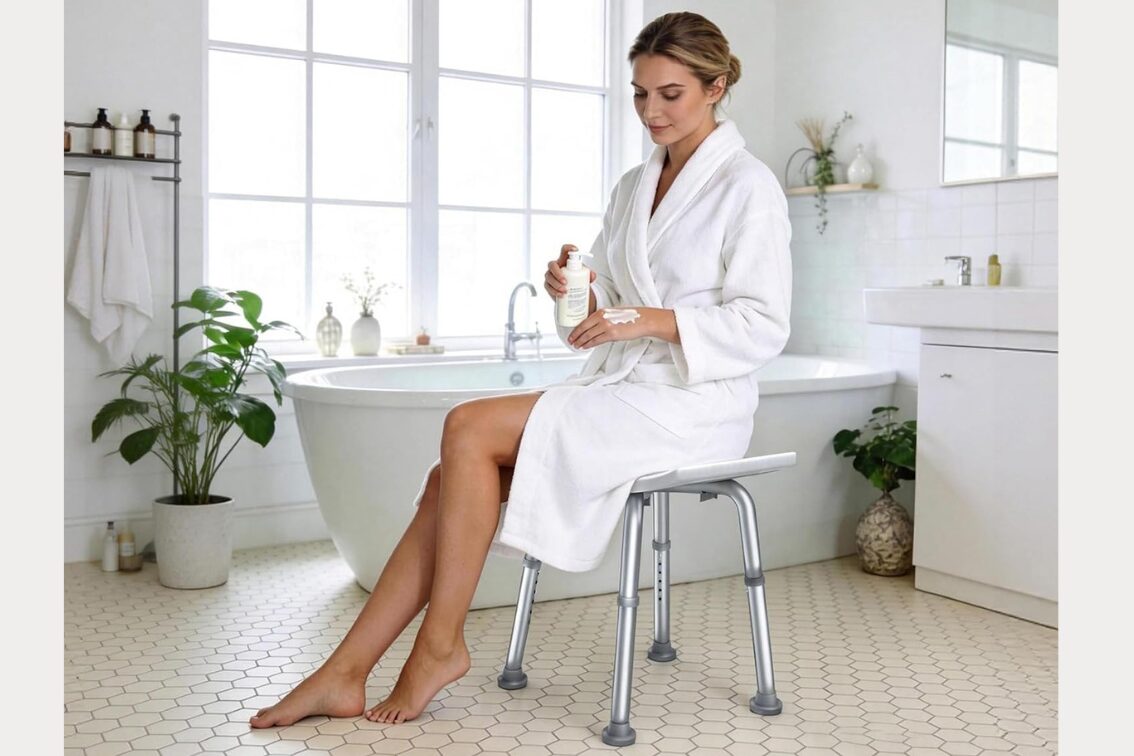
A shower stool provides a small seat without the full backrest of a shower chair. Its compact shape can be useful in a smaller shower, and it is usually easier to move when the bathing area needs to be cleared.
The Dr. Kay’s Shower Stool is one option to compare. Check the exact version carefully because similarly named products may have different dimensions and weight ratings.
A stool may suit someone who can sit upright comfortably and does not need the additional support of a backrest or armrests. It is generally a less suitable starting point for someone who has significant balance problems or needs arm support to sit down and stand up.
Before choosing a stool
- Check the seat height and width.
- Make sure all legs sit firmly on the shower floor.
- Confirm the rated weight capacity.
- Consider whether the user can lower onto and rise from the stool without pulling on unstable bathroom fixtures.
- Choose a chair with a back and arms instead if additional support is needed.
A compact seat is not necessarily the best choice simply because it saves space. The user must be able to sit and reposition safely.

How to Choose the Right Shower Seat for Arthritis
Consider which movement is most difficult
Think about the part of bathing that causes the most trouble:
- Standing for several minutes: A shower chair may allow the user to sit while washing.
- Lowering onto a seat or standing up: Armrests and an appropriate seat height may help.
- Stepping over a bathtub wall: A transfer bench may be more appropriate than a chair placed inside the tub.
- Turning the body: A swivel design may help if the user can operate and lock it correctly.
- Maintaining an upright position: A backrest may be preferable to a stool.
- Fitting into a small shower: Measure the space and compare the chair’s full footprint, including the legs and armrests.
Check seat height
A seat that is too low can make standing up more difficult, while one that is too high may leave the feet unsupported.
Look for an adjustment range that suits the user’s height and the bathing area. When seated, the feet should be supported, and the position should feel stable rather than forcing a deep squat or leaving the legs dangling. The best position may vary with the person’s mobility and transfer needs.
Decide whether armrests and a backrest are needed
Armrests may offer a place to rest the hands or push from, but they can also obstruct a sideways transfer. A backrest may help with sitting comfort and positioning, but a stool may be easier to fit into a confined space.
Choose according to the user’s actual needs, not simply the number of features advertised.
Measure the bathroom before ordering
Measure the shower floor or the inside of the tub, and compare those measurements with the product’s full footprint. Check the width between the legs, seat dimensions, height range, and whether the chair can sit level without obstructing the drain.
For a transfer bench, measure the tub wall and the space needed outside the tub as well. Do not assume that a product will fit because the seat itself appears narrow enough.
Check weight capacity and construction
The manufacturer’s stated capacity is a basic requirement, not a complete measure of suitability. Follow the specified limit and look for secure leg adjustments, a stable frame, undamaged parts, and feet that maintain contact with the floor.
If a person needs a particularly wide or heavy-duty seat, confirm the exact dimensions and weight rating with the manufacturer or supplier.
Shower Chair Safety and Maintenance
A shower seat is only one part of a safer bathing setup. It does not eliminate the risk of slipping or falling.
- Assemble the chair exactly as directed.
- Confirm that adjustment pins and locking mechanisms are fully engaged.
- Place the chair on a firm, level surface where every foot sits flat.
- Keep soap residue from building up on the seat and feet.
- Inspect the frame, feet, fasteners, and swivel mechanism regularly.
- Use grab bars that are properly installed for support; do not pull on towel rails or shower doors.
- Consider a handheld showerhead and accessible soap or shampoo to reduce reaching.
- Ask a physiotherapist or occupational therapist for advice if getting into position, transferring, or standing remains difficult.
Do not rely on a suction-cup bath mat or a shower chair to compensate for an unstable setup. Check that all equipment is compatible with the bathing surface and the user’s needs.
Frequently Asked Questions
Is a shower chair helpful for arthritis?
It can be. Sitting while showering may reduce the need to stand for an extended period and may make bathing less tiring. The most suitable chair depends on the joints affected, balance, strength, and ability to transfer.
Should I choose a shower chair with arms?
Armrests can provide support when sitting down or standing up, but they may obstruct certain transfers. If the user needs help rising from a seat, compare models with armrests and seek advice if you are unsure which design fits their movement pattern.
Is a shower stool or a shower chair better?
A stool takes up less space, but it has no backrest and may not provide enough support for someone with balance difficulties. A chair with a back and armrests is often a more appropriate option when the user needs additional support.
What is the difference between a swivel shower chair and a transfer bench?
A swivel shower chair rotates its seat and is generally used within the bathing area. A transfer bench extends across a bathtub wall so the user can sit down before moving their legs over the wall. Some transfer benches also have swivel or sliding features, but these are different products with different space and transfer requirements.
What weight capacity should I choose?
Check the exact manufacturer’s rating and follow the stated limit. The seat also needs to be wide enough, the height appropriate, and the frame stable on the intended surface. If the user needs a higher-capacity model, verify the rating and dimensions before ordering.
Can a shower chair go inside a bathtub?
Some models can, but not every chair fits every tub. Check the tub’s inside dimensions, floor shape, drain location, and the manufacturer’s instructions. Every leg must sit securely on the bathing surface. A transfer bench may be a better option if stepping over the tub wall is difficult.
Does a swivel shower seat make bathing safer?
A swivel seat may make turning easier for some users, but it is not automatically safer for everyone. The user must be able to operate the mechanism correctly and follow the locking instructions. A therapist can help assess whether it is suitable.
Final Recommendation
For many people with arthritis, a height-adjustable shower chair with a backrest and armrests is a practical place to start. A transfer bench is worth considering when stepping over a bathtub wall is the main difficulty, while a swivel seat may help some users who struggle with turning.
If a higher weight capacity is required, compare heavy-duty models carefully and verify their exact ratings and dimensions. The best choice is the seat that fits the bathroom, supports the user’s needs, and can be used according to the manufacturer’s instructions.
Related Reading
- Arthritis Tools for Safe Bathing and Showering — Explore other aids that may make washing and bathing easier.
- Bathing Tips for Arthritis Relief: Safe and Soothing Shower Ideas — Review practical ways to simplify a bathing routine.
- Best Non-Slip Bath Mats for Arthritis — Compare mats designed for use inside the tub and on the bathroom floor.
- Arthritis-Friendly Home Modifications: A Room-by-Room Guide — Find other changes that may make everyday tasks easier.
Medical Disclaimer: This article is for informational purposes only and does not constitute medical advice. Always consult your doctor, rheumatologist, or occupational therapist before making changes to how you manage your arthritis.
