

Disclosure: As an Amazon Associate, Arthritis Wares earns from qualifying purchases at no extra cost to you. We are not paid or sponsored by any manufacturer. Affiliate links help support our work.
Managing arthritis often means recurring purchases — braces, ergonomic tools, therapy devices, comfort aids, mobility supports, and other daily living products. Even modest costs add up over time, so it’s worth knowing where genuine savings tend to show up on Amazon, and how to tell a real deal from an inflated one.
How We Approached This Guide
This isn’t a roundup of today’s discounts, which go stale within days. Instead we focused on the repeatable strategies — where deals reliably show up, how to tell a real price drop from an inflated one — so the guide stays useful no matter when you’re reading it.
How Can You Save Money on Arthritis Products on Amazon?
You can typically reduce costs by identifying the specific problem you’re solving before you shop, watching Today’s Deals, clipping digital coupons, using Wishlists to track price drops, comparing Subscribe & Save pricing, browsing Amazon Warehouse and Outlet listings, and considering Renewed items. Timing purchases around major sales events helps too. Combining a few of these approaches tends to produce the most reliable savings — but the biggest discount isn’t always the best deal.
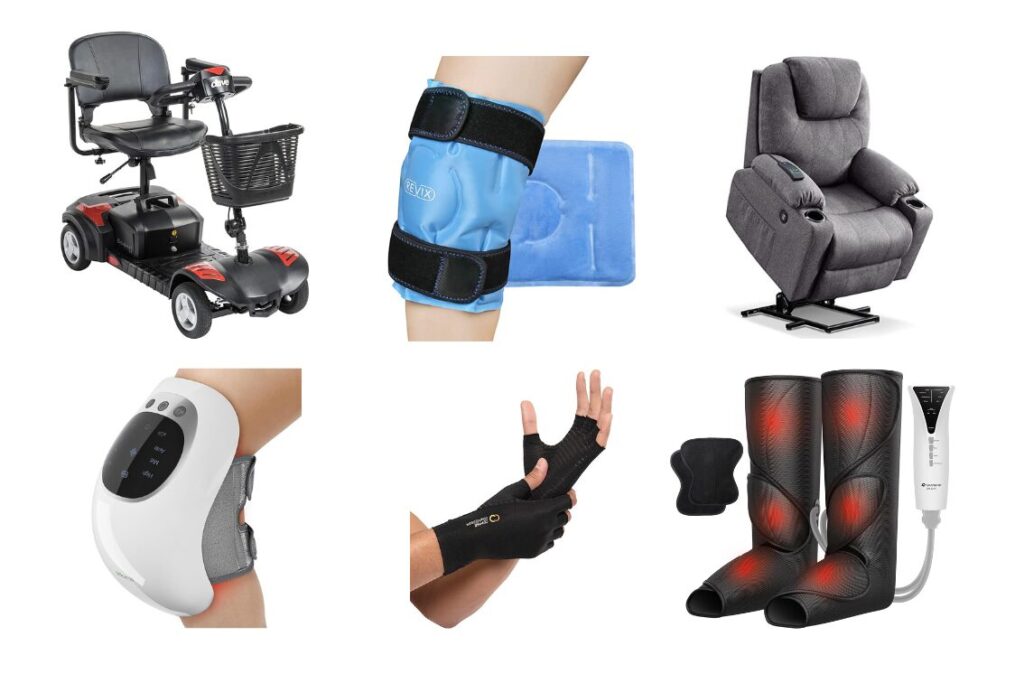
The Cheapest Product Isn’t Always the Best Deal
It’s tempting to choose the least expensive option when shopping for arthritis aids. But a lower price doesn’t always mean better value.
A $10 jar opener may seem like a bargain, but if it still requires significant hand strength, it may end up sitting unused in a drawer. A cheap brace that doesn’t fit correctly may not provide the support you need. A heavily discounted therapy device may be missing the one feature that actually matters to you.
Before looking for the lowest price, identify the problem you’re trying to solve — then look for the best combination of price, fit, quality, and usefulness.
If you’re still deciding what type of product you need, start with our Arthritis Supplies & Tools: Complete Guide to Daily Living Aids.
Start With the Problem, Not the Discount
One of the easiest ways to overspend is to start browsing without a specific need in mind. It’s easy to see a product marketed as an “arthritis must-have” and assume you need it — even when it doesn’t address your particular problem.
Instead, start by asking what task is difficult for you right now:
- Difficulty opening jars → look for a jar opener that reduces grip and twisting
- Difficulty buttoning clothing → consider a button hook or adaptive clothing
- Trouble reaching low or high objects → consider a reacher or grabber
- Difficulty standing from a chair → explore appropriate seating or stand-assist options
- Hand fatigue while writing → look for a larger, ergonomic pen
- Difficulty getting into the shower → explore bathroom safety aids
Once you know the problem, you’re comparing products designed to solve it — not just chasing whatever has the biggest discount badge.
Check Today’s Deals for Short-Term Discounts
Amazon’s Today’s Deals section regularly features limited-time markdowns across health, wellness, and household categories. Braces, supports, cushions, and ergonomic tools show up here often — but not every “deal” reflects real value.
Before buying from a deal:
- Filter by Health & Household or Medical Supplies
- Sort by discount, high to low
- Compare against the item’s typical price history — some deals start from an inflated base price
- Be cautious with Lightning Deals — the countdown timer is designed to create urgency, which can lead to rushed decisions
Short-term discounts work best for products you already planned to buy, not ones you’re discovering for the first time under a countdown clock.
Use Wishlists to Track Price Drops

Amazon Wishlists double as a simple price-monitoring tool. Adding arthritis products to a dedicated list lets you revisit items later and notice price changes, new coupons, or stock changes — without repeating the same search over and over.
- Create category-specific lists — Pain Relief, Mobility Aids, Daily Living Tools, Sleep & Comfort
- Check back periodically, since discounts and coupons rotate
- Keep a short “buy soon” list so you’re ready to move during sales events
- Turn on app notifications if you’re shopping from your phone
Don’t Miss Amazon’s Digital Coupons

Digital coupons are one of the most overlooked ways to save on Amazon. They apply instantly at checkout, but they’re easy to miss if you’re moving quickly through a purchase — and they often provide better savings than the “sale” price alone.
Pricing on a given listing tends to cycle between a base price, a coupon discount, and occasionally a combined coupon-plus-sale price. Shoppers who check back over a few days often land on better pricing than those who buy on the first visit.
- Always look for a “Clip Coupon” checkbox near the price
- Confirm the coupon applies to the exact size or variation you want
- Revisit listings — coupons appear and disappear without much warning
- Stack coupons with Subscribe & Save or sale pricing where possible
- Don’t assume the price without a visible coupon is the lowest it’ll go
Subscribe & Save for Recurring Purchases
Subscribe & Save pricing can meaningfully lower long-term costs on items you buy repeatedly, such as supplements, topical pain relief products, personal care items, and household aids you replace regularly.
It’s still worth comparing periodically — a one-time sale price can occasionally beat the subscription discount. If you don’t need an item regularly, a subscription may create unnecessary purchases rather than saving you money.
Amazon Resale and Outlet: Open-Box and Overstock Savings

Amazon Resale lists returned, open-box, or cosmetically damaged items at reduced prices, often with no functional issues. This tends to work well for non-wearable products like seat cushions, furniture aids, mobility accessories, and therapy devices.
For wearable or hygiene-sensitive items like braces and compression gear, read the condition notes carefully before buying used or open-box — or consider whether paying more for new is worth the peace of mind.
Amazon Outlet is worth a periodic look too — it carries surplus and discontinued inventory, and occasionally includes assistive devices or household aids at a meaningful discount.
Amazon Renewed for Lower-Cost Devices
Amazon Renewed listings are professionally inspected, refurbished products, and they can offer substantial savings on higher-ticket electronics like TENS units, massagers, and other assistive gadgets. Always check the warranty terms and condition grade before buying — “Renewed” quality can vary by seller.
Buy the Right Product the First Time
This may be the most important money-saving strategy of all. A product that doesn’t work for you isn’t a bargain — even if you bought it at a steep discount.
Before purchasing an arthritis aid, consider:
- Fit — especially important for braces, compression gloves, supports, and mobility aids
- Ease of use — can you actually operate the product comfortably, or does it require more grip strength than you have?
- Weight — if hand or arm strength is limited, a lighter product may be easier to use
- Adjustability — can you customize the product to fit your needs?
- Return policy — can you return it if it doesn’t work for you?
- Reviews — do they mention the specific issue you’re trying to solve?
A few extra minutes of research can prevent an expensive mistake. For more help choosing the right type of device, see How to Choose Arthritis Assistive Devices: Buyer’s Guide.
When Are Arthritis Products Cheapest on Amazon?

Major sales events — Prime Day, Black Friday and Cyber Monday, and seasonal promotions — tend to bring the deepest discounts. One caution: prices sometimes rise briefly before a big sale, so what looks like a steep markdown may just be a return to the normal price. Keeping a wishlist ahead of time makes it much easier to spot a genuine deal versus a manufactured one.
Where Arthritis Deals Most Reliably Appear
| Amazon Section | Best For | Key Advantage | Watch Out For |
|---|---|---|---|
| Today’s Deals | Braces, supports, daily aids | Frequent short-term discounts | Some “deals” are cosmetic |
| Wishlists | Any planned purchase | Passive price tracking | Requires patience |
| Coupons | Supplements, pain relief products | Instant checkout savings | Rotate frequently — recheck often |
| Subscribe & Save | Repeat-purchase essentials | Long-term discount stacking | Compare against one-time sales |
| Amazon Warehouse | Cushions, devices, mobility aids | Open-box savings | Review condition notes carefully |
| Amazon Outlet | Overstock and clearance items | Unexpected markdowns | Inventory is limited and inconsistent |
| Amazon Renewed | Therapy devices, electronics | Lower cost with inspection guarantee | Check warranty terms |
| Sales Events | Prepared, list-ready buyers | Broadest discounts of the year | Pre-sale price bumps; impulse buying |
How to Save by Product Type
| Product Type | Ways to Save | What to Watch For |
|---|---|---|
| Daily living aids | Compare similar products and look for coupons | Make sure the tool actually reduces the task that’s difficult for you |
| Kitchen tools | Look for sales, coupons, and alternative brands | Check handle size, grip, and weight |
| Braces and supports | Compare prices and watch for sales | Don’t sacrifice proper fit for a lower price |
| Compression gloves | Compare brands, sizes, and materials | Check sizing carefully before buying |
| Mobility aids | Compare features and prices across brands | Safety, fit, and stability come before price |
| Therapy devices | Look for sales or appropriate Renewed options | Check features, warranty, and return policy |
| Comfort products | Use wishlists and watch for sales | Consider whether it provides meaningful benefit |
Common Deal-Hunting Mistakes to Avoid
- Buying something just because it’s on sale
- Choosing price over fit — especially risky with braces, compression products, and mobility aids
- Judging a deal by discount percentage alone, without checking price history
- Ignoring reviews that mention ease of use for people with similar challenges
- Forgetting to clip an available coupon
- Overlooking Warehouse or Renewed listings on higher-cost items
- Buying under pressure from a countdown timer
- Buying too many products at once, rather than testing one or two first
A Smart, Combined Strategy
The most consistent savings usually come from stacking approaches rather than relying on just one:
- Identify the specific problem you want to solve
- Find several products designed to address it
- Compare fit, features, reviews, and ease of use
- Check current prices of your top choices
- Look for coupons or an active promotion
- If the purchase isn’t urgent, add it to a wishlist and monitor it
- When you’re ready, compare the final price one more time — coupon, sale, Warehouse, or Renewed
- Choose the product with the best overall value, not necessarily the lowest price
Patience tends to outperform urgency here — the best price on a given item is rarely the first one you see.
Frequently Asked Questions
How can I get cheaper arthritis products?
Compare prices between similar products, look for coupons, monitor wishlists, and shop during major sales events. You can also consider open-box or Renewed products when appropriate.
When is the best time to buy arthritis products?
Major sales events may offer discounts on some products, but the best time depends on the specific item. If you don’t need something immediately, monitoring its price over time can help you recognize a genuine discount versus a pre-sale price bump.
Are discounted arthritis products worth buying?
They can be, as long as the product is appropriate for your needs. A discounted product that doesn’t fit properly or is difficult to use isn’t necessarily a good value.
Is Amazon Renewed safe for medical devices like TENS units?
Renewed items are inspected and tested before resale and most come with a limited warranty. It’s still worth reviewing the seller’s condition grade and return policy before buying a device you’ll rely on regularly.
Do Lightning Deals actually offer the best prices?
Not always. Lightning Deals can be genuine, but the countdown timer is designed to create urgency. It’s worth comparing the deal price against the item’s recent price history before buying.
Is Subscribe & Save always cheaper than a one-time purchase?
Usually, but not always. Sales events and coupons can occasionally beat the subscription price on a given order, so it’s worth comparing periodically rather than assuming Subscribe & Save is always the lowest option.
Related Guides
- Mobility Aids for Arthritis: A Buyer’s Guide
- Arthritis Supplies & Tools: Complete Guide to Daily Living Aids
- How to Choose Arthritis Assistive Devices: Buyer’s Guide
Medical Disclaimer: This article is for informational purposes only and does not constitute medical advice. Always consult your doctor, rheumatologist, or occupational therapist before making changes to how you manage your arthritis.
