
Disclosure: As an Amazon Associate, Arthritis Wares earns from qualifying purchases at no extra cost to you. We are not paid or sponsored by any manufacturer. Affiliate links help support our work.
Getting in and out of bed can become more difficult when arthritis affects the knees, hips, shoulders, or hands. Morning stiffness, reduced strength, and difficulty changing position can make the movement from lying down to sitting and then standing a daily challenge.
A bed assist rail provides a handhold beside the mattress that may help some people reposition, sit up, and steady themselves during a bed transfer. Unlike a powered lifting device, it does not raise the user’s body.
However, not every bed rail fits every bed, and these products are not suitable for everyone. The mattress, bed frame, user’s mobility, and potential entrapment risks all matter when choosing one.
This guide explains what to look for, introduces the Medical King Bed Assist Rail as a product to consider, and compares bed rails with adjustable beds and other support options.
Quick Answer: Are Bed Assist Rails Worth Considering?
A bed assist rail may be worth considering if you can move and bear weight with some independence but need a stable handhold to help you sit up or prepare to stand.
Before buying, check:
- Bed compatibility: The rail must be approved for your mattress and bed frame.
- Safety and installation: Follow the manufacturer’s instructions for securing the rail and checking for gaps.
- Grip comfort: The handle should be easy to reach and hold without excessive wrist, shoulder, or finger strain.
- Weight capacity: Confirm the current manufacturer’s rating and any restrictions on how the rail may be used.
- Your mobility needs: A rail provides support, not powered lifting assistance.
If you need someone or something to lift most of your body weight, or you have significant balance or movement difficulties, a bed rail alone may not be appropriate. An occupational therapist can help assess safer alternatives.
What Is a Bed Assist Rail?
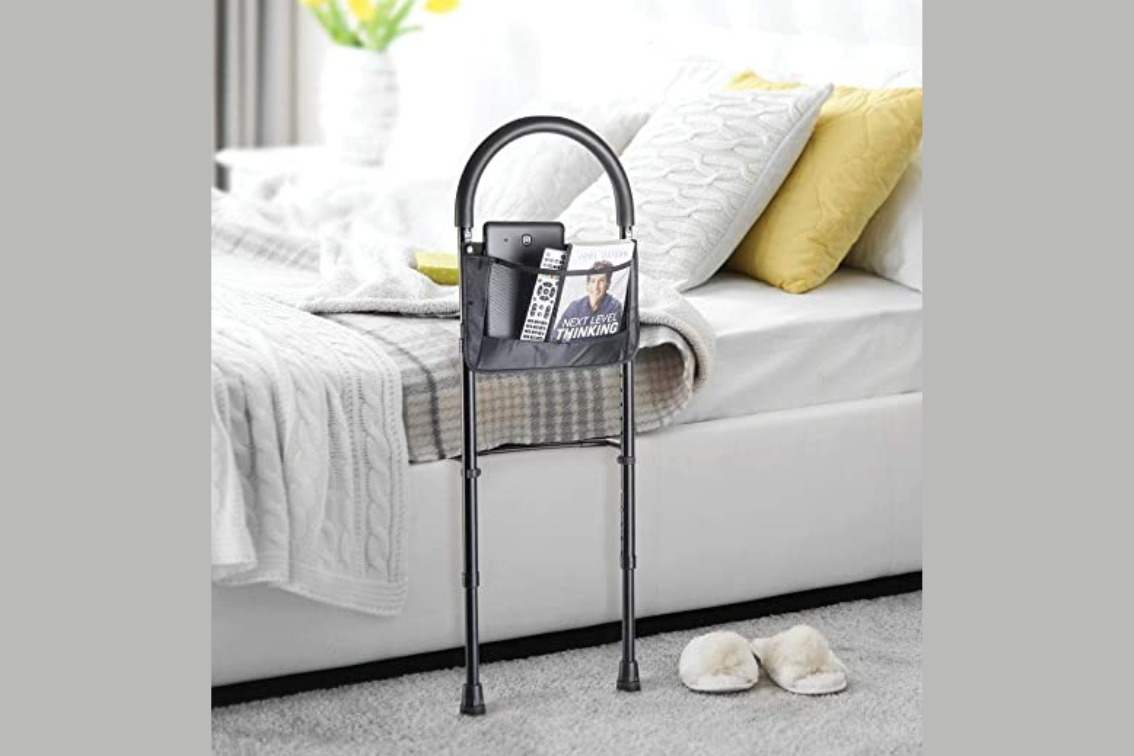
A bed assist rail is a handle or support frame positioned alongside a bed. Depending on the design, it may slide beneath the mattress, attach to a compatible bed frame, or use another specified mounting system.
The handle gives the user something to hold while moving from lying to sitting, adjusting their position, or preparing to get out of bed.
Bed assist rails are different from full-length hospital bed rails. Many home models are designed primarily as mobility aids rather than as barriers to prevent someone from leaving the bed.
They are also different from adjustable beds, which change the position of the mattress, and powered transfer aids, which provide mechanical assistance.
How a Bed Rail May Help With Arthritis
Arthritis can make several parts of a bed transfer uncomfortable:
- Sitting up: A handhold may provide leverage while moving from lying down to sitting.
- Repositioning: Some people find a stable handle useful when adjusting their position in bed.
- Preparing to stand: A suitable rail may provide support while moving toward the edge of the mattress.
- Confidence: Having a consistent handhold may make a familiar movement feel more manageable.
The benefit depends on the person’s strength, joint function, balance, and ability to use the rail correctly. A bed rail should not be assumed to prevent falls or eliminate the physical effort involved in a transfer.
Important Safety Checks Before Buying a Bed Rail
Safety deserves more attention than appearance or the number of adjustable settings. A bed rail that is incompatible with a mattress or installed incorrectly can create a serious hazard.
1. Check Mattress and Bed Frame Compatibility
Before ordering, measure your mattress and review the manufacturer’s approved bed types.
Check:
- Mattress thickness and dimensions.
- Bed frame construction and the space available beneath the mattress.
- Whether the rail requires a particular mattress or frame type.
- Whether the installation method is suitable for an adjustable bed, if applicable.
- Whether the rail can be secured as directed without shifting during normal use.
Do not assume a rail fits simply because its base slides under the mattress.
2. Understand the Risk of Entrapment
Gaps between a bed rail, mattress, and bed frame can trap a person’s head, neck, chest, or limbs. The risk may be particularly serious for people who have limited mobility, difficulty repositioning themselves, confusion, or involuntary movements.
A rail that is intended for one bed setup may not be safe on another. Follow all manufacturer instructions for installation, mattress compatibility, and gap checks.
If you cannot confirm that the rail and bed combination is suitable, do not use the device until you have obtained appropriate advice.
3. Check Stability and Securing Requirements
Some bed rails use a support base beneath the mattress; others have different attachment systems. The manufacturer’s instructions determine how each model must be secured.
Do not rely solely on pulling the handle by hand to decide whether the rail is safe. Follow the specified anchoring method, check for movement as directed, and inspect the installation periodically.
Never modify the rail or its attachment system unless the manufacturer explicitly permits it.
4. Consider the User’s Grip and Strength
People with arthritis may have painful finger joints, weak grip, or shoulder discomfort. A handle that is difficult to grasp or requires forceful pulling may not help.
Look for a grip that is comfortable to hold and positioned so the user does not have to twist, overreach, or place excessive strain on the shoulders.
The user must also be able to use the rail as intended. A rail is not a substitute for a lifting device when substantial assistance is required.
5. Make Sure the Rail Does Not Obstruct the Exit
Think about how the person normally gets out of bed. The rail should not create an obstacle that forces them to twist awkwardly, step over a frame, or reach around the handle.
Also consider the available space beside the bed, the location of bedside furniture, and whether the person can safely move their feet to the floor.
Key Features to Compare When Choosing a Bed Assist Rail
| Feature | What to look for |
|---|---|
| Compatibility | Clear manufacturer specifications for mattress and bed frame |
| Stability | A suitable mounting and securing system used as directed |
| Handle height | A position that supports comfortable reaching and gripping |
| Grip design | A handle that feels manageable for painful or stiff hands |
| Weight capacity | A verified manufacturer rating and permitted use |
| Adjustability | Settings that accommodate the approved bed setup and user’s needs |
| Installation | Instructions that can be followed correctly |
| Portability | A design that can be moved safely if the manufacturer’s instructions permit it |
| Additional features | Storage pockets or other extras that are useful but secondary to safety |
Adjustability can be helpful, but more adjustment options do not automatically make a bed rail safer or more suitable. Correct fit and installation should come first.
Featured Option: Medical King Bed Assist Rail
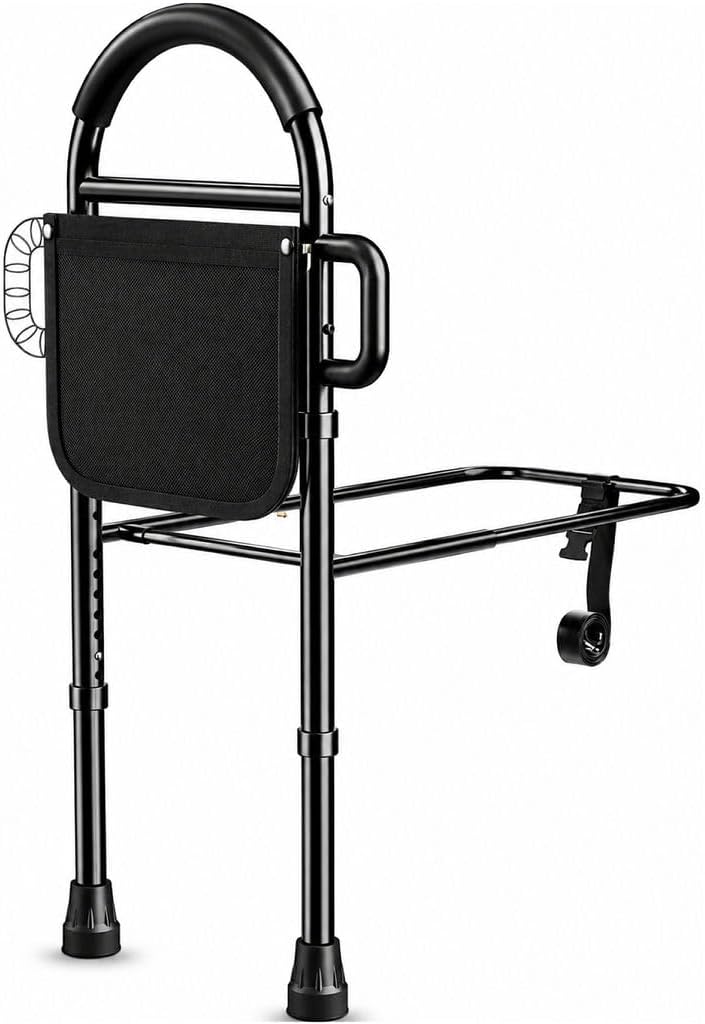
The Medical King Bed Assist Rail is an adjustable bedside support option to consider if you want a handle for getting in and out of bed.
The supplied product listing describes features including adjustable height settings, a non-slip handle surface, a safety strap, tool-free assembly, and a removable storage pocket. Confirm the current listing and manufacturer’s instructions for the exact configuration and requirements.
Potential Advantages
- Adjustable handle: Height settings may help accommodate different users and bed arrangements within the manufacturer’s permitted range.
- Grip surface: A non-slip handle surface may provide a more secure-feeling grip.
- Storage pocket: Keeps small items within reach, reducing the need to reach toward a bedside table.
- Assembly: Tool-free assembly may simplify initial setup.
What to Check Before Ordering
- Confirm that the rail is compatible with your mattress thickness and bed frame.
- Check how the base and safety strap must be installed and secured.
- Verify the current weight capacity and all restrictions on use.
- Consider whether the handle is comfortable for your hands and reachable without awkward movement.
- Make sure the installation does not create hazardous gaps or interfere with getting out of bed.
The Medical King rail is a product to evaluate against these requirements, not a universal solution for every bed or mobility problem.
Who May Benefit From a Bed Assist Rail?
A bed assist rail may be worth considering for someone who:
- Experiences stiffness when moving from lying down to sitting.
- Can stand and bear weight but wants an additional handhold during the transfer.
- Finds it difficult to reposition themselves using the mattress alone.
- Wants a bedside support aid without replacing the bed.
- Can understand the instructions and use the rail safely.
When a Bed Rail May Not Be Enough
A bed rail may not be appropriate as the sole solution for someone who:
- Needs substantial assistance lifting their body.
- Cannot safely bear weight through their legs or arms.
- Has significant balance, coordination, or cognitive difficulties that affect safe use.
- Cannot reposition themselves if they become trapped against the rail.
- Uses a bed or mattress that is incompatible with the device.
In these circumstances, ask a healthcare professional or occupational therapist about alternatives and the safest way to complete bed transfers.
Bed Assist Rail vs. Adjustable Bed vs. Grab Bar
These products address different problems. The right choice depends on whether the main difficulty is repositioning, getting leverage, or having a fixed support point.
| Option | Main purpose | Important limitation |
|---|---|---|
| Bed assist rail | Provides a bedside handhold for repositioning and transfers | Requires compatible bedding and safe installation |
| Adjustable bed | Changes mattress position to help with sitting up or repositioning | Does not automatically provide a secure handhold |
| Wall-mounted grab bar | Provides fixed support at a suitable location | Requires appropriate installation and positioning |
| Powered lifting or transfer aid | Provides mechanical assistance for certain mobility needs | Must be selected for the user’s needs and transfer environment |
When an Adjustable Bed May Be Better
An adjustable bed may be worth considering if the main difficulty is moving from lying down to sitting, finding a comfortable resting position, or changing the angle of the upper body.
Some adjustable beds can reduce the effort involved in sitting up, but they do not automatically solve balance or standing difficulties.
See Best Adjustable Beds for Arthritis Pain Relief & Better Sleep.
When a Grab Bar May Be More Suitable
A properly installed grab bar may be useful when a fixed support point is needed in a particular location. However, a wall-mounted bar is only appropriate when the wall, mounting hardware, position, and intended loading have been assessed.
A bathroom grab bar, for example, is not automatically suitable for use beside a bed.
When Another Transfer Aid May Be Needed
If you cannot rise safely even with a suitable handhold, consider getting professional advice about other transfer aids or assistance. A powered lifting device may be more appropriate for some people, but the choice depends on their individual mobility and home setup.
Frequently Asked Questions
Are bed assist rails suitable for people with arthritis?
They may help some people with arthritis who can move and bear weight independently but need an additional handhold. Suitability depends on hand strength, shoulder comfort, balance, mattress compatibility, and the person’s ability to use the rail safely.
Can a bed assist rail prevent falls?
A bed rail should not be considered a guarantee against falls. It may provide a useful handhold during certain movements, but it can also introduce hazards if incorrectly selected or installed. Safe transfers depend on the person, bed setup, and how the device is used.
Will a bed assist rail fit any mattress?
No. Mattress thickness, bed frame construction, available clearance, and the rail’s mounting design all affect compatibility. Check the manufacturer’s specifications and installation instructions before purchasing.
Is an adjustable bed better than a bed rail?
Neither is universally better. An adjustable bed changes the mattress position, while a bed rail provides a handhold. Some people may benefit from one, while others may need a combination of suitable equipment or a different transfer solution.
What if I cannot pull myself up using a rail?
Do not try to compensate by pulling harder or using a rail in a way the manufacturer does not permit. If you cannot complete the movement safely, seek advice from an occupational therapist or another qualified healthcare professional about alternative transfer methods or equipment.
Can I use a chair stand assist instead of a bed rail?
Not necessarily. Chair stand assist devices are designed around particular seating arrangements and transfer movements. A device intended for a sofa or chair should not be used beside a bed unless the manufacturer explicitly approves that application.
For a comparison of chair-standing aids, see Stand Assist Aids for Arthritis: Vive vs. HEPO vs. Stander.
Final Thoughts: Choose a Bed Rail for the Right Reasons
A bed assist rail may provide a helpful handhold for someone who experiences stiffness or difficulty repositioning in bed but can still perform most of the transfer independently.
The most important considerations are not the number of features or the appearance of the handle. They are compatibility with the bed, correct installation, comfortable reach, and whether the device matches the user’s mobility needs.
The Medical King Bed Assist Rail is one option to evaluate, but confirm its current specifications and suitability for your particular bed before purchasing. If you are unsure whether a rail is appropriate, professional advice can help you choose a safer solution.
Related Reading
Bedroom Comfort and Night Discomfort
Mobility and Stability
Pain and Movement
Medical Disclaimer: This article is for informational purposes only and does not constitute medical advice. Always consult your doctor, rheumatologist, or occupational therapist before making changes to how you manage your arthritis.
