

Disclosure: As an Amazon Associate, Arthritis Wares earns from qualifying purchases at no extra cost to you. We are not paid or sponsored by any manufacturer. Affiliate links help support our work.
Bathing can become more difficult when arthritis affects your grip, balance, flexibility, strength, or stamina. A task that once required little thought—stepping over a tub wall, standing through a shower, reaching your back, or squeezing a shampoo bottle—may become painful or uncomfortable.
The right bathing aid can change the task rather than forcing you to work through it.
This guide focuses on practical tools for bathing and showering with arthritis, including what each type of product is designed to help with, what features to look for, and potential drawbacks to consider before buying.
If you’re looking for advice about water temperature, bathing routines, pacing, and other techniques, see our companion guide: Bathing With Arthritis: Tips for Safer, Easier Showers and Baths.
Quick Answer: Which Bathing Tool Addresses Your Problem?
| Your main challenge | Tool to consider |
|---|---|
| Slippery footing | Appropriate non-slip bath or shower mat |
| Difficulty standing for a shower | Shower chair or stool |
| Difficulty stepping over the tub wall | Transfer bench |
| Need for support getting in or out | Properly installed grab bars or an appropriate tub rail |
| Limited reach | Handheld showerhead or long-handled bath sponge |
| Painful or weak grip | Pump-style soap and shampoo dispensers |
| Trouble bending or twisting | Long-handled bathing aids or seated bathing |
| Fatigue while bathing | Shower chair or stool |
| Difficulty getting around the bathroom safely | A combination of appropriate equipment and home modifications |
You may need only one tool. Start with the specific bathing task that is most difficult or unsafe, then look for the simplest product that addresses that problem.
Why Bathing Can Become Difficult With Arthritis
Bathing involves several movements that can become challenging when arthritis affects your joints or mobility.
You may have difficulty with:
- Stepping over a bathtub wall
- Standing for an extended period
- Getting down onto or up from a low surface
- Maintaining your balance on wet surfaces
- Reaching your back, feet, or lower legs
- Holding a slippery showerhead
- Squeezing shampoo or soap bottles
- Twisting faucets or handles
- Getting dressed immediately after bathing because of fatigue
The problem isn’t always the arthritis itself. The bathroom environment can add additional challenges through wet surfaces, limited space, poor lighting, or awkward transfers.
CDC guidance on fall prevention recommends making bathrooms safer with measures such as grab bars inside and outside tubs and showers, removing trip hazards, and improving lighting.
The Arthritis Foundation also recommends bathroom adaptations such as grab bars, shower chairs, and slip-resistant surfaces for people concerned about falls.
Shower Safety Tools for Arthritis
Non-Slip Bath and Shower Mats
Wet surfaces can be difficult to navigate when arthritis also affects balance, strength, or mobility.
A suitable bath or shower mat can provide additional traction, although it should not be treated as a guarantee against slipping.
Features to look for:
- Secure, non-slip construction appropriate for your tub or shower surface
- Drainage holes that allow water to pass through
- A size that provides useful coverage without interfering with movement
- Easy-to-clean materials
- Construction that resists mold and mildew
- A design that remains stable when wet
Best for: People who want additional traction in a tub or shower.
Potential drawback: A mat that does not stay securely in place can create its own hazard. Follow the manufacturer’s installation and cleaning instructions, and replace it if it becomes damaged or loses its grip.
Product to consider:
GORILLA GRIP Bath Tub Shower Mat
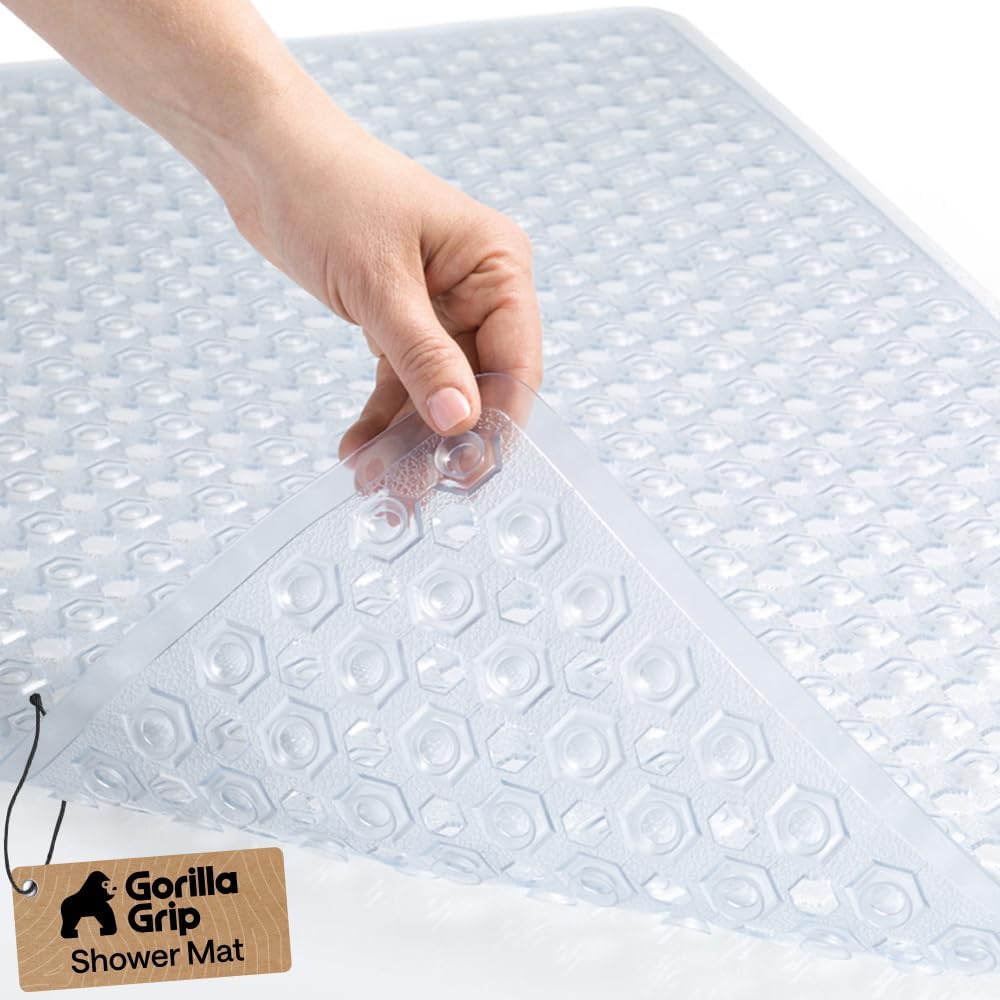
A textured bath mat with suction cups designed to provide traction across the tub or shower floor.
Shower Chairs and Stools
Standing through an entire shower can be tiring or uncomfortable when arthritis affects the knees, hips, ankles, or lower back.
A shower chair or stool allows you to bathe while seated and can reduce the amount of time you need to remain standing.
Features to look for:
- Adjustable height
- Non-slip feet
- A stable, appropriately sized seat
- Weight capacity that comfortably accommodates the user
- Corrosion-resistant materials suitable for wet environments
- Drainage holes if the seat is designed to be used directly under the shower
- A backrest if additional support is useful
Best for: People who find standing painful, tiring, or unsteady.
Potential drawback: A chair takes up space and needs to fit securely in the shower or tub. Make sure there is enough room to sit down and stand up safely.
A shower chair isn’t automatically necessary just because you have arthritis. If standing is comfortable and safe, you may not need one.
Product to consider:
Shower Chair with Removable Back

An adjustable-height shower chair with a removable back that can be used as either a chair or stool.
Handheld Showerheads
A handheld showerhead lets you bring the water to you instead of repeatedly moving your body around a fixed showerhead.
This can be particularly useful when you’re seated or when reaching and twisting are difficult.
Features to look for:
- Lightweight showerhead
- Comfortable, non-slip grip
- Flexible hose long enough to reach from a seated position
- Large, easy-to-operate controls
- Simple mounting system
- A holder that keeps the showerhead accessible when not being held
Best for: People with limited reach or mobility, particularly when using a shower chair or transfer bench.
Potential drawback: Holding the showerhead can still be tiring if you have significant hand or wrist arthritis. In that case, a secure wall holder may be more useful than continuously holding it.
Product to consider:
Handheld Shower Head

A handheld showerhead with an ergonomic grip and flexible hose for directing water while seated or standing.
Grab Bars for the Shower
Grab bars can provide a stable handhold when entering or exiting a shower, changing position, or lowering yourself onto a shower seat.
This is one area where proper installation matters enormously.
Features to look for:
- Secure wall-mounted installation
- Placement appropriate for the movement you need help with
- A grip that remains secure when wet
- A diameter that you can comfortably grasp
- Construction designed to support the intended load
Best for: Anyone who needs additional support when transferring, standing, or changing position in the bathroom.
Important: A properly installed grab bar is different from a suction-cup handle. If you need to support your body weight, don’t assume that a suction product is an equivalent substitute for a properly anchored grab bar.
CDC fall-prevention guidance specifically recommends grab bars inside and outside tubs and showers.
If you’re unsure where a grab bar should be installed, an occupational therapist or qualified bathroom-accessibility professional can help determine appropriate placement.
For renters: Ask your landlord whether a properly installed grab bar can be approved. If permanent installation isn’t possible, discuss alternative equipment with an occupational therapist rather than assuming a suction handle will provide adequate support.
Product to consider:
2 Pack 16 Inch Grab Bars for Bathtubs and Showers

A two-pack of textured grab bars that can be positioned to provide support at different points around the bathing area.
Pump-Style Soap and Shampoo Dispensers
Hand arthritis can make small tasks surprisingly difficult.
Squeezing a shampoo bottle, twisting a cap, or picking up a slippery bottle can require more grip and finger strength than you may have on a painful day.
Pump dispensers can reduce the amount of pinching and squeezing required.
Features to look for:
- Large, easy-to-press pump
- Stable base or secure wall mounting
- Wide dispensing surface
- Easy-to-refill containers
- Labels that make contents easy to identify
Best for: Hand, finger, or wrist arthritis and anyone with reduced grip strength.
Potential drawback: Wall-mounted dispensers require installation and aren’t always practical for renters. Some pumps also require more force than others, so choose one that you can operate comfortably.
Product to consider:
Shampoo and Conditioner Dispenser

A wall-mountable pump dispenser designed to keep shampoo and conditioner accessible without repeatedly gripping and squeezing bottles.
Bathtub Safety Tools for Arthritis
Transfer Benches
Getting over the side of a bathtub can be one of the most difficult movements for someone with painful or limited hip, knee, or ankle mobility.
A transfer bench changes the movement. Instead of stepping over the tub wall while standing, you sit on the outside portion of the bench and move across into the tub.
This can be particularly useful when lifting one leg over the tub wall is difficult.
Features to look for:
- Adjustable leg height
- Stable, non-slip feet
- A seat that fits the tub dimensions
- A design that allows you to transfer comfortably
- Drainage holes
- A weight capacity appropriate for the user
- A backrest or handles if additional support is useful
Best for: People who have difficulty stepping over a tub wall or who feel unsteady during tub entry.
Potential drawback: Transfer benches require enough space outside the tub and may not fit every bathtub configuration. Measure carefully before buying.
Product to consider:
Tub Transfer Bench for Bathtub

An adjustable transfer bench with a padded seat and non-slip feet designed to allow seated movement across the tub edge.
Bathtub Safety Rails
A bathtub safety rail clamps onto the side of a tub and provides a handhold for people who need additional support when sitting down or standing up.
It can be a simpler solution than a transfer bench when the main problem is getting into or out of a conventional bathtub.
Features to look for:
- Adjustable clamp that fits your tub securely
- Padding or comfortable grip
- A stable locking mechanism
- Weight capacity appropriate for the user
- Construction compatible with your bathtub
Best for: People who need additional support when getting into or out of a bathtub but do not require a transfer bench.
Potential drawback: Tub rails are not suitable for every bathtub and should not be treated as a substitute for a full transfer system when stepping over the tub wall remains difficult.
Product to consider:
Vaunn Medical Secure Bathtub Safety Rail

A clamp-style bathtub rail designed to provide a handhold at the side of the tub.
Long-Handled Bath Sponges and Brushes
Limited shoulder, hip, or back mobility can make it difficult to reach your feet, lower legs, or back.
A long-handled sponge or brush extends your reach so you don’t have to bend or twist as much.
Features to look for:
- Lightweight handle
- Comfortable, non-slip grip
- Handle length appropriate for your reach
- Replaceable sponge or brush head
- Angled head if it makes difficult areas easier to reach
Best for: People with limited flexibility or difficulty reaching their back, feet, or lower legs.
Potential drawback: A long handle doesn’t eliminate the need for grip strength. If holding the tool is painful, look for a larger or more ergonomic grip.
Product to consider:
Long Handle Back Scrubber Shower Brush

A long-handled bathing brush designed to make hard-to-reach areas easier to wash without as much bending or twisting.
You May Not Need to Buy Everything
It’s easy to look at a list of arthritis-friendly bathroom products and conclude that you need several new gadgets.
You probably don’t.
Start with the one bathing task that causes the most difficulty.
If standing is the problem, a shower chair may be more useful than a long-handled sponge.
If getting over the tub wall is the problem, a transfer bench may address the issue more directly than a shower stool.
If reaching is the problem, a handheld showerhead or long-handled bathing aid may be enough.
If your hands are the problem, an easier-to-operate dispenser may make more difference than a larger piece of equipment.
The Arthritis Foundation’s general guidance on arthritis-friendly products emphasizes choosing items that are easier to grip, lighter, simpler to operate, and better suited to the task you’re trying to accomplish.
Think about the movement first, then choose the tool.
How to Choose the Right Bathing Aid
Before buying a product, ask yourself five questions.
1. What specific task is difficult?
Be as specific as possible.
Instead of saying, “The shower is difficult,” identify the problem:
- I can’t stand long enough.
- I have trouble stepping over the tub.
- I can’t reach my back.
- I can’t squeeze shampoo bottles.
- I feel unsteady getting out.
- My hands hurt when I hold the showerhead.
The answer points toward a different type of product.
2. Does the tool change the difficult movement?
The best assistive product isn’t necessarily the most complicated one.
Look for something that reduces the amount of:
- Standing
- Bending
- Twisting
- Reaching
- Gripping
- Lifting
- Balancing
required to complete the task.
3. Will it fit your bathroom?
Measure before ordering.
For larger equipment, check:
- Shower or tub dimensions
- Door clearance
- Available floor space
- Seat height
- Tub-wall height
- Whether the product interferes with your existing fixtures
A product can be well designed and still be unsuitable for your particular bathroom.
4. Can you operate it comfortably?
Think beyond the product’s description.
Can you:
- Adjust it?
- Grip it?
- Sit down and stand up from it?
- Move it if necessary?
- Clean it?
- Store it?
If operating the product creates another painful task, it may not be the right solution.
5. What happens if your symptoms are worse?
Arthritis symptoms can vary from day to day.
A product that is easy to use on a good day may be difficult during a flare or when you’re fatigued.
Choose equipment that remains manageable when your symptoms are worse—not just when you’re having a good day.
When an Occupational Therapist Can Help
If you’re unsure which equipment you need, an occupational therapist (OT) can be particularly helpful.
An OT can look at:
- How you get into and out of the tub or shower
- How you stand or sit while bathing
- Your balance and mobility
- Your grip and upper-body strength
- Your bathroom layout
- Where equipment should be positioned
- Which daily tasks are creating unnecessary strain
This can be more useful than buying several products and discovering later that they don’t address the actual problem.
An OT may also help determine whether you need a shower chair, transfer bench, grab bars, or other adaptive equipment.
If you’ve already had a fall, frequently feel unsteady, or are having difficulty safely getting in or out of the tub or shower, professional assessment is particularly worth considering.
Additional Bathroom Safety Improvements
Bathing aids work best when the rest of the bathroom is also set up for safe movement.
Consider:
Improve Lighting
Good lighting makes it easier to see wet surfaces, equipment, and obstacles.
A night light can also be useful if you regularly use the bathroom during the night.
Keep the Floor Clear
Remove clutter and anything that could become a trip hazard.
Avoid loose rugs that can slide under your feet.
Keep Frequently Used Items Within Reach
Store soap, shampoo, towels, and other essentials where you can reach them without excessive bending or stretching.
Keep the Area Dry
Wipe up standing water around the tub or shower rather than leaving it for later.
Make the Bathroom Easy to Navigate
If you use a cane, walker, or other mobility aid, make sure there is enough room to approach and leave the bathing area safely.
Caring for Your Bathing Aids
Bathroom equipment is exposed to water, soap, and humidity every day.
Regular maintenance matters.
- Clean shower chairs, stools, mats, and benches according to the manufacturer’s instructions.
- Inspect rubber feet regularly for wear.
- Check that adjustable legs remain secure.
- Inspect grab bars and tub rails for looseness or damage.
- Replace worn or damaged non-slip mats.
- Clean or replace sponge and brush heads as recommended.
- Check that moving parts continue to operate properly.
- Follow the manufacturer’s weight limits and installation instructions.
Don’t continue using equipment that has become unstable, cracked, damaged, or difficult to secure.
Frequently Asked Questions
What is the most important bathroom safety tool for arthritis?
There isn’t one tool that is best for everyone.
The right starting point depends on the problem. Someone who is unsteady may benefit from properly installed grab bars. Someone who becomes exhausted while standing may need a shower chair. Someone who cannot safely step over a tub wall may need a transfer bench.
Start with the movement that creates the greatest safety concern.
Do I need a shower chair if I have mild arthritis?
Not necessarily.
A shower chair is most useful when standing causes pain, fatigue, or unsteadiness. If you can stand comfortably and safely, you may not need one.
However, symptoms can change. Some people prefer having a shower stool available for days when standing becomes more difficult.
What’s the difference between a shower chair and a transfer bench?
A shower chair or stool is positioned inside the shower or tub and allows you to bathe while seated.
A transfer bench extends across the edge of a bathtub. You sit down outside the tub and then move across the bench rather than stepping over the tub wall.
A transfer bench is therefore more appropriate when getting over the tub edge is the main problem.
Are suction grab bars safe for people with arthritis?
Suction grab bars should not automatically be treated as substitutes for properly installed grab bars.
A suction product may be useful for some purposes, but the ability of a suction device to support body weight depends on the specific product, surface, installation, and conditions. If you need a grab bar for weight-bearing support during a transfer, use a properly installed product designed for that purpose.
Can renters install bathroom grab bars?
It depends on the rental and the landlord.
Permanent grab bars generally require secure installation into appropriate wall structure. Ask your landlord whether installation can be approved.
If permanent installation isn’t possible, an occupational therapist can help you explore safer alternatives based on your bathroom and mobility needs.
What bathing aid is best for hand arthritis?
There isn’t one answer.
Pump-style dispensers can reduce squeezing and pinching. A handheld showerhead with a comfortable grip may be easier than manipulating a fixed showerhead. A long-handled sponge can reduce the need to grip while reaching difficult areas.
Choose according to the specific hand movement that causes you the most trouble.
Are long-handled bathing aids useful for arthritis?
They can be useful when limited flexibility or painful joints make it difficult to reach the back, feet, or lower legs.
Look for a lightweight handle and a grip that you can comfortably hold when wet.
Should I buy a transfer bench if I have trouble getting into my bathtub?
A transfer bench may be worth considering if stepping over the tub wall is difficult or unsafe.
However, bathtub dimensions and your ability to transfer from standing to sitting matter. Measure your tub carefully and consider an OT assessment if you’re uncertain about the safest setup.
When should I ask an occupational therapist for help?
Consider an OT assessment if you’re unsure which equipment to buy, have fallen or nearly fallen, have difficulty getting in or out of the tub, or find that bathing has become exhausting or unsafe.
An OT can assess the actual task and bathroom rather than recommending equipment based only on a general list.
Safer Bathing Starts With the Right Problem
You don’t need to buy every product marketed as “arthritis-friendly.”
Start by identifying the movement that’s causing the problem.
If you struggle with standing, look at shower seating.
If you struggle with tub transfers, consider a transfer bench or appropriate support.
If you struggle with reaching, look at a handheld showerhead or long-handled bathing aid.
If you struggle with gripping, look for products that require less squeezing, twisting, or pinching.
If you’re concerned about balance, prioritize appropriate safety modifications and professional assessment rather than relying on a small gadget.
The goal isn’t to fill your bathroom with equipment. It’s to make the specific tasks that are difficult easier, safer, and more manageable.
Related Reading
- Bathing With Arthritis: Tips for Safer, Easier Showers and Baths
- Arthritis-Friendly Home Modifications: A Room-by-Room Guide
- Best Hand Relief Tools for Arthritis
- Arthritis Supplies & Tools: Complete Guide to Daily Living Aids
Medical Disclaimer: This article is for informational purposes only and does not constitute medical advice. Always consult your doctor, rheumatologist, or occupational therapist before making changes to how you manage your arthritis.
