
Disclosure: As an Amazon Associate, Arthritis Wares earns from qualifying purchases at no extra cost to you. We are not paid or sponsored by any manufacturer. Affiliate links help support our work.
Eating is something most of us do several times a day, but arthritis can make using ordinary forks, spoons, and knives surprisingly difficult.
Painful or stiff finger joints, weak grip strength, limited wrist movement, hand fatigue, or tremors can make it harder to hold utensils securely and guide food to your mouth.
Adaptive utensils are designed to change the way you grip and use cutlery. Some have wider, cushioned handles. Others are weighted, angled, or designed to require less wrist movement.
But which type is right for you?
The answer depends on what makes eating difficult in the first place. Lightweight utensils may be more comfortable when hand weakness and fatigue are the main problems, while some people with tremors may prefer the additional stability of weighted utensils. Angled or bendable utensils can help when wrist movement is limited.
This guide explains the differences and helps you choose adaptive eating utensils based on your specific needs.
How We Compared These Utensils
Weighted and lightweight utensils solve different problems, so we didn’t try to crown a single winner. We compared both Special Supplies sets directly against the specific difficulty each is meant to address — grip fatigue versus tremor stability — rather than by star rating alone.
Quick Answer: Which Adaptive Utensils Are Best for Arthritis?
There isn’t one best adaptive utensil for everyone.
As a general starting point:
| If your main difficulty is… | Consider… | Why |
|---|---|---|
| Painful or weak grip | Lightweight utensils with large handles | Less effort to hold and lift |
| Finger stiffness | Wide, cushioned handles | Reduces the need for a tight grip |
| Hand fatigue | Lightweight cutlery | Less weight to move repeatedly |
| Tremors or shaky hands | Weighted utensils | Added weight may provide greater stability for some people |
| Limited wrist movement | Angled or bendable utensils | Can reduce the amount of wrist rotation required |
| Difficulty cutting food | Rocker or curved knife | May reduce sawing and gripping |
| Utensils slipping from your hand | Non-slip handles | Provides a more secure grip |
| Difficulty using standard cutlery | Built-up or adaptive handles | Makes the utensil easier to hold |
The most important consideration is not whether a utensil is marketed as “adaptive.” It’s whether it makes eating easier and more comfortable for you.
Why Standard Utensils Can Be Difficult With Arthritis
Traditional silverware usually has relatively narrow handles and requires you to maintain a fairly precise grip.
That can be uncomfortable if you have arthritis in your fingers, thumbs, wrists, or hands.
Eating with standard utensils may require:
- Pinching your fingers around a narrow handle
- Maintaining a grip throughout the meal
- Rotating your wrist
- Cutting food with repeated movements
- Lifting the utensil repeatedly
- Coordinating the utensil when your hands are shaky
An adaptive utensil changes one or more of these demands.
For example, a wider handle can make a utensil easier to hold without tightly curling your fingers around it. A bendable utensil can change the angle so you don’t have to rotate your wrist as much.
The goal isn’t to make the utensil more complicated. It’s to make the task easier.
Lightweight Adaptive Utensils: Best for Hand Fatigue and Weak Grip
Lightweight adaptive utensils can be a good choice when your main problem is hand fatigue, weakness, or painful joints.
The less weight you have to repeatedly lift, the less work your hand and wrist may need to do throughout a meal.
Look for:
- Lightweight construction
- Wide handles
- Cushioned or non-slip grips
- Easy-to-hold shapes
- Stainless-steel utensil heads
- Dishwasher-safe construction if convenient for you
A wide handle can be particularly helpful because it may allow you to hold the utensil with less finger flexion than a traditional narrow handle.
When Lightweight May Be the Better Choice
Consider lightweight utensils if:
- Your hands become tired during meals
- Holding heavier objects is uncomfortable
- Your grip strength is reduced
- Finger joints are painful or stiff
- You don’t need additional weight for stability
For someone whose biggest problem is fatigue, adding weight to the utensil may actually make eating more difficult.
Weighted Adaptive Utensils: Could They Help With Tremors?
Weighted utensils are designed with additional mass in the handle or shaft.
Some people with hand tremors find that a heavier utensil feels more stable and easier to control. The added weight may make the utensil feel less likely to move abruptly.
However, weighted utensils aren’t automatically better for everyone with tremors.
The additional weight can also make the utensil more tiring to lift, particularly if you already have significant hand or arm weakness.
That’s why it’s useful to consider both your tremor and your overall strength.
Weighted Utensils May Be Worth Considering If:
- Your hand shakes while eating
- You find lightweight utensils difficult to control
- A little additional weight makes the utensil feel more stable
- You don’t become easily fatigued from the additional weight
If your hands are both shaky and weak, a weighted utensil may not be the best solution. In that situation, professional guidance from an occupational therapist can be particularly useful.
Bendable and Angled Utensils for Limited Wrist Movement
Not every eating difficulty is related to grip strength.
Arthritis can also make it uncomfortable or difficult to rotate your wrist into the position needed to use a standard fork or spoon.
Bendable or angled utensils can help by changing the angle of the utensil head.
Instead of forcing your wrist to rotate toward your mouth, you can adjust the utensil so the food is positioned more naturally.
These utensils may be particularly useful if you have:
- Limited wrist range of motion
- Wrist pain
- Elbow or shoulder limitations that affect eating
- Difficulty positioning standard utensils
The right angle depends on your individual range of motion, so adjustability can be a useful feature.
Built-Up Handles Can Make a Big Difference
Sometimes you don’t need a specialized utensil at all. A larger handle may solve the problem.
Built-up handles are thicker than standard silverware and can be easier to grasp without requiring a tight pinch.
When comparing handles, look for:
Width – A wider handle may be easier to hold than a thin traditional utensil.
Cushioning – Soft materials can make prolonged use more comfortable.
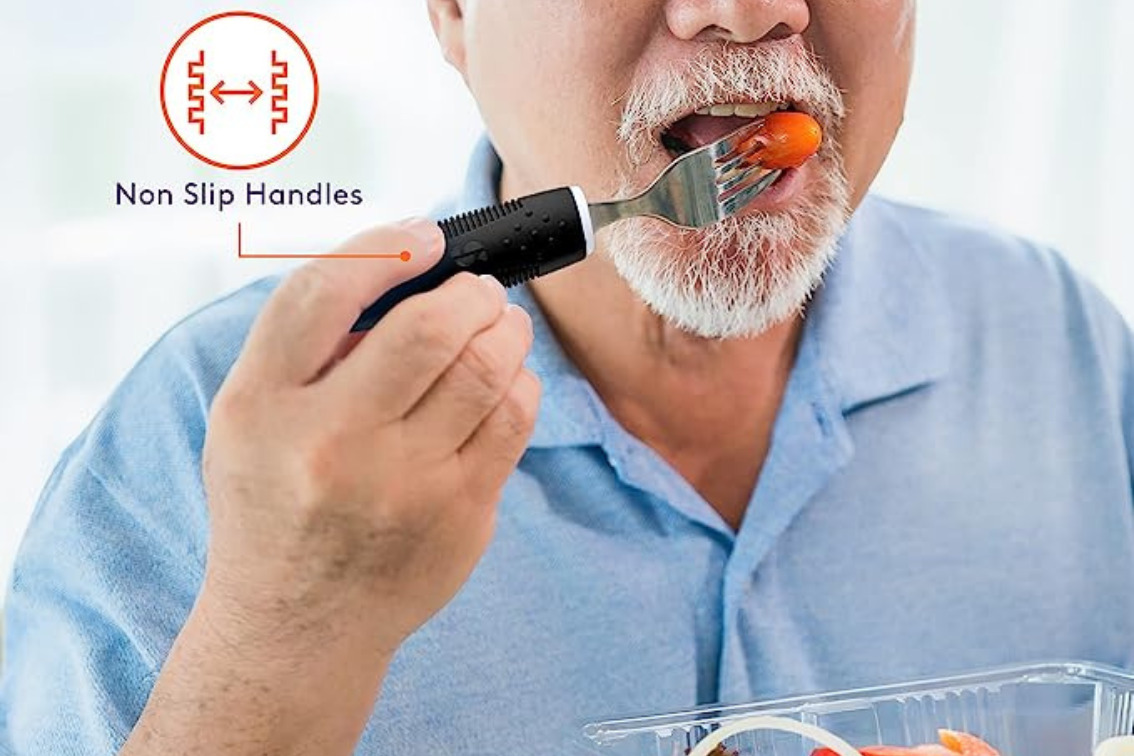
Non-Slip Grip – A textured or silicone surface can help prevent the utensil from slipping without requiring as much gripping force.
Shape – Some handles are contoured to fit naturally into the hand and distribute pressure more comfortably.
The best handle is ultimately the one that feels secure without forcing you to squeeze tightly.
What About Adaptive Knives?
Knives can be particularly challenging because cutting food often requires repeated back-and-forth wrist and hand movements.
An adaptive knife may use a curved or rocker-style blade so you can cut food with a rocking motion rather than repeatedly sawing back and forth.
This can be useful if:
- Cutting with a standard knife hurts
- Wrist movement is limited
- Grip strength is reduced
- Repetitive cutting causes hand fatigue
Some adaptive utensil sets include a curved or rocker knife, which can be convenient if you want one coordinated set rather than purchasing individual pieces.
A Closer Look at Special Supplies Adaptive Utensils
Two Special Supplies sets provide a useful example of the difference between lightweight and weighted adaptive cutlery.
They aren’t necessarily the right choice for everyone, but comparing them illustrates what to look for when choosing your own utensils.
1. Special Supplies 5-Piece Non-Weighted Set (Best for Weak Grip & Hand Strain)
If you struggle with hand fatigue or joint stiffness but do not suffer from tremors, this lightweight set minimizes the physical effort needed to lift food.
- Key Features:
- Ultra-Lightweight Build: Easy to maneuver for reduced fatigue.
- Wide, Non-Slip Handles: Cushioned food-grade silicone offers a secure grip.
- 5-Piece Versatility: Includes fork, dinner spoon, soup spoon, standard knife, and a curved knife for easier cutting.
- Maintenance: Dishwasher-safe stainless steel construction.
- Best For: Individuals with reduced grip strength, hand stiffness, or generalized joint pain who prefer minimal weight.

2. Special Supplies 4-Piece Weighted Set (Best for Hand Tremors & Limited Range)
For those dealing with Parkinson’s, severe tremors, or limited wrist movement, extra weight and custom angles offer much-needed control.
- Key Features:
- 6 oz. Weighted Design: Adds sensory feedback and counteracts hand tremors.
- 90-Degree Bendable Metal: The fork and spoons can be bent repeatedly to match your natural range of motion.
- Wide, Non-Slip Handles: Deeply textured silicone grip prevents slipping.
- 4-Piece Core Set: Includes fork, dinner spoon, soup spoon, and knife.
- Best For: Users needing tremor control, motor stabilization, or customized utensil angles.

Lightweight vs. Weighted Adaptive Utensils
Here’s the simplest way to think about the difference:
| Feature | Lightweight utensils | Weighted utensils |
|---|---|---|
| Overall weight | Lower | Higher |
| Best starting point for | Weakness, fatigue, stiffness | Some users with tremors |
| Hand fatigue | May be easier to manage | May increase fatigue for some people |
| Stability | Standard | Added weight may feel more stable |
| Grip | Usually wide and ergonomic | Usually wide and ergonomic |
| Wrist adjustment | Depends on design | Some models are bendable |
| Best choice when | Lifting weight is difficult | Stability is more important than weight |
There is no universal winner.
Choose based on what your hands need—not simply on which product has more features.
How to Choose the Right Adaptive Utensils
Before buying a set, think about the exact problem you’re trying to solve.
If Your Hands Hurt When You Grip – Prioritize a wide, cushioned handle that doesn’t require a tight grip.
If Your Hands Get Tired– Start with lightweight utensils. Extra weight may increase fatigue rather than reduce it.
If Your Hands Tremble – Consider whether additional weight feels more stable to you. If possible, try a weighted utensil before committing to an entire set.
If Your Wrist Doesn’t Move Easily – Look for angled or bendable utensils that allow you to position the utensil head without forcing your wrist into an uncomfortable position.
If Cutting Is the Problem – Look for a curved or rocker-style knife that changes the cutting motion.
If Utensils Slip From Your Hand – Prioritize textured, non-slip handles and a size that you can comfortably hold.
Don’t Choose by Weight Alone
It’s easy to assume that weighted utensils are better for tremors or that lightweight utensils are always better for arthritis.
Real life isn’t quite that simple.
Two people with arthritis can have completely different needs. One person may have painful finger joints but good strength. Another may have significant weakness and fatigue. Someone else may have limited wrist movement.
That’s why the handle design, utensil shape, weight, and angle all matter together.
If possible, consider trying one utensil before purchasing a complete set.
Other Features Worth Considering
Beyond weight, look at the details that affect everyday usability.
Dishwasher Compatibility If hand-washing dishes is difficult, dishwasher-safe utensils can eliminate another potentially painful chore.
Handle Diameter Check the actual handle dimensions rather than relying only on descriptions such as “ergonomic” or “large handle.”
Overall Weight Pay attention to the weight of the complete utensil, not just the handle.
Adjustability If your wrist movement is limited, a bendable or adjustable shaft may be particularly useful.
Durability Look for sturdy construction and handles that won’t separate or deteriorate quickly with regular washing.
Set Contents Consider which utensils you actually use. A smaller set containing the pieces you need may be more useful than a larger collection with items that sit unused.
What If Adaptive Utensils Still Aren’t Enough?
If eating remains difficult despite using adaptive cutlery, there may be other ways to reduce the demands of the task.
Depending on your needs, you might also consider:
- Plates with raised or curved edges
- Non-slip placemats
- Plate guards
- Cups with easy-grip handles
- Lightweight dishes
- Two-handled mugs
- Straws or drinking aids
- Food preparation tools that reduce the amount of cutting required
Sometimes the best solution isn’t changing the utensil—it’s changing another part of the eating process.
When Should You Ask an Occupational Therapist?
Adaptive utensils are relatively simple products, but professional advice can be valuable when eating difficulties are significant.
An occupational therapist can look at how you grip, move, and control utensils and may be able to recommend equipment suited to your specific limitations.
Consider professional guidance if:
- You frequently drop utensils
- Tremors make eating particularly difficult
- You have significant weakness
- Wrist or arm movement is severely restricted
- Eating has become frustrating or unsafe
- You’re having difficulty feeding yourself independently
A professional can also help determine whether other adaptive equipment could make meals easier.
Frequently Asked Questions
Are weighted utensils good for arthritis?
They can be useful for some people, particularly when added weight provides a feeling of greater stability. However, heavier utensils may increase fatigue if you have weak or painful hands. Lightweight utensils may be a better choice when reducing effort is the priority.
Are lightweight utensils better for weak hands?
Often, they can be. Lightweight utensils require less effort to repeatedly lift during a meal. A wide, cushioned handle can also make the utensil easier to hold without a tight grip.
Do weighted utensils stop hand tremors?
No. Weighted utensils aren’t a treatment for tremors. Some people find that the additional weight makes the utensil feel more stable and easier to control, but the effect varies from person to person.
What are the best utensils for arthritis in the hands?
Look for utensils with wide, comfortable handles, non-slip surfaces, and a weight you can manage comfortably. If wrist movement is limited, angled or bendable utensils may also help.
What are the best utensils for limited wrist movement?
Angled or bendable utensils can reduce the amount of wrist rotation needed to bring food to your mouth. The appropriate angle depends on your individual range of motion.
Our Recommendation: Choose Based on Your Main Difficulty
There isn’t one adaptive utensil set that is best for everyone.
If hand weakness, stiffness, or fatigue is your primary concern, a lightweight set with wide, cushioned handles is a sensible place to start.
If tremors or control are your biggest challenge, a weighted set may be worth trying to see whether the additional weight feels more stable.
If wrist movement is limited, look for bendable or angled utensils.
And if cutting is particularly difficult, a rocker or curved knife may make a bigger difference than changing your entire set of silverware.
The most important thing is to choose utensils that reduce the specific movement that’s making eating difficult.
Final Thoughts
You don’t have to struggle with standard silverware simply because that’s what you’ve always used.
A wider handle can reduce the need for a tight grip. A lightweight utensil can reduce fatigue. A weighted utensil may provide greater stability for some users. An angled utensil can reduce uncomfortable wrist movement, while a rocker knife can make cutting easier.
Start by identifying what makes eating difficult for you.
Then choose the simplest utensil that addresses that problem.
If you’re unsure, start with one or two pieces rather than purchasing an entire set. Once you know what works comfortably in your hands, you can build a complete adaptive eating setup around your needs.
For more ways to make food preparation easier, see our guide to Kitchen Tools for Arthritis.
Medical Disclaimer: This article is for informational purposes only and does not constitute medical advice. Always consult your doctor, rheumatologist, or occupational therapist before making changes to how you manage your arthritis.
