

Disclosure: As an Amazon Associate, Arthritis Wares earns from qualifying purchases at no extra cost to you. We are not paid or sponsored by any manufacturer. Affiliate links help support our work.
Getting up from a sofa, recliner, or cushioned chair can become difficult when arthritis affects the knees, hips, hands, or shoulders. A low seat, soft cushions, and painful joints can make the movement from sitting to standing feel awkward or unstable.
Stand assist aids provide a sturdy handhold to help with the transition from sitting to standing. Unlike powered lift chairs, these devices do not raise your body automatically. They provide leverage and support for people who can stand with some independence but need a more secure place to hold.
Three options worth comparing are the Vive Stand Assist, HEPO Stand Assist, and Stander CouchCane. Each uses a different mounting or stabilizing design, so the best choice depends on your furniture, available space, grip comfort, and mobility needs.
Quick Answer: Which Stand Assist Aid Should You Choose?
- Vive Stand Assist: Consider this option if you want a portable handle designed for compatible sofas and cushioned chairs, with tool-free placement.
- HEPO Stand Assist: Consider this lightweight option if you want a support handle that may be moved between suitable locations, including some beds, chairs, and recliners.
- Stander CouchCane: Consider this option if you prefer a support handle installed around the legs of a compatible sofa or chair and plan to use it in one main location.
Before choosing any of these devices, check the manufacturer’s current weight capacity, installation instructions, furniture compatibility, and intended use.
A stand assist aid may be helpful if you can bear weight through your legs and use your arms for support. If you need someone or something to lift most of your body weight, a stand assist handle may not provide enough assistance.
Vive vs. HEPO vs. Stander: Quick Comparison
| Feature | Vive Stand Assist | HEPO Stand Assist | Stander CouchCane |
|---|---|---|---|
| Stabilizing design | Positioned around or beneath compatible seat cushions | Y-style stabilizing legs | Attaches to compatible furniture legs |
| Weight capacity | Listed up to 300 lbs; verify current instructions | Verify current manufacturer specification | Verify current manufacturer specification |
| Approximate device weight | Check current listing | Approximately 4 lbs; verify current listing | Check current listing |
| Setup | Tool-free placement | Basic assembly required | Assembly and furniture-leg installation |
| Grip | Foam-padded handles | Foam-padded, outward-curved handles | Foam-padded grab handle |
| Main consideration | Cushion and seat compatibility | Base clearance and placement | Furniture-leg compatibility |
| Portability | Easy to reposition when correctly set up | Lightweight and portable | Less convenient to move after installation |
| Additional feature | Simple, portable design | Lightweight construction | Organizer pouch for small items |
Specifications and included features can change. Check the current product listing and manufacturer’s instructions before purchasing.
1. Vive Stand Assist: A Portable Handle for Sofas and Chairs
The Vive Stand Assist is designed to provide a handhold beside compatible cushioned seating. Its frame is positioned around or beneath the seat cushion, depending on the model’s installation requirements, rather than being permanently attached to the furniture.
The design may suit someone who wants support at a main sofa or chair without installing a fixed handle into the furniture.
Potential advantages
- Tool-free placement makes setup relatively straightforward.
- Foam-padded handles provide a more comfortable contact surface than a bare metal grip for some users.
- The device can be repositioned when needed, provided it is reinstalled securely according to the instructions.
- The stated weight capacity is up to 300 lbs; confirm the current manufacturer’s rating and all applicable use restrictions.
Limitations to consider
- The sofa or chair must be compatible with the frame and its stabilizing design.
- Very soft, low, or unstable seating may make standing difficult even with a support handle.
- The device does not lift the user, and it should not be used to pull the body upward beyond its intended purpose.
Best suited to: Someone who wants a removable support handle for a compatible sofa or cushioned chair and can still perform most of the standing movement independently.
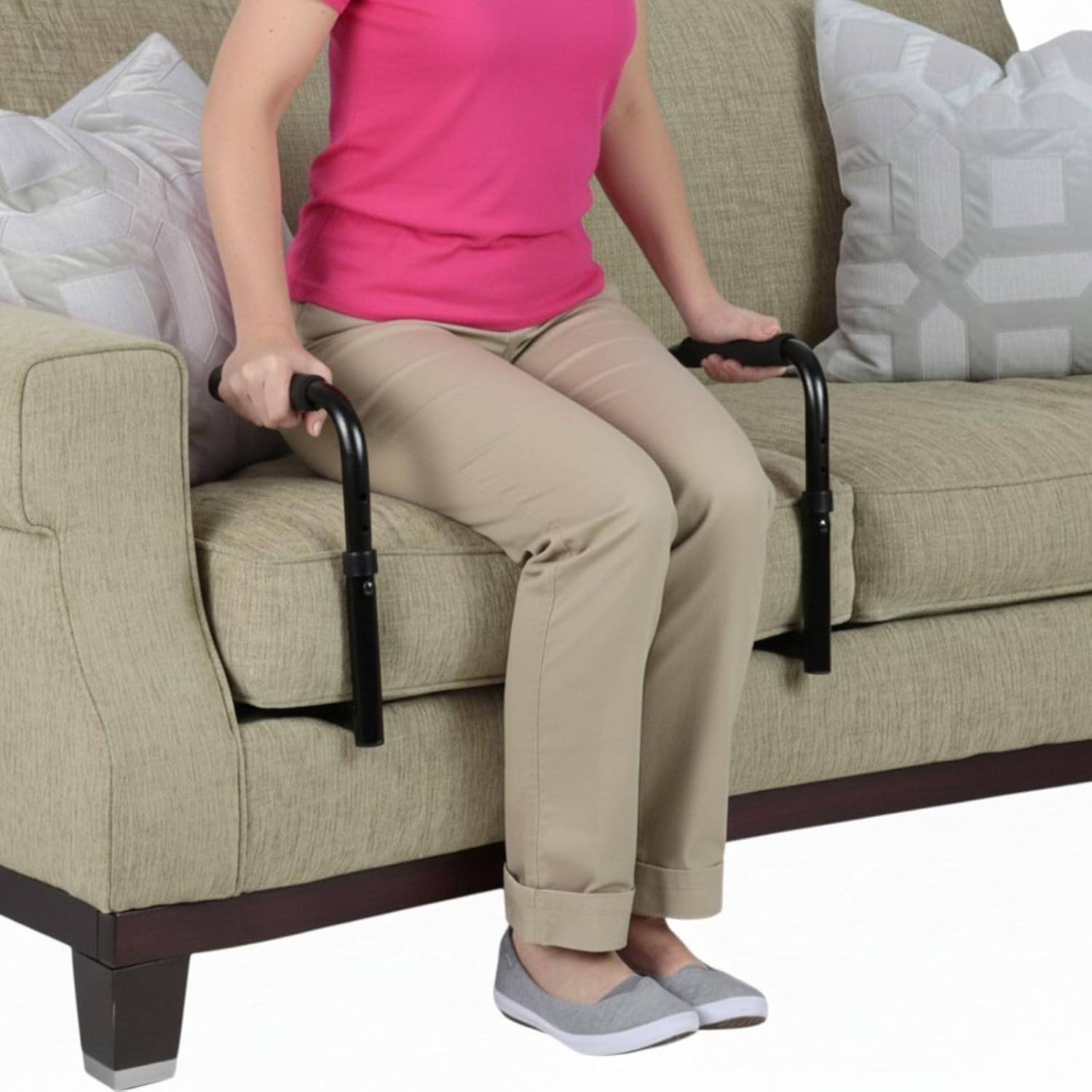
2. HEPO Stand Assist: A Lightweight, Portable Alternative
The HEPO Stand Assist uses a different stabilizing design, with Y-style support legs positioned beside the furniture. It is intended for use in several settings, subject to the manufacturer’s compatibility and installation requirements.
At approximately 4 lbs according to the supplied product information, it may appeal to someone who wants a lightweight aid that can be moved between suitable locations.
Its outward-curved, foam-padded handles offer a different grip shape from some competing models. This may feel more comfortable to certain users, although individual hand size, finger mobility, and grip strength will influence comfort.
Potential advantages
- Lightweight construction makes it easier to carry and reposition.
- The stabilizing-leg design differs from the Vive’s cushion-positioned design.
- Curved, padded handles offer an alternative grip shape.
- It may be useful in more than one room if each location meets the manufacturer’s requirements.
Limitations to consider
- Basic assembly is required.
- The stabilizing legs need sufficient clearance and a suitable position beside the furniture.
- It may not fit beneath very low recliners or work with every bed, chair, or sofa.
- Its weight capacity and permitted uses should be confirmed using the current manufacturer’s instructions.
Best suited to: Someone who values portability and wants to consider a different base and handle design, provided the intended furniture is compatible.

3. Stander CouchCane: A Handle Installed on Compatible Furniture
The Stander CouchCane takes a more furniture-specific approach. Rather than relying on a portable base positioned beside the seating, it attaches to compatible furniture legs using its installation system.
This arrangement may appeal to someone who uses the same sofa, recliner, or chair every day and prefers to keep the support handle in a consistent position.
The CouchCane also includes an organizer pouch for small items such as a remote control, phone, or reading glasses. This is a convenient extra, although the primary consideration should remain whether the handle is compatible with the furniture and the user’s transfer needs.
Potential advantages
- Provides a dedicated handhold at a frequently used seating location.
- Its furniture-mounted design differs from the other two options.
- The organizer pouch keeps small everyday items close at hand.
- Once correctly installed, it can remain in place rather than being moved between rooms.
Limitations to consider
- Installation and assembly are required.
- The furniture must meet the manufacturer’s leg and installation requirements.
- It is less convenient to move between different chairs or sofas.
- The installation must not interfere with furniture stability or create an obstruction around the seating area.
Best suited to: Someone who wants a regularly positioned support handle for one compatible sofa or chair and does not need to move the device frequently.

How to Choose a Stand Assist Aid That Fits Your Furniture
The mounting design is only one part of the decision. A device that works well with one sofa may be unsuitable for another, even if the furniture looks similar.
Check the seat height and firmness
A very low seat can require substantial knee and hip movement to stand. Deep, soft cushions may also compress under body weight, making it harder to move forward and rise.
A support handle may help with leverage, but it does not correct every problem caused by unsuitable seating. If possible, consider whether a firmer or higher chair would make transfers easier.
Measure the available space
Before ordering, check the manufacturer’s measurements against your furniture.
- For a cushion-positioned device, check the required cushion arrangement, seat dimensions, and frame clearance.
- For a stand assist with stabilizing legs, check the space available beside and beneath the furniture.
- For a furniture-mounted device, check the leg configuration and installation dimensions.
Also make sure the handle will be positioned where you naturally reach when preparing to stand.
Consider your hand and wrist comfort
Arthritis can make a narrow handle, hard grip, or awkward wrist angle uncomfortable. Padded handles and different grip shapes may help, but padding alone does not guarantee comfort.
Consider whether you can close your hand around the handle without excessive finger pain and whether you can apply pressure without bending your wrist into an uncomfortable position.
If gripping is a major limitation, discuss alternative transfer aids with an occupational therapist.
Check whether you can safely bear weight
A stand assist handle provides a place to hold; it does not lift you. The device must be suitable for the forces generated during your particular transfer, and you must be able to use it as intended.
Do not assume a handle is safe simply because it feels solid when pulled by hand. Follow the manufacturer’s installation and use instructions.
Make sure the furniture remains stable
A sofa or chair that slides, rocks, or tips can create a fall hazard. A stand assist aid should not be used to compensate for unstable furniture.
If you are uncertain whether the device, chair, or transfer method is suitable, seek advice from a qualified occupational therapist or other appropriate healthcare professional.
Stand Assist Aid vs. a Lift Chair: What’s the Difference?
A stand assist handle and a powered lift chair address different levels of difficulty.
| Feature | Stand Assist Aid | Powered Lift Chair |
|---|---|---|
| Main function | Provides a handhold and leverage | Uses a powered mechanism to tilt or raise the seated user |
| User effort | User performs most of the standing movement | The lift mechanism assists with the movement |
| Power required | No | Yes |
| Cost and space | Generally less expensive and smaller | Typically a larger investment and larger footprint |
| Best suited to | People who can stand with some independence | People who need more assistance rising from a chair, subject to suitability |
A lift chair may be worth considering if a person cannot rise safely using a handhold alone. However, it is not automatically suitable for everyone who has difficulty standing. The chair’s fit, transfer needs, balance, and ability to use the controls all matter.
For more options, see Best Recliner Lift Chairs for Arthritis.
Who May Benefit from a Stand Assist Aid?
A stand assist aid may be worth considering for someone who:
- Has stiff knees or hips and finds the initial movement out of a chair difficult.
- Can bear weight through their legs but wants an additional handhold.
- Finds soft armrests difficult to push against.
- Wants support in a particular seating area without purchasing a powered lift chair.
- Can understand and follow the device’s instructions and use it in a controlled manner.
It may not be sufficient for someone who needs substantial lifting assistance, has repeated falls, cannot reliably bear weight, or has significant balance or coordination difficulties.
People with painful or weak hands and shoulders should also consider whether the required gripping and pushing movements are appropriate for them.
Frequently Asked Questions
Do stand assist aids lift you out of a chair?
No. These are non-powered support devices that provide a handhold and leverage. The user still performs most of the movement from sitting to standing. A powered lift chair or another assessed transfer aid may be more appropriate if substantial lifting assistance is needed.
Will a stand assist aid fit any sofa or recliner?
No. Compatibility depends on the device’s mounting design, furniture dimensions, cushion arrangement, leg configuration, and available clearance. Check the manufacturer’s instructions before ordering.
Which stand assist aid is best for arthritis in the hands?
There is no single best option for everyone. Compare handle diameter, padding, shape, and wrist position. The HEPO’s curved grip may feel different from the Vive’s or Stander’s handle, but personal comfort and the ability to use the device safely are more important than the design description alone.
Can a stand assist aid be used beside a bed?
Some designs may be suitable for particular bedside applications, but do not assume a chair-standing aid is an appropriate bed rail. Bed transfers involve different positioning and safety considerations. Check the manufacturer’s permitted uses and consider a bed-specific aid when the main difficulty is getting in and out of bed.
For more information, see Bed Assist Rails: A Simple Aid for Safer Bed Transfers.
When should I consider a lift chair instead?
Consider discussing a lift chair or another transfer aid with a healthcare professional if you cannot stand safely using a handhold alone, need substantial assistance, or repeatedly lose your balance when rising. The appropriate solution depends on your mobility, strength, and home setup.
Final Thoughts: Choose for Fit, Comfort, and the Right Kind of Support
The Vive Stand Assist, HEPO Stand Assist, and Stander CouchCane offer different approaches to providing a handhold when rising from a sofa or chair. The Vive emphasizes portable cushion positioning, the HEPO offers a lightweight stabilizing-leg design, and the Stander CouchCane attaches to compatible furniture.
Rather than choosing by brand alone, start with your furniture and the movement you need help with. Check the mounting requirements, handle position, weight capacity, and whether you can safely use the device without excessive strain.
If a handhold is not enough to make standing safe, a different seating arrangement, a powered lift chair, or a professional transfer assessment may be a better next step.
Related Reading
Bed and Chair Transfers
More Mobility Support
Medical Disclaimer: This article is for informational purposes only and does not constitute medical advice. Always consult your doctor, rheumatologist, or occupational therapist before making changes to how you manage your arthritis.
