
When your hands ache through ordinary tasks — typing, cooking, getting dressed in the morning — it’s exhausting in a way that’s hard to explain to people who haven’t felt it. Hand arthritis doesn’t just cause pain. It chips away at your independence, one small task at a time.
Compression gloves are one of the most widely recommended tools for managing hand arthritis symptoms. They’re non-drug, non-invasive, and designed to be worn throughout the day — so you get relief while your hands are still working. But not all compression gloves are created equal, and a common question we hear is whether copper-infused options are worth the extra cost.
In this guide, we explain how compression gloves help arthritis, how they compare to hand braces, what the evidence actually says about copper specifically, and which gloves are worth considering based on comfort, compression level, and daily use.
How we evaluated these gloves: Our recommendations are based on published compression therapy research, manufacturer specifications, verified buyer feedback patterns, and comparison against occupational therapy guidance on hand arthritis management. We are not medical professionals — always confirm any new tool is appropriate for your specific condition with your doctor or rheumatologist.
How compression gloves help arthritis
Compression gloves work by applying gentle, consistent pressure to the hands and fingers. This pressure is associated with several effects that may help with arthritis symptoms:
- May reduce swelling by encouraging fluid to move away from inflamed joints
- May improve circulation, which can bring warmth and ease deep, aching stiffness
- Provides gentle support to the joints of the fingers and knuckles during movement
- Increases awareness of hand position, which may help reduce awkward movements that aggravate pain
Compression gloves do not immobilise joints the way a brace does. They’re designed for comfort and all-day use — you can still type, write, cook, and go about your day while wearing them. That’s what distinguishes them from most other arthritis hand tools.
Research on mild compression as a symptom-management tool is generally supportive for people with rheumatoid arthritis and osteoarthritis, though results vary by individual. Compression gloves are commonly included among self-management tools recommended by arthritis organizations, alongside other approaches like heat therapy and gentle hand exercises.
Who benefits most from compression gloves
Compression gloves tend to be most helpful for people who experience:
- Moderate hand or finger pain during activity
- Swelling or puffiness, especially in the morning
- Stiffness that eases as the day goes on — a common arthritis pattern
- Cold sensitivity or poor circulation in the fingers
They’re often used alongside other approaches — heat therapy, topical pain relief, and gentle hand exercises — rather than as a standalone treatment. For joint instability or more significant arthritis, a structured brace may be more appropriate.
💡 For joint instability, see our guide to thumb and wrist braces for arthritis.
Compression gloves vs. hand braces: what’s the difference
| Feature | Compression gloves | Hand / thumb braces |
|---|---|---|
| Primary purpose | Pain relief & swelling | Joint stabilisation |
| Compression | Gentle, even | Targeted / rigid |
| Movement | Full range — hands still work normally | Limited — restricts movement intentionally |
| Best for | Daily comfort, swelling, stiffness | Instability, more significant pain, post-injury |
| Can be worn all day? | Yes | Sometimes — depends on type |
If your main issue is pain and swelling, compression gloves are usually the better starting point. If you have joint instability — a feeling of looseness, clicking, or buckling in a joint — a brace is likely more appropriate.
Best compression gloves for arthritis
Here are five options worth considering, chosen for comfort, compression quality, and real-world usability for people with arthritis.
Dr. Arthritis Compression Gloves — best overall for daily comfort
Designed specifically for arthritis, these gloves offer balanced compression without feeling restrictive. The open-finger design means you can use your phone, type, and handle small objects without removing them — a genuine advantage for all-day wear.

Pros:
- Breathable, soft fabric that doesn’t irritate sensitive skin
- Comfortable fit for extended wear — users report forgetting they’re wearing them
- Good balance of support and flexibility
- Comes with an informational booklet from a medical team
Cons:
- Limited benefit for more significant arthritis where stronger support is needed
- Sizing can run slightly small — check the size guide carefully before ordering
Copper Compression Arthritis Gloves — best for those curious about copper
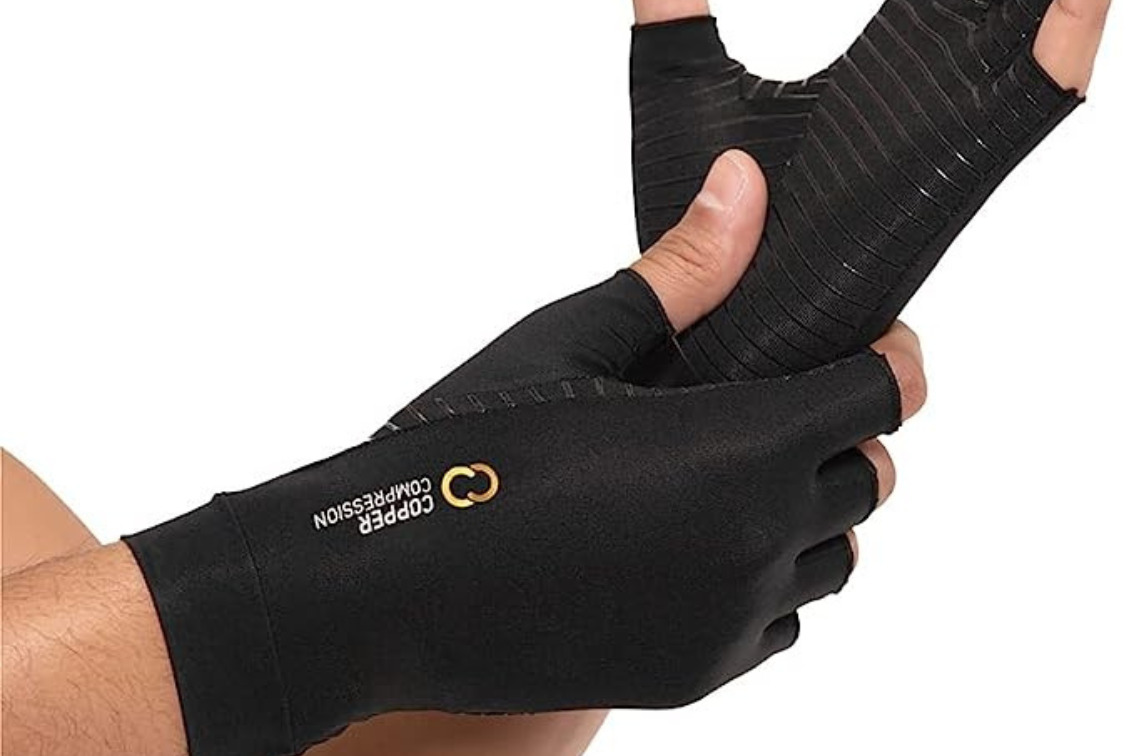
These gloves combine standard compression with copper-infused fabric. If you’ve heard about copper gloves and want to try them, this is a well-made option — comfortable fit, widely available in multiple sizes, and reasonably priced. The open-finger, fingerless design keeps hands free for typing, cooking, and other everyday tasks.

Pros:
- Breathable and flexible — doesn’t restrict movement for daily tasks
- Fingerless design with full palm coverage
- Comfortable, snug fit that holds its shape after washing
- Available in multiple sizes, including wider options
- Affordable price point for those wanting to try copper
Cons:
- The copper itself is unlikely to provide benefit beyond the compression (see below)
- Compression level is similar to non-copper gloves for most users
Vive Compression Gloves — best budget-friendly option
A lightweight, affordable option that works well for occasional use or for people who want to try compression gloves before committing to a pricier pair.

Pros:
- Very affordable — low risk for first-time buyers
- Easy to put on and take off, even with stiff hands
Cons:
- Lighter compression — may not provide enough relief for moderate symptoms
- Less durable with frequent washing
Thermoskin Arthritic Gloves — best for warmth and compression combined
A strong alternative if warmth matters as much as compression. Thermoskin gloves use a thermal lining that retains body heat, making them particularly suited to people whose stiffness is noticeably worse in cold conditions or first thing in the morning.

Pros:
- Strong heat retention — well suited to cold mornings or cold environments
- Firm, even compression across the hand and fingers
- Durable construction that holds its shape after repeated washing
Cons:
- Warmer fabric may feel too hot for summer use or warmer climates
- Closed-finger design on some models limits dexterity
IMAK Compression Arthritis Gloves — best for mild symptoms
A lighter-compression option often recommended by occupational therapists and found in medical supply catalogues. IMAK gloves use a cotton-spandex blend that’s breathable and gentle — a good starting point for people new to compression gloves or with mild symptoms.

Pros:
- Very comfortable and breathable — easy to tolerate all day
- Commonly recommended by occupational therapists
- Recipient of an Arthritis Foundation Ease of Use Commendation
Cons:
- Lower compression level — not suited to moderate-to-significant symptoms
- No copper infusion — included here as a comparison benchmark
Do copper compression gloves really work?
Copper compression gloves are popular — but the evidence doesn’t clearly show that copper itself relieves arthritis pain. Copper has been used in folk medicine for centuries, and its antimicrobial properties are genuinely real — copper surfaces do reduce bacteria and viruses on contact. But that’s a different question from whether copper woven into a fabric glove relieves joint pain.
What copper appears to contribute in a glove:
- Antimicrobial properties — copper fibres may help keep gloves fresher for longer and reduce odour with regular wear. This is the most well-supported benefit of copper-infused fabric
- Comfort and softness — copper-infused yarn tends to produce a smooth, comfortable fabric that many people find pleasant against sensitive or inflamed skin
What copper probably doesn’t contribute:
- Direct pain relief — there is no strong clinical evidence that copper ions absorbed through the skin reduce arthritis pain or inflammation
- Anti-inflammatory effects — some early research suggested a possible mechanism, but this hasn’t translated into reliable evidence of benefit in well-designed clinical trials
The honest summary: copper may help keep gloves cleaner and more comfortable for extended wear — but it doesn’t appear to be the source of pain relief. That comes from the compression itself. This doesn’t make copper gloves a bad choice — if the antimicrobial properties mean you’ll wear them more consistently, or the fabric feels better against your skin, the copper element still has practical value. Whether that’s worth a small price premium depends on how often you’ll wear them.
Tips for using compression gloves safely
- Start with short wear periods — begin with 1–2 hours and increase gradually as your hands adjust
- Remove if tingling or numbness occurs — this means the compression is too tight or the fit isn’t right
- Avoid wearing overnight unless a product is specifically designed for night use — circulation needs to flow freely during sleep
- Wash regularly — compression gloves sit against skin all day; most are machine-washable on a gentle cycle
- Combine with gentle hand exercises for better long-term results — compression manages symptoms, exercise builds resilience
When compression gloves may not be enough
Compression gloves are excellent for symptom management — but they have limits. They may not be sufficient if you have:
- More significant or rapidly progressing arthritis — speak with a rheumatologist about medical treatment options
- Weak grip or significant loss of hand function — hand therapy tools and occupational therapy can help more directly
- Joint instability — a structured brace offers more support than compression alone
- Sharp pain during specific movements — this may indicate a structural issue that needs medical assessment
A hand therapist or occupational therapist can assess your specific situation and recommend the right combination of tools, along with exercises to complement whatever you wear.
How to choose the right compression gloves
- Fit above all else — a poorly fitting glove provides uneven compression and may make symptoms worse. Measure your hand circumference at the knuckles before ordering and follow the brand’s size guide
- Open vs. closed fingertips — open-fingertip gloves allow full dexterity and suit all-day wear. Closed-fingertip designs offer more coverage but limit fine motor tasks
- Compression level — mild compression suits most everyday arthritis management; moderate compression is better for more significant swelling but should be used with guidance
- Fabric and breathability — if you’ll be wearing them for hours at a time, fabric comfort matters. Check for any sensitivities to synthetic materials
- Washability — daily-wear gloves need to be machine washable. Most compression gloves are, but check before buying
Frequently asked questions
How long should I wear compression gloves each day?
Most people find 4–8 hours of daily wear provides good relief without causing discomfort. Start with shorter periods and build up as your hands adjust. Remove them if you feel tingling, numbness, or increased discomfort — that’s a sign the fit or compression level isn’t right.
Can I wear compression gloves at night?
Most standard compression gloves aren’t designed for overnight use, as they can restrict circulation during sleep. Some products are specifically made for night wear — typically softer and looser-fitting. If morning stiffness is your biggest problem, ask your pharmacist or occupational therapist about night-specific options.
Do copper compression gloves work better than regular ones?
No — the pain-relieving benefit comes from compression, not copper. Copper-infused gloves offer the same compression benefits as standard gloves, plus antimicrobial properties that may help gloves stay fresher with extended daily wear.
Will compression gloves help trigger finger or carpal tunnel?
Compression gloves may offer some comfort for these conditions, but they’re not a targeted treatment. Trigger finger typically responds better to splinting of the affected finger, while carpal tunnel usually needs a wrist splint that holds the wrist in a neutral position overnight. If you’re unsure what’s causing your hand symptoms, it’s worth getting a diagnosis before choosing a tool.
How do I know if my compression gloves fit correctly?
A well-fitting compression glove should feel snug but not tight — you should be able to make a fist without the fabric cutting in, and your fingertips should reach the end of the glove without bunching. If your fingers tingle, go numb, or change color, the gloves are too tight. Measure around your knuckles with a tape measure before ordering.
Are compression gloves covered by insurance or the NHS?
In some cases, yes. In the UK, compression gloves can be prescribed through the NHS via a GP or rheumatology department. In the US, they may be covered under FSA or HSA accounts, and some insurance plans cover them with a doctor’s referral. It’s worth asking your GP or rheumatologist whether a prescription or referral applies to your situation.
Final thoughts
Compression gloves won’t cure arthritis — but for many people, they make a real, everyday difference. They may help reduce swelling, ease morning stiffness, and let you move through your day with a little less pain and a little more confidence.
The key is finding a pair that fits well and that you’ll actually wear. If copper appeals to you, a well-made copper-infused glove will provide the same core benefits as a non-copper pair — so prioritise fit and fabric over marketing claims about any special material.
If compression gloves alone aren’t giving you enough relief, they work best as part of a broader toolkit.
Explore our related guides:
- Best Hand Massagers for Arthritis
- Topical Pain Relief for Arthritis
- Best Hand Therapy Tools for Arthritis
- Best Thumb & Wrist Braces for Arthritis